Argentina

Argentina. Exhilarating, interesting, vibrant, complex, complicated, intriguing Argentina. 

My Virtual Nomad philosophy is to not influence our Virtual Nomad travels with my pre-existing knowledge, particularly if I have visited the country. This is because that is my personal experience and not a shared one, and the objective of Virtual Nomad is not to tell the stories of my past. 

This said, I have been to Argentina so many times I have lost count and when we finally organise a Virtual Nomad Argentinian night, the Virtual Nomad Special Adviser CH (who has been to approximately 140 countries) and I are happy to compare travel notes and our experience of the country, and we find out that there is so much to say and share. 

Argentina is famous. The food, the meat, la pampa, tango, the music, Maradona, Lionel Messi, Evita Perón, Buenos Aires, the grandmothers of Plaza de Mayo, the disappeared, the economic crisis of the 1990s, the Falkland/Malvinas war, dulce de leche, Perito Moreno, wine, etc. Argentina is so much, Everyone knows where it is so this Virtual Nomad stop was easy to find. 

Argentina lies in South America. A huge country of 2,780,400km2, it is the 8th largest country in the world. It has the southernmost city in the world (although there is a town further south of less than 3000 people in Chile called Puerto Williams) and a climatic variety from rainforest to glaciers. 

An Argentinian night 

There is a fairly famous Argentinian restaurant in Sydney but a closer look at its menu does not convince the virtual nomads. I decide to organise an Argentinian night at home and find the ingredients mostly from small local producers. For an Argentinian night to be a success, we will need, at the very least, meat, chimichurri, provoleta, dulce de leche, empanadas, alfajorres and yerba mate. This will all be accompanied by an ordinary salad whose sole objective is to look pretty but be overshadowed by the Argentinian delicatessen.  

I am vegetarian but there is something I have learned from meat-eaters and that is: the best, the very best, meat comes from Argentina. The consumption per capita of red meat is the highest in the world and Argentinians are proud of their asado

The Argentinian night gathers all the central players of the Virtual Nomad adventure – my children L (15) and A (9), CH (Special Advisor), and of course the Virtual Nomad Chief Editor JK and his child FK (13). 

JK gets quality meat from a butcher on the North Shore, and then I make a list of what I need for a successful Argentinian night. So exciting. 

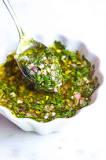
Chimichurri is an uncooked sauce that can be used with almost anything. It is prepared mostly of herbs (mainly parsley and cilantro), garlic, vinegar, olive oil and spices. 

Image result for chimichurri
C:\Users\139942\Downloads\38E2BEB0-8F6B-431E-BEFA-2A969395D32A.jpeg

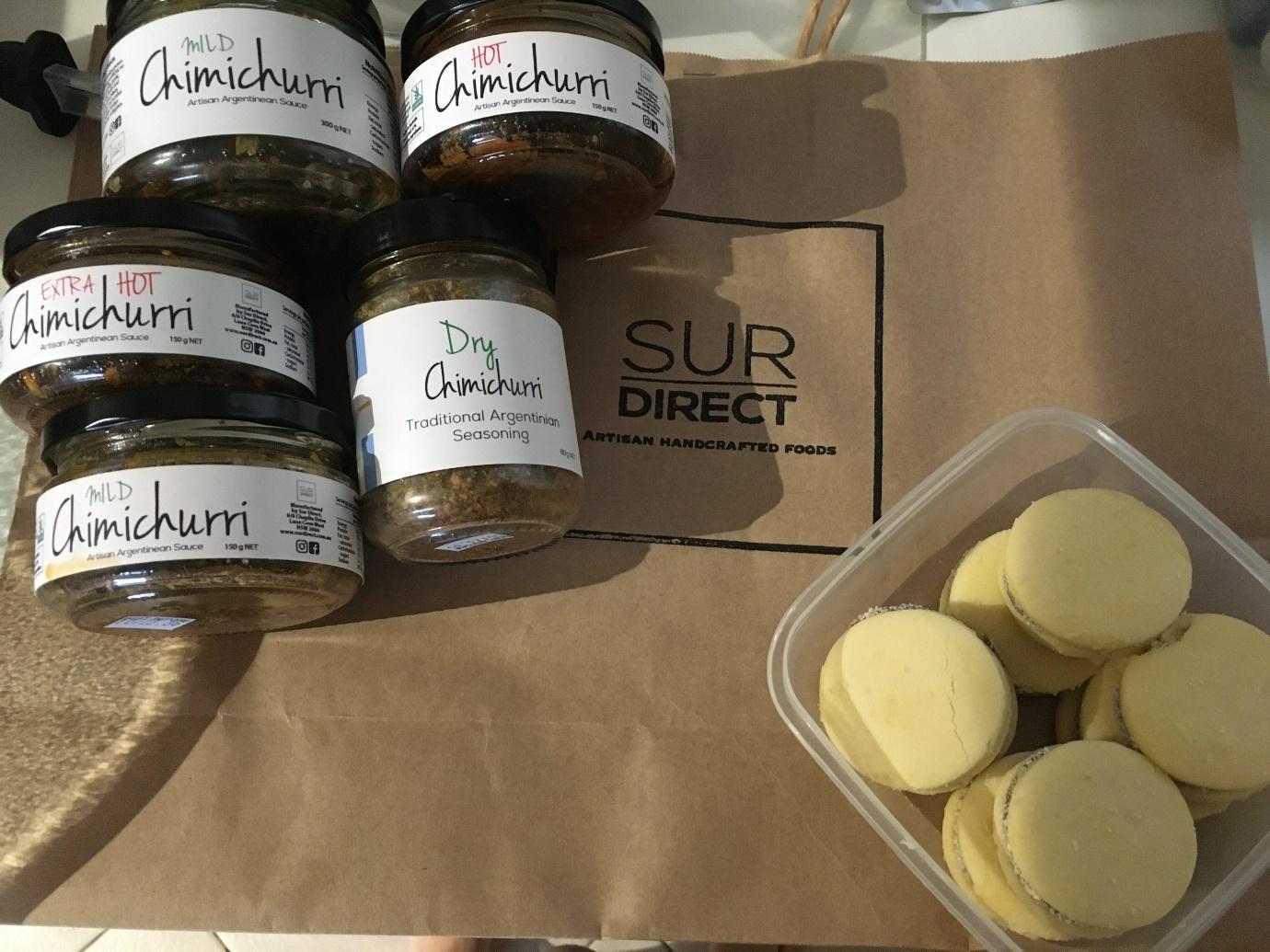
I order chimichurri and alfajorres from a wonderful small family business called Sur Direct. They are an absolute delight to deal with, have impeccable customer service, affordable prices and quick delivery in a beautiful paper bag. On top of that, the quality of the products is incredibly high. Sur Direct gets 10/10 from us. I get three types of chimichurri (mild, hot and extra hot, and also Chimichurri spices for future cooking) and beautiful alfajorres – dessert cookies that combine a delicate flour structure with dulce de leche in the middle. 

As for the empanadas, there is an Empanadas Che in Drummoyne that is absolutely fabulous. I put an order in for 10 empanadas of different flavours. When I pick up my order – one rainy morning before work – my order has been lost but the woman working at the counter goes at it and produces ten empanadas in no time. Gotta’ love the Latin attitude. The Café also has authentic Dulce de Leche, so I buy a tub to go with the empanadas. I get ten empanadas of six flavours (chorizo and potato, pollo, carne, gorgonzola with ham, ham and cheese, vegetarian caprese) with criolla sauce and also a ‘choripan’ (chorizo with bread) and the Dulce de Leche. While my order is being prepared, I chat without a customer who comes by weekly and does not mind the wait. 

I get provoleta from Harris Farm Market but I forget to serve it because of all the Argentinian food and desserts from both Argentina and Antigua and Barbuda (see previous entry). Provoleta is an Argentinian cheese that tastes similar to traditional provolone cheese. 

We decide against Yerba Mate, which contains up to 30% caffeine. As none of us are really coffee drinkers, it would probably mean that we would not sleep for a week, But for anyone who would like to know, Yerba Mate is said to be very good for many different health issues (even if there is still very little evidence on that) and a very popular drink in Argentina, Uruguay, Paraguay and southern Brazil. 

CH brings excellent Argentinian wine, which will be mostly consumed by me as both JK and CH are not heavy drinkers. CH also brings an excellent Chilean wine but we will have to leave it for the future occasion when we get to the Cs in about a ten years time!

We have a wonderful night of great food, great company, great music and a great country trivia for the kids. We learn from the Argentina trivia that: 

  • Argentina has both the highest (mount Aconcagua) and lowest point (Laguna del Carbón) in the Southern Hemisphere.  Laguna del Carbón is a salt lake in the Santa Cruz Province and the seventh lowest point on Earth.  
  • 88-97% of the Argentinian population has European roots – mostly from Spain or Italy. 
  • The first ever (documented) person to be born in Antarctica was Emilio Marcos Palma in 1978. Why his mother was sent to give birth in such a remote place is an interesting story. 
  • Argentina has 23 provinces. The capital city Buenos Aires is in the province of Buenos Aires/La Plata (Silver city)
  • Argentina is one of the most biodiverse countries in the world with 15 continental zones and four main climate types. 
  • Perito Moreno glacier is one of Argentina’s top tourist destinations. 
  • Ernesto Che Quevara was a middle-class boy from Rosario who, after receiving a medical degree, decided to join the Cuban revolution under Fidel Castro. 
  • The first animated film was made in Argentina in 1917 (El Apostol). 

It takes two to tango 

There is a lot of amazing music that has originated in Argentina. This includes very famous musicians of different genres, such as Mercedes Sosa (probably the most prolific Argentinian singer and famous for opposing the military regime), Facundo Cabral (a harrowing life story and murdered while on tour in Guatemala), Andrés Calamaro ( hybrid musical style mixing different genres), Leon Gieco, Gustavo Santaolalla (who wrote the Brokeback Mountain soundtrack) and a young superstar Paulo Londra.  

But tonight, tango it is. We listen to tango all night from Carlos Gardel to Astor Piazzolla and the Gotan Project. Tango was born in the dance halls of Buenos Aires in the 1880s. Carlos Gardel was probably the most famous tango singer. One of his most famous songs is El día que me quieras, whilst La Cumparsita is probably the most famous tango of all time. My children found the Gotan Project to be especially interesting. 

Many years ago, I learned the basics of tango dancing but never got to the level of LRT. One of my dearest friends, who now happens to live four hours from me, looked like she hardly touched the floor when she danced tango. 

Argentina in images

What to watch out of everything that there is on offer? I try to be guided by my basic rule: history, geography, people and significant events. My children and I are either native or nearly native Spanish speakers, so diving into the turbulent Argentinean history in the original language is fairly easy. 

The quick histories of Mr History are usually excellent but the Quick History of Argentina does not do justice to the complicated history of the country. It is a confusing set of many events starting from the Palaeolithic era. Something we do learn is that Argentina got its name from the Latin word for ‘silver’ (‘Argentum’). At the time of the Spanish conquest, Argentina had no grand civilisations (like Peru) but rather different tribes living in the territory. Buenos Aires was established in 1580. Argentina was first part of the Spanish viceroyalty of Peru and then the viceroyalty of Rio de la Plata. José de San Martin is an important figure in Latin American political history, having liberated a huge portion of the Latin American countries, leading Argentina to become independent in 1816, but then falling into a prolonged civil war. More wars with neighbouring countries followed, as did a succession of presidents. Juan Perón is one of the famous ones, also famous for being the husband of Eva Perón. After Perón resigned in 1955, several other presidents followed until Jorge Videla became the dictator and the dirty war of 1974 -1983 saw thousands of people disappear. Argentina lived through another great recession 1998 – 2003 and the economy finally improved around the time when Néstor Kirchner became president, followed by his wife Cristina Fernández de Kirchner. The current president is Alberto Fernández. The Quick History concludes with the words: “despite centuries of social and political conflict, this country still managed to give the world tango, Nobel winning scientists, brilliant writers and sportspeople, and to maintain a very high human development rank.”


But we get it. Argentinian history is complex. 

I have to think through what I should explain to the children about the (contemporary) history of Argentina. We decide that instead of trying to cover it all, I should choose different topics. I think long and hard and then decide to go for these three: 

  • Grandmothers of Plaza de Mayo and children of the disappeared 

During the Argentinian military dictatorship 1976 – 1983, the “dirty war”, an estimated 30.000 people died or disappeared. This is only an estimate and a full list of murdered and disappeared people does not exist. Most of these people were captured for political and religious reasons, many of them were young and a number of the young women were pregnant. There are approximately 500 children that were born to mothers that were captured and then ‘disappeared’. Most of those children were never returned to their biological families but sold or given up for adoption under a different name and identity.

Abuelas de Plaza de Mayo is a human rights organisation founded in 1977 by grandmothers of missing grandchildren, born in captivity to women that were later ‘disappeared’. The objective of the organisation is to connect the stolen children with their biological families through DNA testing and offer awareness, training and counselling. It is work that, of course, is not without its difficulties and controversies. As of 2022, 130 grandchildren have been found

Estela de Carlotto is a human rights activist and the President of Grandmothers of Plaza de Mayo. She became the President of the organisation in 1979 and spent 36 years looking for her grandson – son of her murdered daughter Laura, who was one of the few ‘disappeared’ whose body was delivered to the family. In 2014, Laura’s son and Estela’s grandson was found. The stories of the stolen grandchildren are not simple but have nuances of personal conflict. For Ignacio, being Estela’s grandchild has not been easy, but he still believes in the importance of finding the missing grandchildren. 

There are several testimonies on Youtube from the found grandchildren. My children were able to follow these stories in Spanish but there are also several in English. These stories are dark tales of abduction and theft of identity, confusion and tragedy, but also stories of hope and growth.  

  • Who is Evita Perón?

Evita Perón is one of the most prominent figures of Argentinian history, made immortal by the musical and, above all, the iconic song. She was the wife of president Juan Perón and has had a strong impact on the Argentinian collective memory. She died of cervical cancer at the age of 33. 

As with many historical figures, the kids find the musical more interesting than the actual story of Eva Perón. But her life story is quite fascinating and her final resting place is in the Recoleta cemetery. 

  • Economic crisis 1998 – 2002 

I chose this theme because explaining the political turbulence and corruption is difficult to place for the kids, who have no prior knowledge. Many people I know were affected by the Argentine great recession, caused by many factors including the Russian and Brazilian financial crises, a partial default of public debt, and an abandonment of the fixed exchange rate. The economy plunged, leaving over 50% of Argentinians living below the poverty line. Many people lost their savings, unemployment rose to unprecedented levels and many who could, left the country. It took the economy several years to recover. 

Short stories and reflection on ‘sexaffective’ relationships

Argentinian literature is famous, varied, abundant and rich. The most famous Argentinian writer is Jorge Luis Borges (author of Ficciones, 1944 and Aleph, 1949). There is Ernesto Sabato and Julio Cortázar. Cortázar is famous for his 1963 book Rayuela (Hopscotch in English). I had a complicated relationship with Rayuela when I read it many moons ago as its open-ended structure drove me crazy. Many of my Latin American friends consider Rayuela a masterpiece. It has a unique structure that allows the reader to read it either in a linear or non-linear mode, but for me it was a book that ‘talks a lot but says very little’. I recognise, now that I am older, that I could enjoy it more and I make a promise to myself to go back to Rayuela one day and give it another try. 

But for now I want something new. Something more contemporary. 

I turn to two very dear Argentinian friends. AS who lives in an ecological community in Uruguay with his wife and MG who is originally from Mar del Plata but has lived in Madrid for many years. When I ask for contemporary Argentinian authors, MG comes back with the message: “I would recommend Samanta Schweblin (narrative, short stories, lives in Berlin), Mariana Enríquez (journalist, innovative, horror genre), Claudia Piňero (politico-social narrative), Gabriela Cabezón Cámara (feminist, activist), María Gainza (art related narrative), and Leila Guerreiro (journalist, short stories, narrative, sharp social focus). 

Well, I think, I should start with these. 

I can’t read all of them so I decide to go with Samanta Schweblin and her book Pájaros en la boca y otros cuentos. It is a collection of short stories and won the Schweblin the Casa de las Americas award in 2008, and then the English translation (Mouthful of Birds, 2019) was nominated for the Mar Brooker International Prize and won the Shirley Jackson Award

Samanta lives in Berlin and is considered prodigious in her home country. She has won many prestigious awards and in 2010, she was selected as one of the best writers in Spanish under 35. 

The book (Pájaros en la boca y otros cuentos) leaves me in a state of slight confusion. It could be the format – short stories has never been my favourite genre – or the open-endedness of the stories. The stories in this book are like photographs – little studies of people and human nature, situations without resolution or proper explanation. They have unusual topics that play with themes and images and much is left to the reader. For some, this might be unusual, interesting, mind-blowing and an intriguing way of writing without ready-made formulas and without chewing the content too mushy for the reader – and I get it. But for me, it’s exhausting. I still enjoy the book and the stories – some more than others – but I feel a bit relieved when it’s over. Maybe I am old and I need answers, and when I don’t get them, it frustrates me.“What the hell was that supposed to mean?” is my primary thought after many of the stories. 

Feeling slightly unsatisfied, I decide to read another book. Another friend recommends a book called El Fin del Amor (The end of love) by Tamara Tenenbaum – a young journalist and academic who left the ultra-conservative orthodox Jewish community of her childhood to go to a ‘normal’ high school and university, and to live a ‘normal’ life as a young Latin American woman. That ‘normality’, of course, means a lot of headaches and pondering about heterosexual relationships. 

The book is not what I had expected. I had expected fiction but the book is a study of modern heterosexual ‘sexoaffetive’ relationships in Argentina, tangled with autobiographical anecdotes from

Tamara’s life. The description of the book is: 

El fin del amor gives us a glimpse of what happens when marriage and the monogamous couple are no longer a life’s objective, and it’s a tool for the creative destruction of romantic love and the principles that sustain it so that from its ashes, a better love – one that makes men and women more free in their relationships – can rise. From the value of friendship to the culture of consent, passing through motherhood as a choice or an imperative, desired and abhorred singlehood, polyamory, open relationships, the workings of the technologies of desire (Happn, Tinder), and with a vast bibliography about these topics, Tamara Tenenbaum talks about everything in order to dive into the universe of affection, celebrate the end of romantic love, and propose the eroticization of consent.”

It is an interesting book and I can imagine how important it can be for young Argentinians and Latin Americans. Every generation seems to think that they have discovered something that the previous generations have not, and that is a bit the approach of Tenenbaum (31 years old), whose youth shines through in some parts of the book. Nevertheless, it is an incredibly well researched book with a lot of ground to cover from the history of marriage to studying the functionality of open relationships, modern understanding of sexual activity, the role of women in (heterosexual) relationships, the modern culture of worshipping youth and beauty, decisions on maternity, building the culture of consent and the examination of sexual violence. It is interesting and I enjoyed reading it. She mixes the themes with autobiographical anecdotes from her own life, and her original cultural group. I also learned  there is a Netflix series drawn from this book. 

Some parts of the book have incredible value, whereas others are slightly preachy. When she writes about sexual violence and building a culture of consent, she is as sharp as a knife. Tamara explains how sexual violence is not an innate characteristic of men (not every man is a ‘potential rapist’) but a product of a culture, which sees male sexuality as an uncontrollable phenomenon and admires power. She talks about women of her generation making hard decisions on career and maternity, the culture of the ‘cult of the physical body’ affecting relationships – sometimes seen as a market of flesh (due to dating apps that she seems not to be in favour of). She also calls for sexual education for young people that focuses on consent, respect and pleasure. 

Tamara says that after researching all these different forms of relationships, she has opted for quite a revolutionary one in which she lives with her boyfriend but her female friends are such an important part of her life that they also have keys to her house and she (Tamara) envisions herself growing old with her girlfriends rather than her partner. It does make me smile as it feels as if Tamara believes she is the first one to discover the value of female friends in life, and also because of her idyllic ideas regarding her vision for her old age. 

Where in the cyberspace are you, moving images?  

Argentinian cinema is famous and abundant. There are many quality films of different genres and there are many movies that I would like to show JK and L who are less acquainted with Argentinian cinema than I am. 

There is a slight problem. 

None of the many, many Argentinian movies I want to show them are available on streaming platforms, at least in Australia. I go through Netflix, Prime Video, Disney, Youtube, Kanopy, SBS, Tubi, Amazon and even try to access them in other ways. I look for DVDs to order from the library or from overseas. No luck. 

So, L asks, if you would have to choose five Argentinian movies to show us what would you do? 

I think about it long and hard and then decide on a selection that I am not currently able to offer them, but hopefully one day I will. These are not automatically my favourite movies (although I do include the one that is) but a great representation of Argentinian cinema and a good collection for general knowledge: 

  • Nine Queens – fast paced movie about two con artists in Buenos Aires with twists and turns. A very clever script that I thought JK and L would appreciate. Could not find it anywhere. Boo. 
  • The Official Story – a fictional story of an adoption of a stolen grandchild. A very important movie on this topic mentioned above.
  • The secret in their eyes – An award winning thriller that won a swag of awards. There is an American version, but this one is better. 
  • A boyfriend for my wife – I also wanted to include a comedy so there you have it. A man wants to divorce his wife but rather than telling her, he hires another man to seduce her. 
  • Intimate storiesI loved this small warm-hearted road movie from Patagonia, but it has been a while since I saw it.

As I am unable to show Argentinian movies, I decide to watch one anyway. Something I have not seen before. I select Initials S.G., available on SBS. It is described as a dark comedy about a former porn actor who is trying to find a place in the mainstream cinema. It has a 100% tomatometer rating in Rotten Tomatoes. Sounds promising. 

Needless to say, I am not watching this with kids.

It was not a movie for me. That is all I will say.

Next stop: Armenia

Antigua and Barbuda

It is important for the Virtual Nomad to give every place the significance it deserves. A tiny island state is no exception. Even if, for food, we group it with the much more well known Argentina (see next entry), we still stop to cherish the landscape, the words, tastes and sounds of the Caribbean island state called Antigua and Barbuda. 

The kids have no idea where Antigua and Barbuda is. The three adults (JK, CH and I) surely know it is somewhere in the Caribbean but we all fail to place it. After a while, we hit the right spot. 

Antigua and Barbuda is a young state, independent since 1981. It consists of two major islands (you guessed it – Antigua and Barbuda) and several smaller islands. It is situated in the Caribbean and, like other island states, is vulnerable to the effects of climate change. The capital is St John’s and the population is around 120,000. Antigua and Barbuda makes most of its money from tourism. 

With the food we cheat. This time we combine an Argentinian night (next entry) with desserts from Antigua and Barbuda. The reason for this is that the local cuisine relies a lot on fresh fish and the Caribbean types are rare in winter. The dessert selection seems varied and broad enough to gain its own entry. 

I buy fudge and tamarind balls online, and get peanut brittle from Harris Farm Market but decide to prepare coconut sugar cakes myself despite my atrocious attempt with Angolan funge. The result is not amazing but it is good enough. The desserts are yummy and make us think that the people of the Caribbean enjoy their sweets. 

Carnival Rhythms 

The traditional dance of Antigua and Barbuda is the quadrille, 18th and 19th century Europe’s gift to the colonies. The Caribbean version is a bit more rhythmic than its stiff European version. 

As for the music, it is influenced by West African slaves. One of the earliest forms of the music is benna. Benna is a calypso-influenced Antigua and Barbudan music style that originally was used as a way of communicating news and gossip. 

MadTguans, a Soca boy band group from Antigua sings about benna in a video with a lot of twerking.  

Other popular types of music in Antigua include the aforementioned soca, with roots in calypso, funk, soul, and other types of music. The Antiguan queen of soca is Claudette Peters. Her song Nasty has clear carnival energy and her 2002 international hit is an upbeat Caribbean soca

Calypso is strongly identified as a Caribbean music of style, first identified in Trinidad but immensely popular around the Caribbean. Originally a means of communication for West African slaves, it quickly spread around the Caribbean. Famous Antiguan Calypso musicians are King Short and King Swallow, an Antiguan icon who passed in 2020 at the age of 78.

Other popular music styles in Antigua and Barbuda include dancehall and, of course, reggae. Causion is the ‘Antigua’s Reggae Ambassador’. His song Antigua Me Come From is a lovely hymn for Antigua on a cold winter morning. He is currently battling colon cancer.

Two big islands and several small ones

Most of the population live on Antigua (97%). The population is largely of African descent and the spoken language is English. 

No one really knows who the first people that inhabited the islands were. The first named people were the Arawak from the beautifully named Orinoco River in Venezuela who were conquered (and possibly eaten) by the cannibalistic Caribs. In 1493, a fella’ named Christopher Columbus arrived and gave Antigua its name. 

Spain saw no value in the islands so the British took over in 1632. The islands were the destination for many African slaves until slavery was abolished in 1834. Antiguan independence has its roots in the fight of a Salvation Army officer, Vere Bird, for better working conditions for the black majority. He became the first Prime Minister in 1981. He was of course, not all good because – as we have seen in other countries so far – power corrupts, makes people greedy and alienates them from their original ideals. 

The flag was created in 1967 by Sir Reginald Samuel. The sun in the flag is the symbol of a new dawning of the new era, the black refers to the black ancestry, white the sand and blue is a symbol of hope and the sea. The red refers to the vibrancy and energy of the people. We also learn that 30% of Antigua is suitable for farming but only 18% is used for farming.

The Internet is full of touristy videos of Antigua and Barbuda beaches and carnivals. Less so about the devastating Hurricane Irma that, in 2017, destroyed most of the island of Barbuda and all inhabitants evacuated to Antigua or the criticism of the Bird family dynasty’s extended stay in power. 

Vere Bird is an(other) interesting political figure who fought for the rights of the working class and then was the Prime Minister for 13 years, followed by his son Lester Bird who was the Prime Minister for ten years. The Birds (including the eldest son Vere Jr) have faced accusations of corruption, connections with Colombian drug carters, arms dealings, use of public funds for private benefit, etc. The current Prime Minister Gaston Browne is married to Lester Bird’s niece Maria Bird-Browne

Other interesting facts of Antigua

  • The highest point in Antigua, Boggy Peak was called Mount Obama from 2009 to 2016 (yes, named after President Obama). The original name refers to the stories the masters told the slaves about a Boogie Man that lived on the mountain, so that the slaves would not escape. Some people did and established their own settlements on the mountain. It is not that high, a mere 402 metres.
  • Antigua and Barbuda has the lowest suicide rate in the world in 2022 (the highest being Lesotho, followed by Guyana and Eswatiti). 
  • Hurricane Irma destroyed 95% of all infrastructure of Barbuda leaving 60% of the population homeless.
  • Many of Antigua’s smaller islands are owned by very wealthy people. 

Mothers and daughters 

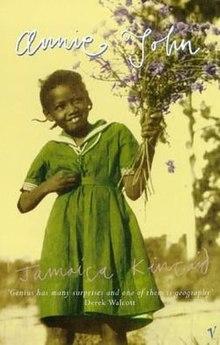
Antigua’s most prominent writer Jamaica Kincaid is an Antiguan-American author and Professor of African and African American Studies in Residence at Harvard University. She was born in St John’s (island of Antigua) and now resides in the US. Her books are described as semi-autobiographical, which feels accurate for her first novel, Annie John (1985).  It is a fairly short book (162 pages), primarily a coming-of-age story and a study of a mother-daughter relationship from childhood to early adulthood. 

JamacaKincaid AnnieJohn.jpg

For me, it is an enjoyable book but there is nothing exceptional about it. The focus is the transformation of the mother-daughter relationship from childhood to separation. Some reviewers have seen it as a study of race, gender and colonialism but for me it’s much more superficial than that – it represents a quite universal story of coming-of-age from a self-centred and predominantly unlikable perspective that at times is very annoying. Some aspects of Caribbean mysticism and magic are included but mostly it is about rebelling, first crushes (even if same-sex, but does not really make a difference) and breaking free from the repressive presence of a mother. The mother does not get a voice and seems to be doing her best in the circumstances, so the growing rejection sounds a bit harsh at times, but probably reflects the author’s relationship with her own family that she stopped talking to for a couple of decades. 

There are delicious colonial jabs such as “The headmistress, Miss Moore. I knew right away that she had come to Antigua from England, for she looked like a prune left out of its jar for a long time and she sounded as if she had borrowed her voice from an owl”. 

No sweet mango

The first feature film from Antigua (2001) is a romantic comedy called the Sweetest Mango, which is about a woman who returns from Canada to her native Antigua. This is all I can gather because the movie is not available for rent, to buy or stream from anywhere other than India. 

Instead, I watch Working Girl (2009) about a schoolgirl’s journey to prostitution due to her mother’s illness. Painfully badly acted and at times comical in its melodramatics, and with an unexpected twist, it still manages to somewhat deliver a universal story about abuse, exploitation and poverty. It is not in any way a remarkable film but it is a rare treat of Caribbean film making. What makes it more interesting than the plot itself is the landscape, settings and language. Written and directed by Antiguan Nigel Trellis, it is filmed in Antigua with an all-Caribbean cast. 

Next stop: Argentina 

Angola

We are eating food from a country I can’t remember the name of,” says A on the phone before we eat dinner, acknowledging mum’s atrocious attempt to cook Angolan food. 

We begin the journey to Angola knowing that Virtual Nomad is live and people have been reacting quite positively. Nearly 500 people have visited Virtual Nomad’s four adventures and the feedback has been wonderful.  It encourages us to continue the journey, and it seems to have inspired others to start theirs. 

So, to our fifth country on the Virtual Nomad journey. 

Where is Angola? The first guess places Angola in the Middle East (sigh) and then in Africa. A guesses West Africa and L guesses East Africa. Angola turns out to be so far the most difficult to find and the one they have heard the least about. For both, this is the first time they hear the name Angola. 

Angola is in Central/South Africa, bordered by Namibia, the Democratic Republic of Congo, Zambia and the Atlantic Ocean (the province of Cabinda is also bordered by the Republic of Congo). 

Angola is famous for its nearly thirty-year civil war, one of the world’s most expensive capital cities (Luanda) and vast mineral resources. It has a rapidly growing economy but uneven distribution of wealth, low life expectancy and high infant mortality rates. The civil war left the country with nearly a million deaths and thousands of antipersonnel landmines distributed around the country. It is in Angola where Princess Diana did her famous landmine walk.

Rich cuisine, poor cooking results 

Angolan cuisine is very rich. The diet is based on beans, rice, vegetables, chicken and pork. Funge is a traditional side dish made of cassava flour and water. Funge seems to accompany most Angolan dishes and form the foundation of Angolan cuisine. 

Photo: the Foreign Fork

There are a few African restaurants in Sydney but with most, the description of the menu is generic. ‘West African’ does not satisfy our thirst for something specific and it is back to the kitchen and putting my nomad cooking skills into play. Oh, hear the children roar with happiness. 

The result is atrocious. I first try to make funge by combining cassawa flour (found in a local supermarket) and boiling water, but it turns into an inedible mess. All I can produce is a dough, hard as a brick.  There is no way to eat it and I am not quite sure what I have done wrong. I followed the recipe religiously but the result is a disaster. We nibble the stone dry dough and abandon the idea of eating it altogether.

I accompany my too-hard-to-eat funge with Muamba de Galinha, which is described by Taste Atlas as:

Studies have shown its various health benefits – it is rich in antioxidants, helpful in preventing heart disease, and regulates cholesterol. Since Angola was a Portuguese colony for ages, Portuguese gastronomy had a great influence on Angolan cuisine, so as a result, many Angolan dishes are based on meat and palm oil. 

The result is not much better than with funge but at least it is edible. L says that it is almost good. It does not look like anything in the photos but I trust that the Angolan spirit accompanies it. I make butter chicken out of plant-based ‘chicken’ to accompany the dinner, but that is not great either.

I am afraid I am not doing Angola any justice with my cooking skills. Disculpe, sinto muito Angola.

Music makes you dance

Spotify offers several Angolan playlists and the ‘Angolan Music’ playlist is the one for us. At first, the music does not sound different from other popular music from basically anywhere but then we find ourselves taking dance breaks because the music makes our surprised bodies move from side to side and then get up and boogie on the improvised dance floor that is the living room. We are, in fact, quite surprised about how delightful and hybrid most of the music we are hearing is. 

We hear artists such as Dotorado Pro (Africa House, for example song Marimba Rija, quite hypnotic), Neru Americano -watch the video for the dance alone, Deejay Telio (Que Safoda – probably my favourite), Trx Music Angola, Fildo do Zua (A Saia Del – in the video a boy dreams of a girl of whom you mostly only see the torso and her bottom, but again an interesting video for all the dancing). A lot of Afro House music. Spotify also offers an Angola Afro House list but it is much more repetitive. 

Oil, diamonds and one of the most expensive cities in the world 

The first people to inhabit the lands were Khoi and San – Khoisan (Khoi were cattle keepers and San were hunters) who were mostly kicked out by the Bantu people. Bantu spoke different languages and the word Ngongo (meaning an iron object that symbolises kingship among the Mbundu and Lunda people) is where Angola gets its name. The 500 years of colonisation by the Portuguese started in 1483 when the Portuguese arrived. Paulo Dias de Novais founded Luanda in 1575. During the Portuguese colonisation, more than a million Angolans were sold as slaves. The Atlantic slave trade continued until the independence of Brazil in the 1820s. Slavery was abolished in 1836 and all slaves freed in 1854. Angola finally gained independence in 1975 after the 12 year Independence war and then embarked on a 27 year civil war that left millions of people dead and many injured. 

We learn that Angola has the world’s most expensive city, Luanda. Angola’s flag mirrors the design of the old Soviet flag. 60% of the very important oil reserves are in the Northern part of the country in the disputed area of Cabinda. 

Angola has only two important islands – an oil and gas support island Kwanda and Ilha de Luenda.  99% of the economy revolves around oil and agriculture is a very small sector. Two out of three children suffer from malnutrition and one in six die before the age of six. That number is almost incomprehensible – 1 in 6. 

The forgotten 27-year-civil war 

Then to the more difficult documentaries that again are not for preteens. It is difficult to find a good quality production (mainly regarding audio and visuals) about the Angolan Civil War. It is like the world has forgotten the nearly 30-year war. We find documentaries that feature the Angolan war as part of the Cold War in which Angola is the battlefield for the East-West tension. L and I start watching several documentaries but in most, Angola is secondary in the narrative to the world powers. This leads to me explain the conflict and the recent history of Angola from my perspective to L, and I am not sure if I always get the facts right. That leads to hours of research in the late hours of the night.

In a nutshell there are three main parties: the Communist People’s Movement for the Liberation of Angola (MPLA); anti-communist National Union for the Total Independence of Angola (UNITA); and the National Liberation Front of Angola (FNLA). They are all backed by foreign powers, predominantly the USA, Cuba and South Africa. Thousands of landmines are used around the country. Millions of people die. Ultimately the MPLA won and has ruled the country ever since. 

Queen’s resistance and the richest woman in Africa

Angolan history and present has two fascinating female figures. Queen Nzinga of Ndongo and Matamba and Isabel dos Santos. Queen Nzinga was a ruler in Angola (circa 1581-1663)  when Angola fought against the slave trade and European influence. She was known be a skilled diplomat and an excellent leader of an army who, for 30 years, resisted Portuguese invasion and slave raids. Not a small feat. She is an interesting and polarising character with a fascinating story. 

Isabel dos Santos is the daughter of José Eduardo dos Santos who was the President of Angola for nearly 40 years. She used her role as the ‘Princess of Angola’ to gain economic benefits, lucrative deals and licenses because of her connections. Her money comes from involvement in mobile networks, diamonds and construction. She was the chairperson of Angola’s state-owned oil company, Sonangol, while her father was President. When her father finally resigned, she left the Board with a 58 million dollar payment. Her wealth is a striking contrast to the 40-50% of the Angolan population living below the poverty line, despite oil and diamond revenues. She and her husband are accused of embezzling more than one billion dollars of public money. It is quite entertaining to watch some of her interviews in which she claims to be a self-made woman. 

Oil, diamonds, land mines, poverty and more oil 

I looked into recommendations for Angolan literature. There seem to be two books that appear on different lists: Black Dahlia, Black Gold by Daniel Metcalfe (2014) and The Return of the Water Spirit by Pepetela (1995). Both are available on Kindle – one in English and one in Portuguese – so that is where I am heading. 

I start with Black Dahlia, Black Gold. This book is not written by an Angolan author but a British journalist who embarks on a journey in Angola (and also São Tomé and Príncipe, a place I have always, always wanted to visit). It is a fascinating book and written in an entertaining and informative way, even if in a slightly obnoxious (and sometimes ungrateful) way by a privileged outsider. 

I learn more about Angolan history from this book than any of the documentaries I have watched. Daniel has really done his homework and travels the country from one corner to another like ordinary Angolans do, many times hosted by generous locals. I find myself taking notes about people and places – whether the activists he mentions are still alive, what are the distances that he covers, where are the towns he talks about, what are the oil companies he mentions, who are the different leaders of ethnic and political groups, etc. He does an exceptional job describing the backstories of Angolan landmarks and people, but also of prominent contemporary figures. I learn more about Jonas Savimbi (leader of UNITA), Holden Roberto (leader of the FNLA and brother-in-law of Mobuto Sese Seko, a Congolese dictator) and Agistinho Neto (leader of the MPLA and the first president of Angola), He also writes about Elias Isaac, the country director for the Open Society of Initiative of South Africa and the work of the Halo Trust that works in clearing landmines around the country. 

Metcalfe travels around the country with a journalist’s gut and drive. Conversations are detailed and he has a great eye for details and descriptions. He covers the Angolan history in detail, drills deep into the slave trade, visits the most landmined battlefields, talks to everyone and writes down the human stories.  He travels through Luanda and several other cities and regions including landmine-infested Cuito Cuanavale and oil-rich Cabinda. He looks into the culture and history of different ethnic groups. I wish I could read a book like this for every country.  

The Return of the Water Spirit

I also want to read Angolan fiction but that proves to be more difficult than I had imagined. The very interesting Rainy Season by José Eduardo Agualusa, which is about disappeared activist Lidía do Carmo Ferreira, is not available anywhere. Other readers have loved it, which really makes me frustrated. I then turn to search for books by Pepetela, the most prominent Angolan writer. The Return of the Water Spirit has received a lot of praise but it is not available online and ordering it from overseas would not only be costly but also take a lot of time. The best option is to read it in its original language on Kindle. 

Now, my French is not perfect but my Portuguese is worse. By paying a mere $4.71 I get access to this book and its 102 pages, so I decide to give it a try. To my complete surprise, it is fairly easy to follow and an enjoyable reading experience. Even if I could not have a decent conversation in my incredibly rusty Portuguese, I am able to have the pleasure of reading this book.  

Pepetela (Artur Pestana) is an Angolan author and former member of the MPLA during Angola’s Independence guerrilla war. In 1997, he won the Camões Prize, the most important literary award for Lusophone literature. 

The book is about the clash of two worlds. A husband who plays videogames while the world collapses around him and a Marxist militant wife who underneath is a ruthless capitalist. The book mixes mythology with a critical look at the Angolan society after independence and introduces the symbolic destruction of ideals (and built landscape of Luanda) in the form of Kianda – the mysterious water spirit that moves worlds and demands the taken territory back. The book is a satirical, clever tale of the corruptive force of power, betrayal by greedy leaders and the corrosion of ideals after the fight is over. 

A long walk to find what has been taken 

Angolan cinema is a rare treat so it requires quite a lot of digging and research. 

The movie sites on the holy Internet seem to agree that the 1972 movie Sambizanga is the one to watch from Angola. It is not only the best rated Angolan movie but also the one with most views (the last at least on IMDB). Mark Cousins’ ten year old list of 10 best movies from Africa (2012, the Guardian) describes it as “a modern, radical account of a woman going from prison to prison looking for her husband. The setting is Angola, but it was filmed in Congo. Director Sarah Maldoror studied in Moscow, worked on the classic The Battle of Algiers, then grabbed African cinema by the scruff of the neck, forcing it to engage with feminism, loss and movie aesthetics. Wow.

I am convinced so I will give it a go. 

As said, the movie is directed by Sarah Maldoror whose husband Mário Coelho Pinto de Andrade was the founder of the MPLA (but lived in exile after independence). Maldoror died of Covid19 in April 2020 in France. 

The movie was filmed in 1972 in Congo because it was not possible to film in Angola at the time. It has strong Marxist undertones but above all it is a human story. Domingos is a working man and an independence movement activist in Angola in 1961. One day he is dragged away by the secret police. His loving wife Maria (played by a Cape Verdean economist Eliza Andrade) starts a long journey to find him. Maria goes from prison to prison, walks long distances while carrying her infant son on her back. 

For me, the movie is fascinating. For others, it might not be. 

The movie is slow and that might be why it is so effective. The emotion is in long shots of people’s faces. The dialogue is scarce. When Maria starts her long walk, the camera follows her for a long, long time. 

It is not the political message that I find so compelling but the human story. It is a universal story of injustice, longing and loss. This story is about Angola but it could be from any other continent, or country where people try to find their loved ones. A person is captured and tortured, and the ones left behind carry the price of desperation, uncertainty and suffering. It is a story of the big fish eating the small fish, be it from political orientation or whatever. Above all it is a story about loss, longing and the corruptive stench of power, once again. 

Angolan art

Once I have finished the books and the movie. I try to show L and A some Angolan contemporary art. I find interesting sites but contemporary art is no match for Youtube. 

The giant antelope

The giant sable antelope, thought to be extinct since 1982, was rediscovered in Angola in 2006. 

And with that we come to an end of a very long entry for Angola.

Next stop: Antigua and Barbuda 

Andorra

I’ll prepare some Andorran food tonight,” I say to a friend. “Is that a real country?” is the answer. Well, duh, it is!

Mountainous, tiny, landlocked Andorra is the only country in the world with Catalan as its official language. I (at least) claim to speak Catalan fluently, so I find myself within my comfort zone.
Andorra is also about three hours by car from where L was born, which makes it feel simultaneously close, yet worlds away.

Andorra holds boundless beauty and a unique place in history. Less than 50% of the small population of 78,000 has Andorran citizenship. Andorra does not allow dual citizenship and it takes a very long time to gain a citizenship (10-20 years!) if not acquired by birth. Nevertheless, the benefits of living in Andorra include one of the highest life expectancy in the world and one of the best health care systems in the world (in all the different rankings, Andorra places within the top 10). Residency can be obtained with significant investment. For outsiders, the country is famous for skiing and tax free goods. The capital of Andorra is Andorra la Vella.

I have a beautiful friend SV who spent her childhood and part of her youth in Andorra. SV speaks fluent Catalan, Spanish and French as her native languages, on top of many other languages that she has learnt. Currently, SV lives in Paris, and it was the perfect occasion for me to reach out to her so that she can guide me through everything Andorran. Because of our friendship, I do know more about Andorra than most of the people, and it is always lovely to hear from her.

Bread with tomato

We start with food. SV tells me that the Andorran cuisine is of course influenced by its neighbours, especially by the Catalan cuisine. I am overjoyed, as bread with tomato is one of my favourite Catalan dishes. Obviously, Sydney does not have an Andorran restaurant so no matter what we prepare at home, pa amb tomàquet or bread with tomato will be part of that.

Let’s start with that because it is so yummy. For tomato bread, you just need good quality bread (my favourite is Iggy’s in the Eastern Suburbs but any good sourdough works). Spread oil, garlic and tomato with a bit of salt on top over toasted bread. That’s all. It’s beautiful, it’s yummy and it tastes like home.

Andorran national food is escudella but it is so heavy and complicated that I immediately abandon the idea of preparing it. But for anyone interested, it has chicken, pork, ham, ham bones, chick beans, potato. It is serious winter mountain food that simply doesn’t do the trick in Sydney’s rainy winter nights or for a vegetarian like me.

Instead, I prepare Trinxat de la muntanya with a chicory salad. Trinxat de la muntanya is basically mashed potato and cabbage, with bacon if you wish. And some garlic and salt. Incredibly easy, albeit slightly dull. I like it, but L is not thrilled. She still happily eats the bacon, and I find myself putting some more salt on the potato.

The chicory salad (chicory is typical plant of the mountainsides in Andorra) has nuts and parmesan in it. It is not thrilling, but definitely edible. We also have embutits, sort-of sausages for the meat eaters.

For the Andorran night, it is just L and I, which feels weird. Fellow nomads are unable to join tonight. But Andorra is small and so will our party be tonight. L appreciated my efforts with Catalan food, but it does not really charm her exquisite culinary taste. I am happy and convinced that everything that I have prepared tonight is extraordinary.

The only Andorran music we can find is Andorra’s participation in the Eurovision from 2009, the last time Andorra participated. Andorra stubbornly performs mostly in Catalan. We think it’s cute.

Landlocked beauty

While we eat out deliciously, marvellously prepared dinner, L and I watch documentaries about Andorra.

Andorra is the world’s 17th smallest country, and the Andorrans get their name from Andosini, pre-Roman people in the Iberian Peninsula. The country has the 2nd oldest parliament in Europe. It’s a quick story of how Andorra “became the place to be for those who want to shop and ski”. In general, compared to many other places, Andorra has had quite peaceful and neutral position, being harboured by France and Spain.

Andorran flag is a combination of French and Spanish flags, and has a shield in the middle with words “Virtus Vinita fortior“, or “United is Stronger”. Travelling to Andorra is tricky by public transport with no trains or airports. Andorra is mountainous, and only 2% of the land is farmable, resulting in the majority of food being imported. Tourism is the main source of income for Andorra. Catalan is the official language, but Spanish, Catalan and French schools co-exist (most people send their kids to a French School – my friend SV went to one). Andorra has a head of state, but the co-heads of state are the President of France and the bishop of Urgell.

Andorra is famous for its natural beauty, so we watch a couple of documentaries about the mountains. 30% of the country is covered by national parks, meaning there is a lot of nature to explore. Andorra is a paradise for hikers in summer and for skiers in winter, and there is a lot of shopping options.

Small market for creatives

SV cannot think of an Andorran book so I turn to my soul brother JB, one of my favourite people in the world – one of those people that are incredibly helpful, generous and whom no one has anything negative to say about. JB lives in Barcelona with his Australian wife and their son. JB takes the task and comes back with a wonderful suggestion.

There is a woman who took part in a legendary postgraduate course in an organisation I was working in many moons ago. Many good things came out of that course, including my friendship with JB. I remember the woman he mentions vaguely, but the Internet tells me more. Since then she has had three children, several degrees (including a PhD in Political Science) and has built an impressive career in international development. She is originally from Andorra and a published author. I do not have her contact information so I cannot ask her for more, but I find some of her poetry online – and I also send her a message through the cyberspace hoping that one day she’ll respond. She has also written a couple of very interesting books, but in most places I look her books are out of stock. Therefore, I read her poetry that I find quite charming. I particularly like one of her poems that translates into pour some more wine to me.

Sometimes a group of extraordinary people get together and create special energy. That particular postgraduate course seems to have done just that and this woman is another example. I am still in contact with four other people from that group and this prompts me to think about what other amazing things the rest of the people have done.

Bad movies

As for visuals, Andorran film industry is very limited and there basically are no options for further cinematic experiences. I have seen Amor Idiota (2004) that is listed as an Andorran/Spanish co-production but I refuse to watch it again. It is disturbingly bad. A woman falls in lust with her stalker. I hated it when I saw it and for sure, I would hate it even more now.

The only other movie available from Andorra is No Pronunciarás el Nombre de Dios en Vano, or “You will not say the name of god in vain”. It is 32 minutes long – the setting is Andorra in the year 2046. A crime lord brings in religious leaders for cross examination to find out how to identify a true Messiah. It was not worth the watch, with such bad quality and in general, just a bad short film that tries to be more than it is. If Andorran movie industry is represented by these two bad films, I find it rather sad.

Hand Solo

To finish Virtual Nomad-ing on a high note, SV (my Andorran friend) gives me an interesting suggestion: a famous Andorran, David Aguilar, aka ‘Hand Solo’ is a lego master who created his own prosthesis with lego, credited by the “Guinness Book of Records” as the first person to do so. An extraordinary person with a background in bioengineering and born with a missing part in his arm, he plans to build better and more affordable prosthetics for people with disabilities. There is also a book available about him which has now become the Andorran book for Virtual Nomad.

The latest Andorra news says that Andorra has no present nor future plans to participate in the Eurovision Song Contest. Too bad.

Next stop: Angola

Algeria

Algeria sounds like somewhere in Africa” was the correct guess from the kids, but nevertheless, Africa is still quite vast! The People’s Democratic Republic of Algeria is the largest country in Africa and is also the 10th largest country in the world. However, Algeria’s size is misleading; more than 90% of the estimated 44+ million people live by the coast and a large portion of the country is sand.

When I think of Algeria, I think of the Sahara.

Home made goodies

Algerian cuisine in Sydney is represented merely by a kebab fast food chain that has an Algerian plate and an Algerian falafel dish. While the neighbouring countries Morocco and Tunisia are visible in Sydney’s restaurant landscape, Algeria, well, less so. Google has informed us that the Algerian cuisine is largely similar to other Maghreb countries, and has a variety of vegetables, grains, fruit, meat and several spices. Mm, yummy.

With no Algerian restaurant or any Algerian friends in sight, the task was to prepare an Algerian dish at home. We chose a vegetable couscous, some tabbouleh and falafel (which I bought).I followed an Algerian recipe but am no master chef so the result was passable, but not thrilling. JK did a much better job with the couscous itself. It was golden and buttery and held the vegetables nicely. L is happy to try the vegetarian couscous and falafel but tabbouleh was not of her liking. A on the other hand is not excited about the food, and ends up eating just plain couscous. Nevertheless, we enjoyed the Algerian meal.

Sounds

Spotify provided us with an Algerian music list which then became our soundtrack for the evening. The selection did not raise big passions but generated a reasonably interesting conversation about the musical landscapes we incorporate when growing up, and how less familiar soundscapes may sound stranger to our ears.

Later, L and I checked out the most popular Algerian singers today. Souad Massi is a popular Algerian Berber singer. She was part of the political rock band Atakor but had to leave the country following death threats and now lives in France. She sings in many different languages and her style is an interesting combination of Algerian, oriental, fado, western music, among others. A couple of her songs end up on my playlists.

Another singer we listened to is Zaho who is quite well known in France, Canada and Algeria. Kenza Farah is another Algerian musician, a hip hop and R&B artist with success in France – some of her songs are pure pop and some have clear Algerian influence.

Algerian facts

Algerian facts and figures include a lot of sand (the Sahara is the hottest desert in the world), a capital Algiers (“Algiers, the white”- full of white buildings), and the neighbouring countries, which are Morocco, Tunisia, Libya, Mauritania, Western Sahara, Mali and Niger. Algerian history facts include the Ottoman Empire’s occupation from the 16th century until the French invasion in 1830 that lasted for more than a century, the brutal Algerian war (1954-1962), Algerian independence in 1962, the 1988 riots and a bloody civil war from 1999 to 2002.

A funny fact is that due to a widespread cheating scandal in Algerian schools, in 2018, the government shut down the internet during final exams to make sure the kids had no access to external help.

A super quick history of Albania” was a fun and easy introduction to Albania’s complex history, so this time we decided to go to Mr History’s youtube channel once again for “A super quick history of Algeria“. It starts with cave paintings and then goes through different ethnic groups, colonisers, wars, French rule for more than a century, independence, civil war and everything in between. The video states that Algeria has had a hectic history but has reached a high human development index. It brushes quite lightly through some of the most turbulent episodes in Algerian history, so it is safe for kids to see.

The video “Geography now” gave us a much needed geography lesson of Algeria. We learnt that only 3% of Algeria’s territory is arable land (suitable for growing crops), which explains the concentration of population in the north (the rest of Algeria is sand). 45% of food comes from imports. We also learnt the symbolism of the Algerian flag (the white represents peace; the green, star, and crescent represent Islam; and the red symbolises the blood of those killed fighting for independence in the Algerian War). The video describes how the majority of the population is Arab-Berber, and that they have built long roads that cross the desert for travel. The Geography now guy has the same concept as we do, and his alphabetical geographical series will come very handy in our future Virtual Nomad journeys. It is an unproblematic format that covers flags, geography, demographics and the ‘friend zone’ (meaning the friendly relationship that countries have, in case of Algeria, its relationship with Morocco is quite infamously tense).

The biggest country in Africa” is a short 3-minute tourist video by Drew Binsky, (who has been to every country in the world), which is easy to follow and gives a glimpse of the landscape of the capital Algiers and some other sites. According to our boy Drew, Algeria is the friendliest country in Africa.

For the last video we (that is just L and I, this is no territory for the preadolescent A) try to choose something a bit more politically charged, covering aspects that are unsettling and turbulent. The French rule, the war crimes of the Algerian war, the youth uprising in 1988, the civil war, the rise of terrorism. We end up watching several videos from the Foreign Correspondent to Al Jazeera and many in between. They were difficult to watch, and another bitter remainder of what humans are capable of doing to each other.

A confused reading experience

After two distinguished, albeit male authors, I wanted to read a book by a woman. I asked my beautiful friend SB (who knows Arab literature much better than I do), but she was not sure whom to recommend so I turn to Internet to look for Algerian authors that are women.

Photo Wikipedia

My first choice Samira Bellil (1972 – 2004) reveals a harrowing life story of the author. Her autobiography that is said to have shocked France is not available in Australia or online, so for the moment, I cannot get hold of it. This setback does not keep me from reading more about her and all that she had to endure. Gang-raped several times as a teenager and trying to find an individual path free from traditional family setting, she was brave, compassionate and ground-breaking. She died in 2004 at the age of 31.

Samira Belli’s story is harrowing and upsetting, but it is also a story about immigration and the banlieues of Paris more than Algeria itself. I will need to find someone who represents more the Algerian side of the story.

I then select another female author, Assia Djebar, who has called Algeria “A dream of sand”. She is probably the most known contemporary Algerian author, and according to her biography many of her books focus on the role and place of women in the Algerian society. She is widely praised and studied, and holds an important place in North African and global literature. She was the first author from Maghreb to be elected into the Académie française, a prestigious institution guarding the heritage of French language.

At the local library, I find one of her essay books “The women of Islam” from 1961, not frequently mentioned in her collection of works, which I find interesting. It is not a work of fiction but a long essay accompanied by photos of Muslim women. This certainly sounds promising, and I am sure it will be a very interesting read in regards to women in Algeria with the author’s biography providing a backdrop for the book.

The book left me in a state of slight confusion. It was completely different from what I had expected, far removed from my own thinking. I pushed through even if I was tempted to drop it. I am really puzzled, as everything that I read about Djebar is about giving women a voice, bringing women’s stories to light and defend the progress, emancipation and rights of women in Algeria and the Maghreb. This book does celebrate the woman’s role in Islam, but in a very different way than I had expected. The introduction states that the fundamental place for a woman in Islam is in the private sphere, in the family and shielded from external life. That a man’s most precious possession is his wife who needs to be cherished and protected (in places such as harems). That the western idea of an independent life and career only makes her a slave of a modern society and the fragility of a woman needs to be protected, as she is not suited for external pressures. She does state, though, that the gravest dangers for the ‘modern family’, or the sacred unit, are the marriages of underage girls, polygamy and the unilateral repudiation of a wife by her husband. And she also does celebrate education for girls as progress.

She also states several times that man is superior to woman, and that a woman is part of a man. She says: “Let us not assume that this conception of the family is necessarily a sign of the ascendancy of man over woman. Does it not spring, rather, from the wish to safeguard the security of the woman, to shelter her from too great responsibilities? I feel that there is nothing offensive – quite the contrary – about this recognition, made simply and without fuss, of a woman’s frailty, a frailty that makes her the more precious.” I have such a hard time reading sentences like this and find that there are far too many in a small book with not too many pages.

When I calmed down, I reminded myself that this was written in 1961 when she was 25, and at the time, French rulers gave Algerian women less rights than the traditional Algerian society did, and women were just starting to gain certain rights (such as the right to vote) in several countries in the region, and elsewhere. It is not a reflection of the 2022 world but a time where a woman’s place was quite narrow and potentially the safest place for her to be was managing the family – as the alternative might not be as safe and secure, and allow her to fulfil her potential the way the family environment did.

I am intrigued about Assia Djebar and I take this as a challenge. I read a few studies about her literature and these are interesting studies which seem to cement what I have read previously. She truly is an extraordinary author whose writing about Algerian women have gained widespread praise .
But I need to go back to her writing and see it myself.

After the first book, I was left in a strange state of discomfort and wonder. I needed one more sample because I couldn’t accept that the book I just finished would be the representative of a country for Virtual Nomad. I choose one of Djebar’s most famous books that marked a “turning point” in her career as an author. “Femmes d’Alger dans leur appartement” (Women of Algiers in their apartment, 1981) is only available in French on Kindle, but I decided to give it a go even if represents a major challenge for someone like me who has not read in French for a long time. I’m ready for the challenge just to show to myself that I am serious about getting to the bottom of my inquest about Assia Djebar.

The title of the book refers to a painting by Eugène Delacroix from 1833. He visited a harem in Morocco, which then inspired him to paint two versions of the same image, the one from 1833 and another in 1849. For Djebar, it is a setting for stories about women that are sometimes voiceless and longing for freedom, but never figurants and with a rich internal life.

What I understand from Assia Djebar’s book is that she does not want the world to see women as victims of their own fate but give them a voice and a presence, even if they are oppressed and sometimes prisoners of their physical place or state. The book is a collection of stories, long and short, and as fascinating as it is, it’s hard to follow. My confusion could be because I am reading it in the original language which I do not fully command (not even close!) and I’m rushing through the pages rather than stopping to find the linguistic nuances that seem to escape me with my initial read-through.

The language is very rich – that much I do gather – and that is one of the central points of the book. The style is eloquent, poetic stream of consciousness (which in my humble opinion is already very difficult to follow even if you dominate the language). She writes in the language of the colonisers, which from what I have read, seems to be a current theme in her work. She is a very skilful writer and demands the attention and focus from her reader.

The stories are about different women in different moments of Algerian history. The book is divided into two parts; ‘yesterday’ and ‘today’, which touch upon the independent country and the colonial past. It’s about women who are more or less bound to their domestic environments without the option to leave. Women of Algiers in their apartment is also about women who have played an important role in the war but then do not get the recognition they deserve. It is about patriarchy, dependence, and lack of choice.

I am getting a little Assia obsessed, so I also watched her documentary “La Zerda ou les chants d’oubli” (or “the Zerda or the songs of oblivion”) that won Best Historical Film at the 1983 Berlin International Film Festival. It is about the colonial Maghreb between 1912 and 1942. I sit through the 59 minutes of it but I must confess the black and white archives and photos do not do it for me and even if I can understand the historic value of the movie, and as interesting as it is, I’m grateful when it finishes.

Around this time, I also find out that the book to read from Assia is called Fantasia – an Algerian Cavalcade, her highest ranking book by reviewers on different platforms. Alas, I need to leave it for my future reading list that will follow Virtual Nomad in a hundred years time.

I might come back to Assia but after reading two of her books, watching two interviews, reading research papers of her work and the long documentary, I’m ready to move on and explore the next country. My fellow virtual nomads have been patient with me so it is time to leave Djebar behind and travel to the mountains.

We finish the Algerian stop by watching the iconic movie the Battle of Algiers (1966), a masterpiece from the Italian director Gillo Pontecorvo. The movie depicts the rebel activity in Algiers that led to the Algerian Independence War (1954 -1962). The main character in the film is Ali La Ponte, a notorious rebel leader. A small scale petty thief, he served some time in prison and was introduced to anti-colonialist rebels. The movie plays almost as a documentary of urban guerrilla warfare. Considered as one of the best movies ever made and filmed in location, it has survived the test of time and still is a fascinating watch. Only the older kids get to see it and especially L (15) finds it so interesting, she decides to write an essay for English on it.

Next stop: Andorra

I thank my frequent Virtual Nomads for their patience.

I also thank L for her lovely editing skills. I did not write this.

Albania

When I asked the kids where they think Albania is, L, A and FK all guessed Europe, which was already a small win. A more detailed examination reveals that even JK is not sure what the neighbouring countries are. I have a joke running in my head about future dictators who keep their countries sealed and no one knows anything about them ‒ neither the country nor the dictator. But the reality can be too cruel for jokes, so I stay quiet.

Enter Albania.

Growing up in Europe, Albania was a sort of mystery. It was a closed country with a reputation for being agricultural, backwards and traditional ‒ a sealed society living in the past. It was like the North Korea of Europe. Very few of us actually travelled to Albania and those who did, found a charming and almost unspoiled land living under a memory of terror and repression.

Albania is situated in Southeastern Europe with a Mediterranean coastline and has Montenegro, Kosovo, North Macedonia and Greece as its neighbours. Its capital is Tirana and approximately three million people inhabit its lands. Albania lived 40 years under one of the weirdest – and cruellest ‒ authoritarian regimes in the world. As a result of its 1912 independence and loss of territory, combined with the longstanding authoritarian regime (until 1990), there are now more Albanian descendants living outside Albania than in the country itself.

Currently the most famous person of Albanian descent is Dua Lipa, a Grammy-winning pop artist from England (her family is Kosovo Albanians). Here is Dua Lipa speaking Albanian or eating burek ‒ the traditional food of Albania. None of the virtual nomads have a liking for her music but her bio reveals her to be delightfully outspoken and using her celebrity status for all kinds of good deeds.

Other famous people of Albanian descent include Mother Teresa (born Agnes Gonxha Bojaxhiu), Bebe Rexha, Rita Ora (born in Kosovo) and John Belushi. Who knew!

Burek melts in the mouth

There are no Albanian restaurants in Sydney but the Balkan Oven Bakery Café in Rockdale promises an authentic Albanian burek-experience. Again, as with Bamiyan, Internet reviewers love it so after a particularly early school drop off I decide to drive to Rockdale before work. It is a lovely and sunny but chilly winter morning and Rockdale is quite quiet at that time of the day. I find the café quite easily and while I wait for my turn, I admire the golden bureks straight from the oven, shining together with the winter sun. I am served by a wonderfully chatty, large Balkan woman who tells me about an older man who comes to the café every morning, wipes the tables outside and then chooses one to sit at. I ask her how authentic Albanian the burek is and after a look that tells me that I am stupid, she assures me that people in Albania would surely eat it. I leave with the assurance that culinary purity is unnecessary and that the food I am bringing home is Albanian enough.

I heat the burek just before dinner and serve it hot with some salad. FK and I opt for the spinach/feta burek while L and JK choose the meaty one. A is not interested in burek and when given the opportunity to choose, goes for chips.

This is serious winter food. It is rich and oily, and quite heavy. I would not eat it every day but it is yummy. Google and Dua Lipa reassure us that burek is as Albanian as Albanian cuisine can get. Basically it is layered pastry filled with various ingredients. My new Albanian reference, Dua, says on Youtube that the spinach/cheese is the right one.

While we eat, we listen to Albanian music. First we try ‘Albanian hits’ on Spotify which results in standard easy-listening found everywhere, so we switch back to Spotify’s playlist of Albanian folk music. The sounds are folksy as old folk music generally is, with sad undertones of Balkan music. After some time, all the songs start to sound the same to our novice ears.

Bunkers and a crazy dictator

The Albanian trivia was not a great success so it was back to Youtube for some country facts and figures. We watched four videos. Two of them were suitable for both L and A, but two had content that was too heavy for the preadolescent.

Then we learn about the history of Albania. We learn about the constant conquests, the position of Albanian at the crossroads of early eastern and western Christianity, the word ‘Albanians’ being mentioned for the first time in 1079, Progon the founding father of the first independent state of Albania (lasted until the 1200s) and Skanderbeg who fought the Ottomans for 24 years and united the Albanians. Albania was finally conquered by the Ottomans in 1481 and remained “stuck in the medieval era” until the 20th century. In 1912, Albania was declared independent, but the land distribution resulted in 40% of Albanians being left outside the Albanian borders (including in Kosovo). Ahmed Zogu ruled Albania under the groovy name of ‘King Zog’ until Albania was invaded by Italy in 1939. A schoolteacher, Enver Hoxha, led the communist party to run the country after a civil war and then proceeded to carry out a five year purge of suspected enemies. Albania then formed partnerships with such charming figures as Stalin and, after his death, with Mao’s China. Albania also declared itself the world’s first atheist state in 1967 and the communist party stayed in power until 1992. While L is aware of the most famous authoritarian rulers in history, the 40 year Enver Hoxha period comes to her as a surprise. “How did I not know about this?” she asks. Well, not many people do.

Let’s learn more about it.

What was life like in Enver Hoxha’s repressed, closed, poor agricultural country? Certainly not great for the average person. Communist Albania: Enver Hoxha’s land of paranoia by Tales from the Road tells of a paranoid dictator and his 40-year rule of fear and repression in an isolated state. And yes, he ordered the construction of more than 175,000 bunkers around the country to keep enemies away.

Photo: Wikipedia

A legacy of dictatorship examines the methods of persecution of the secret police and the contemporary search for answers for the disappeared. In this document, family members reveal mass graves, provide their DNA in the hope of finding their family members and reflect on their life during the forty years of dictatorship. A technician from the secret police reveals how people were monitored. The document tells us that there are 6000 disappeared people, while more than a 100,000 people went through labour camps and around 25,000 executed. In this document the terror, persecution and loss becomes very real. This is only the second country on our virtual nomad journey, but already human nature is proving difficult to stomach.

To finish on a high note we move to Albania: Mountains and immigrants, which is about an environmental activist promoting sustainable farming in the Albanian countryside.

The Doll

The book from Albania is by Ismael Kadare ‒ the most famous Albanian author and winner of many international literature awards. Kadare is considered one of the leading literary figures of the 20th century and a “voice against totalitarianism”. I have read Kadare extensively before and although I do not recall the plot in detail, Chronicle in Stone impressed me when I was young. But the book I chose this time is unknown to me: The Doll ‒ the story of Kadare’s mother.

While the Afghan book was about sons and fathers, this one is about sons and mothers. It is a story of a young bride in an arranged marriage who moves into a house she doesn’t love to live with her husband’s family ‒ including a mother-in-law who never warms up to her. It is also the setting of Kadare’s story of growing up to be a writer, first in patriarchal, traditional and then authoritarian Albania, ruled with strict moral codes and traditions. He does not always come through the text as a likable character but he talks about his parents with that amused acceptance and affection that people use when talking about parents that belong to a different era.

The Doll is a lovely book, but coming after the Kite Runner it felt underwhelming. It is a lovely book but not thrilling. For me, it is at its best when reflecting the pre-Hoxha society, its strict rules and the oppression and persecution that followed (but this is not much touched upon). It is still a tale of tradition, the narrow places for girls in a society, arranged marriages and a mother who wants to understand more than she does and feels displaced so many times.

Kodare is a clever writer and there are interesting linguistic images. I screenshot some sentences to send to people who would subscribe to the sentiments, including the following (currently does not apply to me):

Father and Godfather

When searching for Albanian movies I know the movie I want to see: Anna, a short film by Kristina Rushiti that has won several awards but it is not available on any platform I have access to. Instead, I watch a five minute short film from possibly the same director, Viktima, which feels like a clumsy student film about online predators ‒ predictable and badly acted. Next I try to find Aga’s House, but I cannot access that either. None of the ‘10 best movies from Albania’ are available so instead I find Father and Godfather on Youtube ‒ an Albanian film from 2007. I am glad that I did. It is hard to explain why I find this film so fascinating. It starts slowly but then I cannot stop watching it. The basic storyline is that of an Albanian village in the 1930s living a very traditional lifestyle, disconnected from the turbulence of the outside world but dictated by rigid moral codes and questions of honour. A young boy is caught between a strict, authoritarian father and liberal, freethinking godfather who lives in America. Women are figurants in the movie. A poignant moment in the movie is when, after a wedding, a stained sheet is put on display for the village to see and we see the look on the very young bride’s face when the boy asks what it means.

The latest news from Albania is that the new president of the country is a top military official, Bajram Begaj, elected by Albania’s parliament after no candidates were nominated in three rounds of voting.

Next stop: Algeria

I take this opportunity to thank my wonderful L for her rearranging and editing the blog page

First stop: Afghanistan

The Nomad’s method

Why in alphabetical order?” and “How do you define a ‘country’?

These are the main questions I get, along with the amused remarks that it will take Virtual Nomad quite a few years to go through all the places, books and food. I’m unconcerned because there are no timelines ‒ for now ‒ so our virtual journey will take as long as it takes. Time runs with an incredible speed but still manages to stay relative. Virtual Nomad is a nomad after all, and the journey is often more important than the destination.

As for the questions, the first one has made me think. Why do we need this rule, and why not just jump first to those places that are most accessible or we fancy the most? Pick a group of 30 and forget the rest? Just do the usual suspects of world cuisine and the work is done!

While pondering this, my marvellous friend MM from the Isle of Lewis in the Outer Hebrides gave me the answer.

“Every place has an equal value for a nomad, and the fairest way to approach them is in an alphabetical order.

So, alphabetical order that is.

To define a country is also tricky so, for now, we will just make it up as we go and hope that our good intentions as we celebrate counties and regions, people and peoples, will suffice. This may lead to disagreement over definitions at some point, but for now Virtual Nomad is bubbling with fresh positivity and an adventurous spirit.

Therefore, the journey begins.

First stop: Afghanistan

The first stop Virtual Nomad takes is Afghanistan, a mountainous landlocked country in Asia with slightly over 40 million inhabitants. Surrounded by six Central Asian states, Afghanistan has a long history of unrest and armed conflict. The capital of Afghanistan is Kabul.

I can place it on a map, have a high degree of awareness of its recent history and I also have close friends that have lived in Afghanistan. Yet I have still been amazed, when taking a closer look, at the composition of the society ‒ its diverse ethnic groups and the richness of the cuisine,

L and A could roughly place Afghanistan in Asia and for them it resonated with the Taliban and the repression of girls ‒ an unfortunate reputation for any place to have. Commencing our virtual globetrotting with Afghanistan means an interesting immersion to the rich culinary tradition, juxtaposed by images of the harsh reality that my children are not used to.

To ensure a soft landing, I have decided to start with food.

There are several Afghan restaurants in Sydney, mostly situated in the Inner or Outer West of the city. We chose Bamiyan in Five Docks. Supported by stellar reviews and a lovely name, Bamiyan is situated on the second floor of a commercial building looking towards a little plaza.

The restaurant carries the name of a city in Afghanistan where the Taliban destroyed the giant Buddha statues in March 2001. While you choose your meal from the generous menu, you can read about the destruction of the statues and what was an immense loss to our global cultural heritage. The first of many heartbreaks on our journey.

The restaurant is cosy with friendly and attentive staff. The food is delicious and well deserving of the glowing reviews. I chose a vegetarian dahl ‒ a wonderful and delicious combination of flavours. JK and CH selected lamb kurooti and kabuli pallow rice, while L had an impressive looking lamb tikka skewers. We also ordered vegetarian ashaak (dumplings). Dessert was rice pudding and halva – different from the Moroccan one I am more used to but still with a hint of halva aroma.

CH, who immediately was promoted to the Special Advisor of Virtual Nomad (with more than 130 countries under her belt), told us about her solo-woman trip along the Silk Road ‒ an amazing adventure driving through different countries and landscapes. She showed photos that were very impressive, with an interesting tale emerging from each image.

I told a story about an old university friend who lived in Afghanistan as a child. One day his parents were going to take him and his brother to see the Buddha statues, but he had eaten ice cream from a street vendor (despite being advised not to) and became too sick to make the journey. His parents and three year old brother went, and my friend has regretted that ice cream to this day.

Bamiyan gets 5/5 from us ‒ top marks for food, service and setting. It really is an example of a restaurant getting everything right.

Afghanistan in images

The Afghanistan trivia of the night had been swallowed by the aroma and flavours of the cuisine, so the closer look at the country itself had to wait. The next step was to search for documentaries or other information on Afghanistan. Welcome to the Internet! Foreign Correspondent has documentaries on Afghanistan but the heavy content could prove too challenging or too boring for children. So…

Youtube is an excellent source for everything irrelevant but it also offers an opportunity to expose children to information without strongly challenging their attention span. I chose three Youtube videos as an introduction to Afghanistan.

The History of Afghanistan summarised by ‘Epimetheus’ is a fast train through the turbulent history of Afghanistan – pure facts of endless wars and domination. Kingdoms come and kingdoms go, with each region getting invaded by one ruler after another before emerging into a turbulent 20th century that offers little relief.

Then comes even more conflict and wars. Then the Taliban, and the inevitable question from A: “Who are the Taliban?” L provided a quite accurate and interesting explanation that made me proud.

The next video is from a New Zealander Nick Fisher, aka Indigo Traveller, who travels around the world and gives a traveller’s perspective. I found the video Walking Streets of Afghanistan to be slightly overdramatised in the narration ‒ “A tragedy strikes Afghanistan on a daily basis” but the comments on the video are overwhelmingly grateful to the Indigo Traveller for documenting the daily life in Kabul, so it certainly has value.

It was an easy enough watching experience for L. It was uncomfortable for A, who is tormented by the images of malnourished children. L was more interested when he visits a women’s bazaar.

The last video was the one that had L most glued to screen. Life under Taliban rule: the Afghan girls fighting to go to school is a documentary by the Guardian that reflects the challenges girls face under the Taliban rule when not allowed to go to school. The girl in the documentary wants to be a doctor but is reduced to watching her brother depart for school every morning. Instead she teaches herself English at home, hoping to become a doctor one day.

There are so many other videos on Afghanistan on Youtube. Not all of them are happy ones, particularly the recent ones.

Negina Azimi

In Afghanistan: What’s life like under the Taliban?, girls in a secret art school talk about the challenges of creating art under the Taliban. In order to look at some contemporary art, L and I read about Negina Azimi , an Afghan artist that fled the country. She was part of an artist collective, painting murals around Kabul that were later destroyed by the Taliban. More of her art here.

foto by artshelp.net

The Kite Runner

Virtual Nomad includes reading a book or two from each place we visit. I have read ‘world literature’ (what a word!) extensively in the past, but have long planned to read a book from every country. Others have done this before me so I cannot take credit for the idea. It is the aspect of the Virtual Nomad journey that gets me most excited, while my fellow Virtual Nomads are more enthusiastic about the food.

The Kite Runner is the most famous contemporary book by an Afghan-born author. My dear friend SB, a soul sister of Middle Eastern origin and Professor of Communications told me it is the one to read. The book is so famous that everyone around me seems not only to have read it, but also to have seen the movie. When I mention the book, people often nod knowingly, making me wonder why I have taken this long to read it.

The Kite Runner is the first novel of an Afghan-American author Khaled Hosseini, a former physician who, since the success of the book, has been able to write full-time.

The book is compelling, riveting and captivating. It is a tale of guilt, redemption and tradition. It is structured in several acts: Afghanistan, diaspora and the return to the motherland. For me this plays in an uneven landscape.

I found the first act the most captivating – the main character’s childhood in Afghanistan and the tale of inequality, betrayal and cruelty through the lense of a child. It is the part that feels most authentic, most lived and most real. The themes are big: loyalty and betrayal, set in the majestic landscape of 1970s Afghanistan, which is beautifully conveyed.

The second act – diaspora – is also interesting. It’s a story that is familiar to any immigrant to some extent – how to maintain what comes with your background while negotiating that cultural baggage with your new home. It features the power play between the values and moral codes of the place of origin, navigating the lifestyle and customs of the new place.

I found the third act of the book to be less convincing. The main character returns to his childhood environment – a very changed Kabul – in search of redemption. It feels more forced and more distant, so I struggled to connect with this part of the story.

The book, published in 2003, was a huge success and was followed by a movie adaptation in 2007. The movie is available on Youtube for rent so I decided to watch it on one particularly chilly southern winter night while the children slept.

The movie is beautiful. Like any adaptation, it does not reach the heights and nuances of the original source, but it is visually pleasing and has a few very compelling performances. It is a good movie to watch for L (a teenager) but not A (preadolescent). I found reading the book first and then watching the movie to be the correct order.

The charm of the movie is in the stills, the landscape, the images and the silences more than the story itself. The movie was banned in Afghanistan due to the ‘sexual nature’ of some of the scenes – where there is actually nothing sexual in the sexual violence that is insinuated but not shown.

Before the Virtual Nomad moves ahead, we stop to read the latest news from Afghanistan (May 2022). The latest news is that the Taliban have forced all female on-air presenters to cover their faces. Another sigh and more heartbreak.

The next stop for the Virtual Nomad will be Albania.

I take this opportunity to thank the very wonderful JK for his editing craftsmanship.
Virtual Nomad would not be without you.

WHAT IS VIRTUAL NOMAD?

Virtual Nomad is a journey that touches the sounds, shapes and tastes of the world. It records and shares my project, undertaken with my children and other dear people, to sample food, history, geography and art from our diverse world.

Virtual Nomad started with a trivia question about a capital city. It made me realise how much the Finnish school system had taught me about geography and history, and how I now value this knowledge as I see my children navigate a STEM- focused school curriculum. The project seeks to give my children a little of what I have been given.

Virtual Nomad should be taken as intended — a love letter to our gorgeous global tapestry. It is not deeply political or educational. It seeks to approach complex realities without depth but with curiosity and respect.

It’s light and fun, not meant to be onerous but entertaining. One cannot gain a deep understanding of a people and a place through one dish, one book or one movie, but it does plant an awareness that a place exists, has a name and a history.

Above all, it gives us a chance to find the world within and where we live, and share experiences with the people around us. I have created a structure and set rules for the project, balanced by my accompanying virtual nomads, who, if needed, gently draw me back to the immediate joy of sharing a new experience.

The fleeting experiences cannot encompass a complex country, culture or region, but provide a setting for awareness, sharing and – undoubtedly – sounds, shapes and tastes of the world. Recommendations of how we might best sample a corner of the earth are warmly welcome.

Travelling will never be as carefree for my children as it was for me. They are much more aware of the ecological and cultural impact of overseas travel than my generation. My hope is that some virtual globetrotting will provide a meeting point for high carbon-footprint parents and net-zero children.