Belarus

C:\Users\139942\AppData\Local\Microsoft\Windows\INetCache\Content.MSO\FE5C5A47.tmp

Russia’s closest ally, Belarus, has no access to the sea. It is a landlocked nation and has Ukraine, Poland, Lithuania, Latvia and of course Russia, as its neighbours. The name Belarus is closely associated with the term Belaya Rus or White Russia, and the two countries are connected, having formed a Union State in 2000. The capital of Belarus is Minsk and while in theory Belarus is a republic, independent Belarus has had a single president, Dictator Alexandr Lukashenko, since 1994. Belarus has the dishonour of being ruled by Europe’s only dictator and lives under corrupt, authoritarian rule. Belarus has also backed Russia’s war in Ukraine. An estimated 100,000+ people have left Belarus in recent years. 

Belarus is much more than Lukashenko and his buddies, making life difficult for ordinary Belarusians, and being supportive of a war most Belarusians do not approve of. There are incredible acts of bravery in standing up to the authoritarian regime, from the massive peaceful protests due to electoral fraud in 2020 to the artists in exile voicing their opposition to the war and the lack of civil and political rights. There is an active, brave generation of Belarusians standing up and not shutting up. 

C:\Users\139942\AppData\Local\Microsoft\Windows\INetCache\Content.MSO\7337A531.tmp

Photo ABC news 

The Virtual Nomad stop in Belarus has, so far, been the most surprising. We knew so little of this country and have been amazed by its turbulent history. Around 25-35% of its population was lost in the Second World War, 70% of the Chernobyl radiation landed in Belarus and the country has lived under authoritarian rule for thirty years with severe human rights violations ‒ the clash culminating in the 2020 mass protests.  

The humble intent of the Virtual Nomads is to dedicate this entry to those brave Belarusians and understand the Belarusian culture through the sacrifices, tragedies and incredible losses the people in Belarus have gone through.

Food: Yummy soup, disastrous pancakes 

It is home cooking time again and our Belarus night grows into a Belarus festival with nearly 20 people preparing several different plates and enjoying time together. Belarusian music plays in the background with a mix of Eurovision-style music and folk music.  

C:\Users\139942\OneDrive - UTS\Pictures\bel 3.jpg

The main dish of the night is a Sorrel Soup – but as it is really hard to find sorrel, we replace it with spinach. JK is suspicious about the recipe not having enough flavour so he adds salt and the result is excellent. It takes some time to prepare and boil but in the end the sorrel-substitute-spinach soup is very good. 

Next on the list is cottage cheese crumpets that look very yummy in the photo. The results are very different as the Virtual Nomads can attest. The failure of the cook (me with some assistance from JK) was to believe that the cottage cheese was solid enough for the pancakes and we could ditch the step of draining liquid through a cheesecloth (we did not have any cheesecloth). Bad mistake. The pan was also not the best for the occasion so the cottage cheese crumpets can be declared as a disaster with the exception of the gluten free option that turned out totally fine. 

C:\Users\139942\OneDrive - UTS\Pictures\bel 4.jpg

Fellow Virtual Nomad AK on her third Virtual Nomad night prepared a grated potato pie, a potato babka, that looks delicious and was well received. The Belarusian cuisine is very potato-rich, so potatoes are the main ingredients of the babka as well. Olgas flavour factory from where we got the recipe from says: Potato Babka is very popular in Belarus. It is made with grated raw potatoes. The potato batter is flavored with sautéed onions and salt pork or bacon. The batter is made similarly with potato pancakes, so the flavor is very similar but it is prepared by baking the potato mixture kind of like a casserole, instead of frying it into thin pancakes. The potato babka is crisp and golden on the outside and fluffy and tender on the inside.

AK also prepared a country salad that instead of potatoes, has beetroot. It has a fresh and rich taste, and is excellent for a summer gathering. 

C:\Users\139942\OneDrive - UTS\Pictures\bel 5.jpg

Virtual Nomad KD on her second Virtual Nomad night brings a Belarusian salmon salad that is multilayered and super tasty. It is her own recipe from a Belarusian friend so it will forever stay as a secret but the result is outstanding ‒ tasty and delicious and a great addition to the menu. 

C:\Users\139942\OneDrive - UTS\Pictures\bel 1.jpg

In addition, we have some dumplings and snacks, making the Belarusian night a great success! Yay, or Ypa, as they would say in Belarusian. 

Living in the shadow of a long-lasting dictatorship

Belarus does not get a lot of attention from most of the rest of the world, and lives quietly in the shadow of the enduring dictatorship of Aleksadr Lukashenko.

C:\Users\139942\OneDrive - UTS\Pictures\bel 2.jpg

The people of Belarus are descendants of the Slavic tribes that migrated to the area between the 6th and the 8th century. Prince Vseslav is a somewhat mythical figure in Belarusian history, rumoured to be a sorcerer and/or a werewolf, but who most certainly was a war general with an appetite for conquest and expansion. Over the centuries, Belarus has formed part of several countries and coalitions of countries including Lithuania (circa 1430), Polish-Lithuanian Commonwealth (1569), Poland (1700s) and the Russian Empire. The Russo-Polish War, also called the Deluge (1654-67), resulted in carnage and destruction for Belarus.

After the Russian Revolution, the Byelorussian Soviet Socialist Republic (SSR) became a founding member of the Soviet Union in 1922. This lasted until 1991 through the iron fist of Stalin, the devastation of the Second World War and the nuclear disaster of Chernobyl. The war was particularly harsh for Belarus – it lost between one quarter and one third of its population and its economy was devastated. Belarus became independent in 1991 during the aftermath of the dissolution of the Soviet Union and in 1994 its first President, Aleksandr Lukashenko, took power and has held it ever since. As with any authoritarian ruler, he is not friendly and loving to those who think that democracy should be restored, freedom of speech matters or human rights should be respected. Europeans do not like him either and several countries do not recognise him as the leader of the country. 

In 2020, an independent uprising stood against the ugly face of the dictatorship that includes election fraud, suspension of freedom of the speech, lack of political freedom, deep-rooted repression, corruption, torture of political prisoners ‒ you name it. Russia came to help its buddy, resulting in masses of people going into exile and over 1800 people being imprisoned. 

As for the language, the Belarusian, or Belarusan, language is a Slavic language with many words taken from Polish. While Belarusan is the mother tongue for more than half of the population, Belarusian contemporary politics have meant that Russian has been favoured as the official language and used by about 70% of the population. Both languages are official languages with Russian being favoured in public institutions. 

Belarus scores highly on the “least welcoming countries list”, basically because it does not bother to provide any data on tourism or travel basically because no data is available. 

Books from Belarus

More than a deserved Nobel 

Chernobyl Prayer: Voices from Chernobyl

On 26 April 1986, Reactor Number 4 of the Chernobyl Power Plant exploded, causing the biggest nuclear disaster of our time. 70% of the radiation from Chernobyl fell on Belarus and affected millions of people. The impacts of the nuclear disaster in Belarus are still not well known. As a comparison, during the Second World War, Germany burned 628 villages in Belarus, together with their inhabitants. During the aftermath of Chernobyl, 485 villages were lost and radiation is the leading cause of the demographic decline. 

C:\Users\139942\OneDrive - UTS\Pictures\cherno 6.jpg

Svetlana Alexievich, a Nobel-winning journalist (2015), now living in exile in Germany, spent three years collecting testimonies and interviewing people from scientists to firemen, villagers, people living in the exclusion zone ‒ everyday people whose lives were shattered. The result, Chernobyl Prayer: A Chronicle of the Future (also known as Voices of Chernobyl), is an astonishing, haunting, impactful book of testimonies and human stories. It is a collection of monologues by people affected by the Chernobyl disaster. 

The opening pages of the book state:

“Belarus… to the outside world we remain terra incognita: an obscure and unchartered region. ‘White Russia’ is roughly how the name of our country translated into English. Everybody has heard of Chernobyl, but only in connection with Ukraine and Russia. Our story is still waiting to be told.” (Narodnaya Gazeta, 27 April 1996)

C:\Users\139942\OneDrive - UTS\Pictures\cherno 3.jpg

It is hard to describe the impact of this book.

“Daddy, I want to live, I’m only little,” says a six-year-old girl to her father after having black spots of radiation appear on her skin. A fireman’s wife describes the agonising death of her husband in fourteen days and the toll that she will carry for touching him before his death. A lonely old woman living in the exclusion zone tells how the rats ate through her blanket but her cat saved her. A neighbour was less lucky as the rats ate her. The cleaners and the firemen who sacrificed their lives to save the world. The hunters who, in their shorts, had to shoot dogs and cats left behind. The physical symptoms of the clean-up crew. The engineer who could not warn his wife because the phones were tapped. The unusual, pink raspberry glowing fire at the atomic plant that the ordinary people watched before being ordered to leave Pripyat. The kids who bicycled to see the fire in the reactor and no one told them to stay away. And yes, the little six-year-old girl died. Her name was Katya. 

It is a grim read – radiation creeps in from between the lines as an invisible danger. The interviews in the book are an endless line of powerful, unsettling monologues, sometimes describing a dog-eat-dog world where there are no heroes. The party boss gets a truck to get his furniture out of the exclusion zone, while there are not enough vehicles to get the children out on time. The survivors of Chernobyl become people without a nation – outcasts, isolated and rejected. ‘Glowing’ death is everywhere and people who are in contact with their children, spouses, friends and family, get radiation sickness. There is the nuclear physicist working at the Institute of Atomic Energy who started calling everyone in Minsk. And then there is the negligence of the Soviet state; the lies, the cover-up, the propaganda. 

All these stories hit hard – it is an intense, heartbreaking read. There are a few that stay with you and you have to take pauses to read it all, to take it in. Towards the very end, it is the voices of the children that probably hits the hardest. There are no words to describe what it feels like to read them. Chernobyl was not a war – it was something inexplicable that made puddles glow green and yellow. 

Svetlana Alexievich gave all these people a voice. The Nobel judges got it right to give her the award, but an award feels small and insignificant. It is very powerful. This book should be mandatory reading. There is absolutely nothing like it and every story carries an incredible weight, inexplicable hollowness, grief and horror. After reading it, you just sit quietly for a very, very long time. 

Women in arms

https://images-na.ssl-images-amazon.com/images/S/compressed.photo.goodreads.com/books/1338204032i/4025275.jpg

It is hard to follow the previous book so I have to take a pause before reading anything else, deciding which one to take next. I decide to read another book of my shero, Svetlana Alexievich. Another of her highly regarded books is War’s unwomanly face. This is not a book exclusively about Belarusians but a story of more than 200 women who became Soviet soldiers in the Second World War. The author spent four years collecting testimonies from all these women. 

These are war stories. They are like the war stories men tell but with menstruation, shame and longstanding silence. Most of the stories come from women who chose to fight in the war, to defend the motherland. Life on the front was not easy but life after the war was not easy either. There were no medals but shame and silence. Some things are difficult to talk about, difficult to live through.

It is an impactful book and I am happy I have read it. The stories are not very different from each other, even if some of them are pure horror, such as the story of a young woman who had to kill her newborn baby to keep a group of partisans alive. Because I have read the Chernobyl Prayer, this book affects me less, which is not to say it is not a deep study, a collection of horrific experiences of women that practically were children at the time. 

We went to die for life, without knowing what life was. We had only read about it in books. I liked movies about love…
Medical assistants in tank units died quickly. There was no room provided for us in a tank; you had to hang on to the armour plating, and the only thought was to avoid having your legs drawn into the caterpillar tread. And we had to watch for burning tanks… To jump down and run or crawl there… We were five girlfriends at the front: Liuba Yasinskaya, Shura Kiseleva, Tonya Bobkova, Zina Latysh, and me. The tank soldiers called us the Konakovo girls. And all the girls were killed…

Film : Moviemaking in the exile 

The heavyweight movies of the Belarusian cinema are usually movies about war. All the ‘best of’ lists, ‘critics picks’ and movie platforms on Belarusian cinema count several war movies among the must-sees, especially one of the greatest anti-war films ever made, Come and See. We (JK and I) did watch it and I will get into that later, but first I want to touch on the current situation.

The difficult political situation in Belarus has had a devastating impact on the movie industry. 

After the mass demonstrations in 2020 protesting the presidential election voting fraud, thousands of people had to leave the country in fear of state-sponsored violence and repression. Many artists had to leave due to censorship, persecution and lack of artistic freedom.  In 2022, several independent Belarusian moviemakers living in exile founded the Belarusian Independent Film Academy The organisation “has been set up in response to a constant threat of persecution, imprisonment and torture against independent artists living in Belarus, who are forced to leave the country in order to work without state repression”. The collective says: 

The idea of creating an organization was born after the beginning of the war in Ukraine in 2022. More than 130 Belarusian filmmakers signed a collective statement on March 1 condemning Russia’s military aggression against Ukraine at that time.”

The six founding members of the Belarusian Independent Film Academy are producer Volia Chajkouskya, directors Aliaksei Paluyan, Darya Zhuk and Andrei Kutsila, film critic Irena Kaciałovič and festival programmer Igor Soukmanov. I wanted to check the movie productions some of them have been involved in:

Aliaksei Paluyan has directed a short story ‘Country of Women’ available on Youtube, which is moments and memories in the life of a Belarusian grandmother, Ludmila. 

C:\Users\139942\AppData\Local\Microsoft\Windows\INetCache\Content.MSO\93F98511.tmp

Aliaksei’s other documentary film, Courage (2021), was nominated for several awards and was the winner of the Political Documentary award in the Cinema for Peace Awards.  The documentary is about the Belarus Free Theatre – an underground theatre group founded by human rights activists Natalia Koliada and Nikolai Khalezin, a playwright and theatre producer. The group is vocal in its criticism of Lukashenka and uses theatre as a voice to address the repression and human rights violations of the regime. It is an impressive political theatre and if you can, look them up and see what they do.

The documentary follows three members of the theatre group in the summer of 2020, amidst the mass protests and brutal reprisal from the regime, and how the authoritarian regime crushed peaceful resistance. It is an intimate portrait of young people in a world of no options and political repression. What the documentary does best is to portray the tension in the air, the unpredictability of the police force and the haunting feeling that something will go wrong. 

As for the Belarus Free Theatre, in 2013 it was named by the New York Times as “one of the most powerful underground companies on the planet”. The underground group has existed since 2005 with the mission of defending artistic expression and free speech. Highly critical of the regime, the performances are/were mostly organised in private locations that would always change for security reasons. The founders, Nikolai Khalezin and Natalia Koliada, are currently living abroad. The group has won several awards including the European Theatre Award and enjoys broad international support. 

C:\Users\139942\AppData\Local\Microsoft\Windows\INetCache\Content.MSO\C2E0A59F.tmp

Darya Zhuk is a Harvard and Colombia-educated young director who is living in the USA. Her first feature film, Crystal Swan, is not easily accessible so unfortunately I could not watch it but I watched her interesting interview on Youtube (2020, just before the fraudulent presidential elections and mass protests) with her talking about her film, the historical and political backdrop, the layers of censorship she needed to navigate in order to make the film and some of the cultural aspects that she feels are still rampant in Belarusian culture. For example, of gender relations she says: “Of course I have something to say about the gender relations there, how aggressive they are and how hard they think that the idea of consent is not something that exists.”

The movie itself, as the director describes it, takes place in the 1990s but it is relevant for today’s generation of young people in Belarus, but also in Ukraine, Russia and Georgia when they make the decision of where to build their life. The director talks about the masses of young people leaving the countries in search of opportunities, but also to escape repression. Based on the interview with the director, it sounds like an amazing movie. 

C:\Users\139942\AppData\Local\Microsoft\Windows\INetCache\Content.MSO\88B96963.tmp

The description of the movie states: As a symbol, the title alone tells us everything we need to know about post-independence Belarus: crystalline figurines may be found in homes across Belarus, and although they look beautiful, they are in fact cheap and mass-produced. Set in the 90s, the film follows workers in a glass factory who are paid for their labour in crystal products rather than cash — a consequence of the catastrophic economic crash that followed the fall of the Soviet Union. Behind tightly closed doors, we see the everyday violence committed by seemingly “good families”. Away from the assembly line, our characters are trapped in their own vicious cycles, best encapsulated in the quote: “our grandfathers lived this way, we live this way, and our children and grandchildren will live this way”. The film’s protagonist, Vel, stands for the everyday citizens of Belarus, and wants to break free and start a new life for herself in the United States — but many different obstacles already stand in her path.

The documentary When Flowers are Not Silent (2021) by Andrei Kutsila deals again with the events of 2020, this time from the perspective of several women. It is non-judgemental, the atmosphere is quite still and this adds to its power. 

Then it is time for the war movies, or the war movie. 

“Come and See” is the greatest anti-war film ever made. It’s a true masterpiece. Everyone should see it at least once in order to comprehend what war is, and does.” (critic) 

Come and See - Rotten Tomatoes

Come and See (1985), whose name comes from the bible (the sixth chapter of the Book of Revelations) is directed by E Klimov, who himself survived the siege of Stalingrad as a child. The movie has been hailed as one of the best movies ever made and, for some, the very best war movie. It’s on several ‘the greatest films of all time’ lists, but comes with a warning that it conveys the genuine and deeply unsettling horror of war. I buckle my seat belt, put my helmet on and brace myself for what is coming because from what I have understood, none of this movie will be feel-good. Luckily JK watches this too but the kiddos are not invited as this is not for them. 

It is different to what JK and I expected. It is an outstanding film. It’s harrowing, horrific and terrible in what it describes. It is true to the horrors of war and the cruelty of mankind. There are no jump scares and little by way of blood and explicit depictions of violence – just a very real feeling of almost being inside of the war. 

There is an excellent article by Maximilian Turp-Balazs (of Emerging Europe) about this movie that is worth a read. It manages to express all the feelings I had in me after watching this movie, and could not express.

It is a powerful, slow, anti-war film that apparently inspired Steven Spielberg’s Saving Private Ryan and the recent Oscar-winner, All Quiet on the Western Front. It is also about the forgotten faces of the Second World War – the Eastern Front. While the Western Front and the unfathomable suffering and cruelty of the Holocaust have been well documented, the struggle and destruction of the Eastern Front has not. It bears repeating that one in every three or four people died in Belarus during the war and in total 27 million civilians lost their lives the Soviet Union, with the most affected being Belarus, Ukraine and Russia itself. But this movie is more than the Eastern Front. It is about what is rotten, damaged, and derailed in the human soul. 

The Art of Resistance 

C:\Users\139942\AppData\Local\Microsoft\Windows\INetCache\Content.MSO\D7078C69.tmp

Photo New East Digital Archive 

Daria Semchuk is a young Belarusian artist who uses the artistic name of Cemra, meaning ‘darkness’ in her native Belarusian. In her work she reflects on Belarusian cultural heritage that has been forgotten and neglected under the current regime. She uses traditional symbols and artifacts, such as embroidered tapestries, in an effort to keep cultural handicrafts alive. The work depicted in the photo above refers to the loss of the cultural heritage, and was produced after she found a national costume in the trash. 

FILE PHOTO: Painting "Belarusian Venus" by artist Chernova is pictured in this handout

Yana Chernova is a visual artist studying in Moscow. Her work Belarusian Venus is a homage to the brave women (and men) that took to the streets in the mass protests of 2020. The women tried to protect the men who were more likely to be detained and tortured. The women handed out flowers as peaceful gestures but many then were also detained and beaten. The objective of the artist was to use “the provocative image as a symbol of modern Belarus” – the bruised woman embraces the outline of Belarus.

Multi-talented artist and human rights activist Ales Pushkin, who was imprisoned by the regime in 2021 and received a five year sentence, died in prison in July 2023.  

Who was Ales Pushkin - an artist who died in captivity | Belarus news ❘  euroradio.fm

Photo Euroradio 

Next stop: Belgium

Proof read by JK

Barbados

This Virtual Nomad stop is a bit different. A (10) and I drive 190 km south to spend a Barbados night with a dear, dear friend. My friend CS is half-Bajan and a gorgeous, beautiful soul. Even if the Virtual Nomad Barbados stop means leaving nearly all the other nomads behind, it is a good excuse for me and A to visit CS and her family.

C:\Users\139942\AppData\Local\Microsoft\Windows\INetCache\Content.MSO\49091C.tmp

But first, Barbados.

Barbados is an island micro-state in the Caribbean, a few islands south of Antigua and Barbuda that the Virtual Nomad has already visited. Barbados is currently world famous for its most famous export, superstar Rihanna. 

Night of talking

The Barbados night consisted more of talking and sharing, than eating. Tales of pig tails, goats and cheap meat cuts with overcooked vegetables, but not actual eating. CS says that as a child, she lived on fast-food burgers, rather than the pig tails, rice and peas. The decision to skip food this time seems like the right one. Instead we talk about cocktails and drinks, and childhood memories. 

A brand new republic

Barbados had an Indigenous population of Arawaks and Caribs before the Spanish and Portuguese arrived – and named the island Barbados, the bearded ones (barba=beard). The Iberos were not interested in the island and it was basically used for slave collection from time to time until, in 1627, Britain claimed it. The Brits settled plantations, mainly for sugar, and imported slaves from Africa. The slaves rebelled several times, the most famous slave leader being called Bussa, who is a national hero. Once slavery was abolished, it still took more than a hundred years for living conditions for the Barbadians to improve. Barbados became independent in 1966, and a republic in 2021 when Sandra Mason was elected as the First President of Barbados. 

The capital of Barbados is the colourful city of Bridgetown 90% of the population (around 280,000) is of Afro-Caribbean ancestry. English is the official language but Bajan Creole is the language of everyday use for most. Since independence, the country has been relatively peaceful with strong economic development. Barbados, together with Japan, has the highest proportion of centenarians per capita. 

Books: The struggles of brown girls

Book Cover

Brown Girl, Brownstones by Paule Marshall was published in 1959. Semi-autobiographical, it is a story of Barbadian immigrants in Brooklyn. It is a coming-of-age story in the context of immigration, identity and belonging. Divided into four parts, the book covers several years of young Selina’s life and her awakening as an adolescent/young woman. She has a hard working, determined mother with a life goal of owning a brownstone house and a drifter father who has never found a purpose for his life. An immigrant’s life is not easy, and black Caribbean immigrants find themselves as objects of discrimination and racism.

This is one of the books I would love to love, and feel guilty for not loving. It tangles masterfully in the experience of alienation and racism, and the experience of black immigration and generational clash in a country that is foreign and not welcoming. There is a true biographical sense to it which reflects the author’s own background as a child of Barbadian immigrants. The themes of immigration, race, education and a woman’s role still resonate in the contemporary context.  

But I did find it a hard and slow read, and it took me many pages to somewhat engage in the lives of the characters. I still think it is a relevant, important book and I am glad that I pushed myself through its description-heavy, slow text until the end, where things are pulled together. 

How the One-Armed Sister Sweeps Her House: Shortlisted for the 2021 Women's Prize for Fiction

Cherie Jones is a Barbadian lawyer, author, single mother or four and a domestic violence survivor. Her debut book How the one-armed sister sweeps her house was shortlisted for the Women’s Prize for Fiction (2021) award.  It is a harrowing tale of violence, captivating from the very start. It is set in Barbados in the 1980s, with the stark contrast of the poor natives and the people that exploit them, from spouses to tourists. The storytelling is of five star quality because you just cannot put the book down. But the relentless cycle of violence, from domestic to incest, the never-ending cycle and everything between, becomes slightly suffocating. It is an intense novel and the description of (domestic) violence is written with knowledge and experience. It’s a never-ending festival of misogyny, poverty and hopelessness even for those who have found the means to survive. It is being in the wrong place and the wrong time, loving the wrong people but above all, it is about the power of the predator over the weak, and of life without an escape. 

The Star Side of Bird Hill: A Novel : Jackson, Naomi: Amazon.com.au: Books

My final Barbados book comes from Naomi Jackson: the Star Side of Birdhill (2015). Assistant Professor of English and Creative Writing, this book was nominated or longlisted for an extensive list of awards including the NAACP Image Award, the Hurston/Wright Legacy Award and the National Book Critics Circle John Leonard Prize. 

It is another book about the clash of two worlds. Two sisters are sent to Barbados from Brooklyn to live with their grandmother for the summer. They explore the island until tragedy strikes and they are faced with a difficult decision. In the book there are several references to Annie John, the book I read for the Antigua and Barbuda stop. 

“Loving another person, she knew well from watching and knowing Avril, was the most dangerous thing of all. Loving a country besides the one you lives in was a recipe for heartache.”

It is captivating at the start, boring from the middle and nearly ridiculous towards the end. Basically a good story wasted in a silly resolution. 

Movies: Freedom and crime

Vigilante – the Crossing (2015), directed by Marcia Weekes is a story of an ex-con gone good à la Barbados. Marcia Weekes is a Jamaican-born Barbadian dancer, director and producer who has won several awards and is the founder of the Caribbean School of The Arts.  She also has a show called the Marcia Weekes show that discusses issues relevant to the black community and African Diaspora. 

The movie itself is not an original story – a reformed criminal returns to his homeland and finds himself needing to clean up his village of thugs while crossing paths with a white woman who wants to help the community to be better. The partially interesting elements are the references to class and race tensions, and the fact that the action takes place in Barbados. 

More interesting is Barrow – Freedom Fighter (2016) from the same director. It is a partly fictional ‘docudrama’ about Errol Barrow, the first Prime Minister who was instrumental in Barbados gaining its independence in 1966. It won the Africa Movie Academy Award for Best Diaspora Documentary in 2018.  It reflects on the birth of a country in a slightly messianic way, but one can understand its importance to a country such as Barbados. The docudrama combines fiction and interviews with people who knew Barrow. 

There are other interesting Bajan movies that for now are left for the watchlist, such as a sci-fi movie Trident – The Land We Call Home (2019) and a horror movie The Barbados Project (2022).

Music: Ri Ri 

By far Barbados’ most famous export is Rihanna. She is a multi-awarded singer, the second best-selling female singer of all time (and 8th of all musicians) and a business woman. On Barbados’ first day as a republic, Rihanna was declared a National Hero of Barbados

She does not really need a introduction but there are several sites that describe her path from the lower side of Bridgetown to global stardom. Her father was an abusive drug addict and alcoholic but young Ri Ri was talented enough to catch the attention of US producers and the rest is history. 

My favourite clip is Rihanna and Seth Myers engaged in some daytime drinking. 

Next stop: Belarus

proofread by JK

Bangladesh

Squeezed between India and Myanmar in the Bay of Bengal, Bangladesh is a densely populated fertile delta that receives the waters of the Himalayas. In the ancient times, these lands were occupied by different kingdoms and empires that introduced and reintroduced Buddhism, Hinduism and finally the Muslim faith (that was to stay). Today Bangladesh is nearly 90% Muslim, 10% Hindu and other religions form a very small minority. The capital is Dhaka, the fourth most populous city in the world (2023).

C:\Users\139942\AppData\Local\Microsoft\Windows\INetCache\Content.MSO\735DD55E.tmp

Amazing food 

C:\Users\139942\OneDrive - UTS\Pictures\bangla 2.jpeg

There are three main areas for Bangladeshi restaurants in Sydney: Lakemba, Rockdale and Ingleburn. While we first look into restaurants in Rockdale, booking becomes too difficult and we turn our attention to Lakemba in Sydney’s outer west. There are several Bangladeshi restaurants on the same street and we opt for Dhanshiri that has the highest rating. And we are very glad we do. While the restaurant’s decor is quite basic, the food is outstanding, or ‘sensational’ as one of the members of the group says. It is indeed one of the best of the Virtual Nomad stops so far – very rich in flavour and taste. We have a party of 13 with some seasoned Virtual Nomads but also four newbies, which makes the experience even more enjoyable.

C:\Users\139942\OneDrive - UTS\Pictures\bangla 1.jpeg

It is a very successful night. We choose some shared entrees and then individual plates but end up sharing all the food, which is a good idea as the food is wonderful and every plate is a delight. There were several flavours that were unknown, exotic and exciting. Some of the dishes are quite spicy but even if spicy, the rich flavour pulls through. This is majestic food and the whole party is gobsmacked by the quality. 

Cricket and Bengali tigers

Bangladesh shares borders with India and Myanmar, and is one of the most populated countries in the world. To be exact, it has the eighth highest population, a whopping 167 million!) The official language is Bengali – an Indo-Aryan language – the seventh most spoken language in the world. 

Bangladesh was part of India until 1947 and when India and Pakistan (1948) became independent from the United Kingdom. British rule had brought some benefits but in general did not do much good for the Bengali people. As a parting gift, Britain destroyed 60,000 fishing boats as a “precaution against Japanese invasion”.  

Bangladesh was named East Pakistan and became part of the newly established country of Pakistan. The two parts of the country were vastly different, not least in terms of the language. While West Pakistan made Urdu the official language, most people in East Pakistan spoke Bengali. Pakistani rule was not any better than previous rulers and the growing tension between the two grew gradually stronger, culminating in the 1971 liberation war backed by India. Three million people died. This is also the first recorded conflict in which rape was used as a weapon of war in massive numbers.  

Independence did not bring peace and political prosperity as several prime ministers and politicians were assassinated. There have been 29 military coups in Bangladesh between August 1975 and December 2011. The current government has been accused of human rights violations and disappearances, and the 2018 Digital Security Act has been used to limit freedom of expression and target Government critics. While Bangladesh is the second largest economy in South Asia and poverty rates have been steadily decreasing, corruption is rampant. 

In 2002, Bangladesh became the first country in the world to ban plastic bags. It also has the fourth highest number of child marriages in the world. While homosexuality is criminalised, third gender and certain transsexual rights are recognised. The Global Slavery Index 2021 shows a high number of victims of modern slavery in Bangladesh (estimated to be 1.2 million people). 

Bangladesh has the longest unbroken sea beach in the world, is home to the largest mangrove forest and its national animal is the Bengali tiger. Bangladeshis also love cricket

Five books of clash and grief

I end up reading five Bangladeshi books (or five books from authors of Bangladeshi origin). I’m not sure how that happened, but it did. Maybe it is that I received recommendations and then could not decide which one to select, so I ended up reading them all. This is how I rate them:

Book 1   *** Book 2   **** Book 3  ** Book 4  **** Book 5  *****

Upstaged by a Messiah (book one)

Startup Wife : Anam, Tahmima: Amazon.com.au: Books

Tahmina Anam is an awarded (Commonwealth Writer’s Prize, O.Henry Award and shortlisted for several more) Harvard-educated author born in Bangladesh and residing in London. I decide to read her latest book, the Startup wife (2021). It is a story of a trio of friends, a young married couple and their gay friend who start an app that offers rituals for non-religious people. In the trio the wife is of Bangladeshi origin and attends MIT. Then she and her white husband and friend move to New York. At the beginning of my read, I am a bit unsettled and annoyed by the book’s desperate attempt to be funnier and cleverer than it really is. It does not start well and the main character’s fascination with his messiah-like, slightly creepy husband is frustrating. The beginning of the story rushes through the love story that makes it feel shallow – and ends up not feeling like a love story. Fortunately, nearly half way through, the story kicks in much more effectively and becomes a slowly constructed story of whitewashing, misogyny, boardroom sexism, creative madness (sometimes more madness than creativity), ethics and the modern quest for cults and ‘answers’ that hits its target in an entertaining manner.  I grow to enjoy the book a lot and towards the end I am nearly fully engaged.  

The clash of two worlds, part 1 (book 2) 

https://images-na.ssl-images-amazon.com/images/S/compressed.photo.goodreads.com/books/1348917288i/11331177.jpg

Fascinated by the unevenness but the gradual cleverness of The Startup Wife, I decide to read another of Tahmina’s books – her well-rated The Good Muslim (2011), the second of her Bangladeshi trilogy. I should read the first book (A Golden Age, 2007) first but in the search for the book, this one is easier to access so I go there. I understand that the Good Muslim takes off where the first book ends. The first book focuses on the time during the Bangladesh War of Independence (1971) and the second book is about the rise of religious fundamentalism through the intimate lenses of two siblings – a brother and a sister – who are worlds apart. One is a religious leader scarred inside and the other a doctor trying to make wrongs right while not always succeeding. It is an astonishing, superb book, well-crafted and built in two different timelines. It is nearly poetic in its depiction of the aftermath of an armed conflict, even a victory and the moral implications of living with guilt. The book has an intense crescendo towards the devastating end. It is a study of faith, religion, moral, class and violence – and a world where the most vulnerable are always the most exploited and suffer the most. 

The clash of two worlds, part 2 (book 3) 

C:\Users\139942\AppData\Local\Microsoft\Windows\INetCache\Content.MSO\3544987E.tmp

Brick Lane (2003) by Monica Ali is a story of a young Bangladeshi woman who is sent to London through an arranged marriage to an older man. Monica Ali herself comes from a Bangladeshi and English background. Brick Lane is her first novel and the name refers to a street in London considered the heart of the Bangladeshi community. The book was a huge success, highly praised and shortlisted for the Man Booker Prize for Fiction (2003). On the other hand, Monica received criticism when the book was published as she was Oxbridge-educated with limited time spent around the real Brick Lane

The book follows the passive Nazneen’s story from Bangladesh to London and occasionally the story of her sister Hasina back in Bangladesh. Nazneen is young, naïve and inexperienced, and her world, at first, is narrow, suffocating and dominated by patriarchy and the weight of traditional roles. The story follows her awakening as a mother, a woman and a sexual being (the latest through her affair with Karim, a radicalised young Muslim who predictably ends up being a fundamentalist disappointment). It is a coming-of-age story with a substantial share of tragedy, loneliness and the sense of helplessness. 

While I found the book moderately interesting, I was not thrilled with the style of writing that seems to drag unnecessarily for pages before getting to the point. The book was definitely interesting but there was also something artificial about it that bothered me. Therefore I was interested to know what people of Bangladeshi origin think about it. An interesting review (although giving away the whole plot) is by Sanchita Islam, a recently passed London-born artist of Bangladeshi origin.

Senseless hate (book 4) 

https://images-na.ssl-images-amazon.com/images/S/compressed.photo.goodreads.com/books/1406445699i/201866.jpg

Lajja (Shame) (1993) by Taslima Nasrin was banned in Bangladesh but became an international bestseller. And it is easy to understand why. The author herself is a physician, human rights activist and feminist known for her criticism regarding women’s oppression. Taslima lives in exile due to the numerous fatwas placed upon her. In the preface of Lajja she says: “Religion drives people to madness, at which point they do not hesitate to abandon even basic humanity… Lajja can be seen as a symbol of protest. It is a protest against the violence, hatred and killings that are going on all over the world in the name of religion” and “Lajja speaks not of hate but love. Lajja asks for equality, not discrimination. Lajja waits for a time of equality, empathy and freedom.”

In a nutshell, it is a simple book. It is a story of a Hindu minority in a Muslim majority country after the destruction of the Babri Masjid in India. A story of religious intolerance, hate and discrimination based on religious differences. It is not different from other religious conflicts or discrimination and it shows how fundamentally senseless it is. Little girls get abducted because they are Hindu, an aging doctor comes to the realisation that he will never get a promotion because he is Hindu, entire Hindu families are killed, women raped, Hindu young people are shut out from opportunities. Pages of atrocities and wrongdoings, injustice and unfathomable cruelty. It is easy to understand why the Bangladeshi authorities wanted the book banned. It contains a lot of accurate and recent history (the 90s) and probably half of the book documents attacks on Hindu minorities (and also a few incidents by Hindu), so at times it reads like non-fiction with a story of a family loosely woven around the sad history. The state terror is ever present in the book, with the police an accomplice to terrible violations as the violence escalates to unprecedented levels. And then there are girls who disappear and never come back.

It is a tough, sad book to read. A review of the book said it is a “documentation of collective defeat and portrays the incomprehensiveness of religious extremism, mob mentality and heinous crimes men are capable of inflicting on each other.” 

Loss, longing and war (book 5) 

https://images-na.ssl-images-amazon.com/images/S/compressed.photo.goodreads.com/books/1682682436i/43517738.jpg

My final book of Bangladesh is I Remember Abbu (1989), by Humayun Azad. The author was a professor of Dhaka University, author, novelist and many other things. A self-proclaimed feminist, he wrote what is considered the first feminist book of Bangladesh, Naree (1992). Humayun was also a vivid supporter of freedom of speech. Critical of religious extremists in Bangladesh, he suffered an assassination attempt in February 2004 (that an Islamic fundamentalist organisation took responsibility for). In August 2004, he was found dead in Munich, Germany. The attackers of the February 04 attempt were later sentenced to death.  

The book is listed as one of Humayun’s novels for teenagers but it feels like a beautiful storybook for children about parents and children, and war. The foreword, written in 2018, is by Humayun’s son, written in exile from Bangladesh, who longs for his father. It is a beautiful and haunting foreword to a beautiful and haunting book. ‘Abbu’ in Bengali means ‘father’. The book is a story about longing and absence, but above all it is a story about the senselessness of war and conflict, and the profound sentiment that despite everything, most people are good. A beautiful, warm book that with very few pages manages to say more than many other far longer books. 

Then to movies….

Fundamentalisms and tragic loves

C:\Users\139942\AppData\Local\Microsoft\Windows\INetCache\Content.MSO\C2D7C8D.tmp

Matir Moina (2002) with an English title The Clay Bird is one of the most acclaimed and highly rated movies from Bangladesh, and when released was first banned in the country and later showed in limited screenings. It is directed by Tareque Masud and influenced by his childhood experiences in the turbulent times of the 1960s. Anu, the main character, is sent to a Muslim boarding school, which like many boarding schools is not a warm and welcoming place. Anu’s father is deeply immersed in ultra conservative Muslim faith and rejects all Western influence. This includes rejecting western medicine for his sick daughter, choosing instead to blindly trust religion and homeopathy as solutions for political unrest and the family’s health crisis.  The background is the political changes preceding the 1969 Bangladesh Liberation War. 

It is a remarkable, subtle and effective movie crafted with skill and symbolism. It is not without its flaws (editing, uneven script at times) but its core message pushes through regarding how damaging fundamentalist ideologies can be, whatever they are. The silence and longing in the eyes of Anu’s mother, married through an arranged marriage at the age of 14, is telling and haunting at the same time. 

undefined

Our second Bangladeshi film is Monpura (2009, directed by Giasuddin Selim) that was a critical and commercial success and the 7th highest grossing Bangladeshi movie of all time. A tragic love story of injustice and betrayal, a contemporary Bengali Romeo and Juliet of a young man framed for murder and his beloved, promised as a bride to the real murderer. It’s slightly melodramatic and predictable, but still very sweet. The island scenery (of the island Monpura) is beautiful. 

The third Bangladeshi film that I watch is a 2019 movie about the underpaid female garment workers in the sweatshops of Bangladesh serving the global fashion industry, Made in Bangladesh (2019). It’s a poignant, feminist take on unionisation with an uplifting ending. The movie was made in the aftermath of several tragedies in the sweatshop industry, most notably the 2013 Rana Plaza building collapse that killed over one thousand people. The movie has a very different feeling to it than the reality which makes it, of course, land in the ‘feel-good’ category. 

Shahidul

The stop in Bangladesh finishes in the form of a personal acquaintance, and an inspiring human Shahidul Alam. He is a photojournalist, public speaker, teacher, social activist and an incredibly warm and welcoming person.  He has been critical of the Bangladeshi Government and in August 2018, Shahidul was arrested and taken into custody. International

Shahidul Alam Detained: Appeal for his Release - Prince Claus Fund

Next stop: Barbados 

Proofread by JK

Bahrain

Bahrain is one of the countries the kiddos have heard very little about. The guesses vary from Africa to different parts of Asia, which isn’t wrong,but when asked to place it on a map, the task becomes trickier. This is the beauty of our Virtual Nomad– this time the kids learn about a country they have heard barely anything about. Enter Bahrain.

Saudi Arabia, Bahrain, Egypt, UAE Cut All Ties With Qatar, Citing  'Terrorism' ; Iran Reaction
Photo: Radio Farda

The Kingdom of Bahrain is another island-state, this time around far removed from the Bahamas, located in the Middle East. It’s the third smallest country in Asia, found on top of Saudi Arabia and connected to the mainland by the King Fahd Causeway (built in 1986). Bahrain is made up of 50 natural islands and 33 artificial islands, with a population just above a million. The capital is called Manama, a name that makes you want to roll your tongue. 

Manama is found in the largest island (about 83% of the land mass), called Bahrain, where the name of all the islands of the country Bahrain together comes from.

60-70% of Bahrain’s population is Shia Muslim, while the ruling class is Sunni.  Interestingly, less than 50% are  Bahraini nationals, the rest being expats from countries such as India and the Philippines. Due to the mainly male immigrant workforce there are many more men than women living there. Furthermore, Bahraini women gained the right to vote in 2002 – well, to be exact, there weren’t any elections from after independence from Britain in 1971 until 2002).

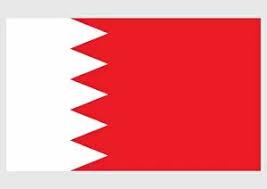
Illustration of national flag of Bahrain available as Framed Prints,  Photos, Wall Art and Photo Gifts

The flag of Bahrain has five white triangles: the white represents peace, and the triangles embody the five pillars of Islam, matching the red which symbolises the blood of martyrs. It is very similar to the flag of Qatar, a country Bahrain has not always had the easiest relationship with. ‘Bahrain’ comes from the Arabic word ‘two seas’ which reflects the connection to water – both the sea and freshwater springs. 

As for the economy, Bahrain has not put all its eggs in one basket, having a more diversified economy, with financial services and tourism rather than relying solely on oil as a source of wealth. 

The Bahrain Night

C:\Users\139942\OneDrive - UTS\Pictures\IMG_7961 (2).jpeg

Since the Bahamian dinner, the Virtual Nomads have become an aging group as most of the youngesters have turned a year older. As the adults, JK, CH (Virtual Nomad Special Advisor who has been to over 140 countries) and I myself stay the same age, we recruit the growing tween and teens, A (10), FK (14), L (16) and L’s boyfriend NA (17) into the mix. 

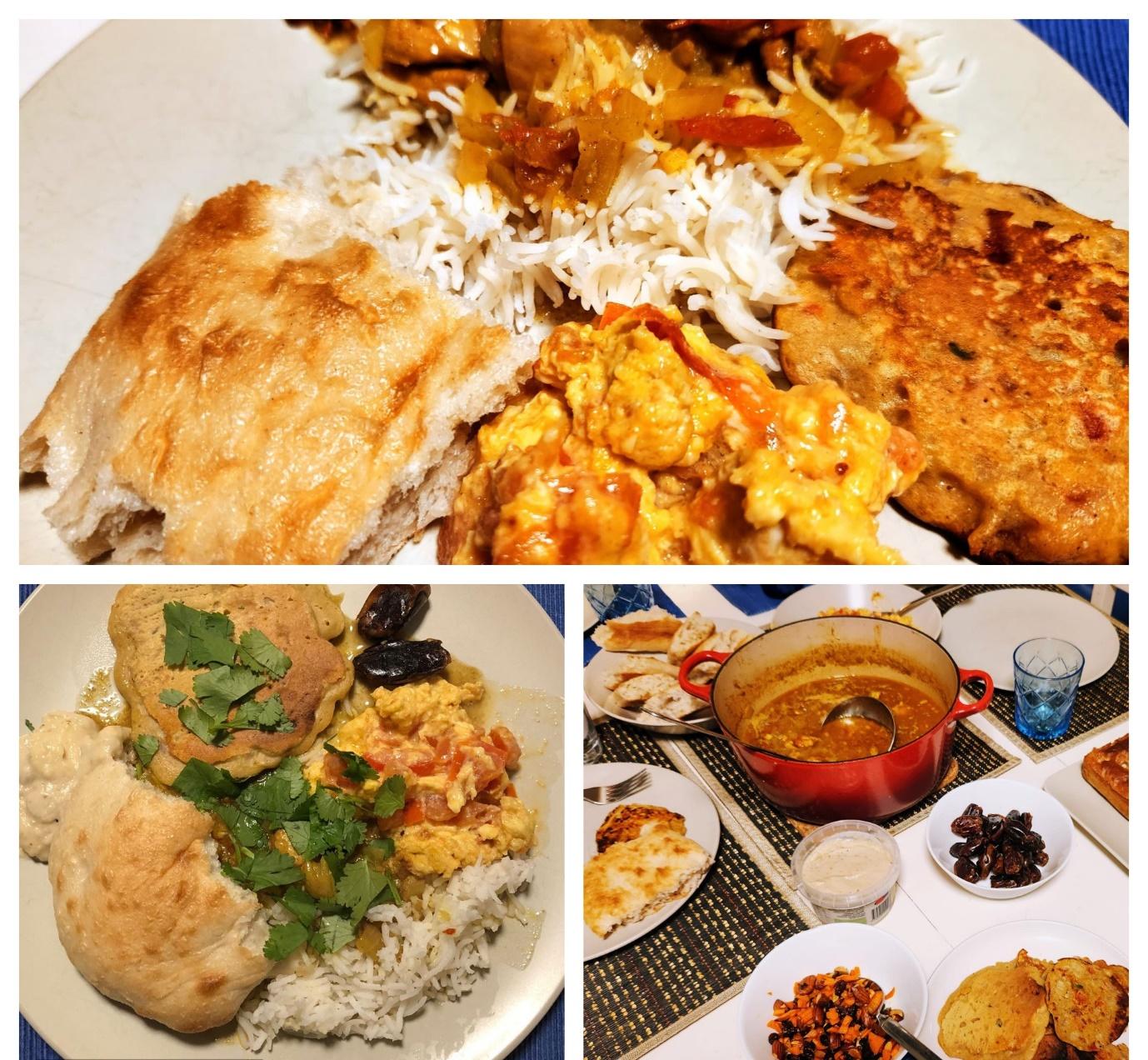
The menu for the night includes:

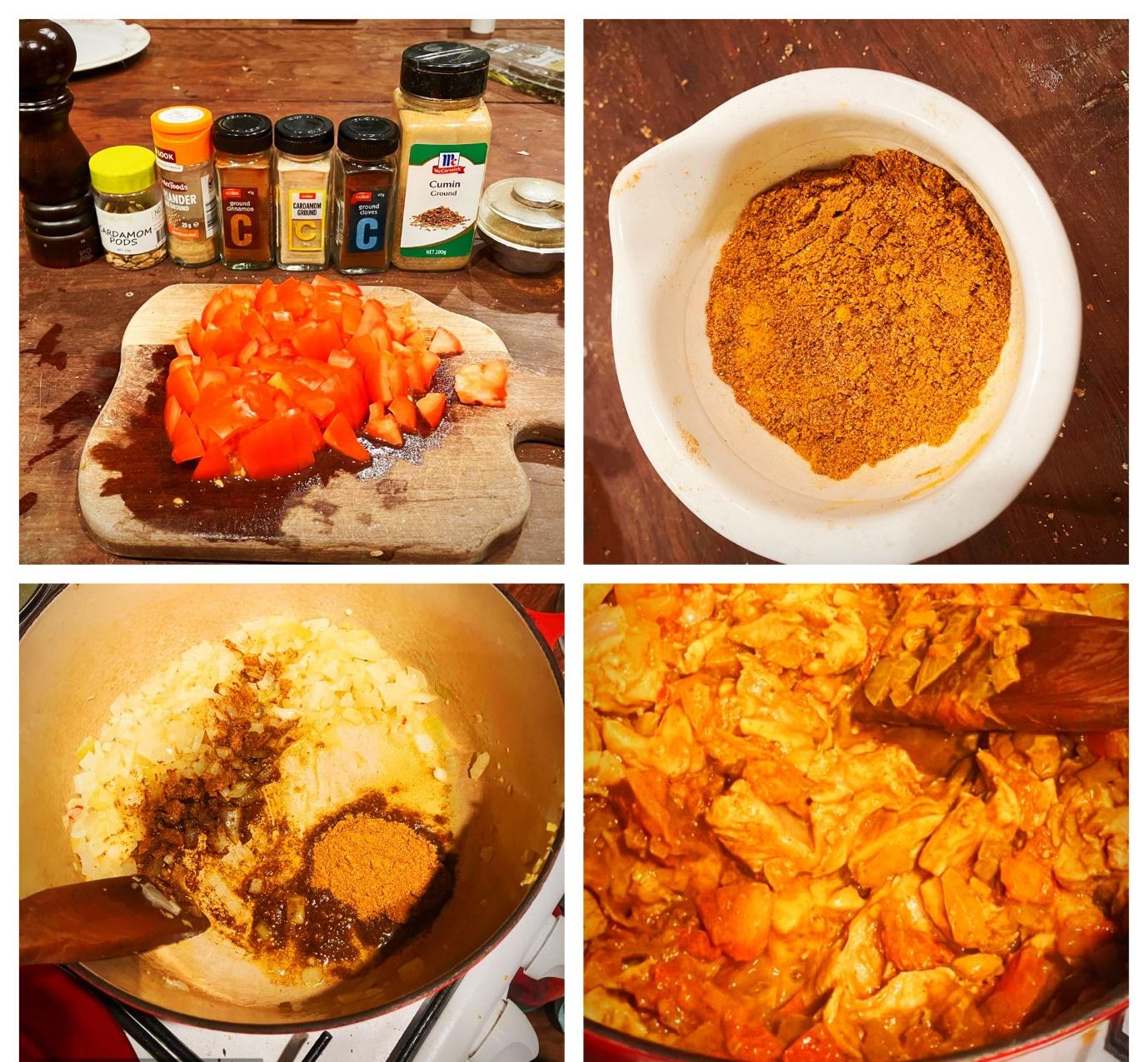
  • Machboos is the national dish of Bahrain. It is a spiced chicken and rice dish with rich flavours of spices and toasted nuts. JK prepares it the night before to make sure the chicken is tasty and juicy, as the dish takes time to prepare. 
  • Baid Tamat is traditionally a breakfast dish of scrambled eggs with tomatoes with the flavour of cumin. The name comes from Arabic words for eggs (baid) and tomatoes (tamat). We prepare on the night and we find it yummy with its exotic taste.  
  • Khobez Jebn is store-bought white flatbread.
  • Kabeb Bahraini are vegetarian appetizers prepared with chickpea (besan) flour added to tomato, onion and spices. 
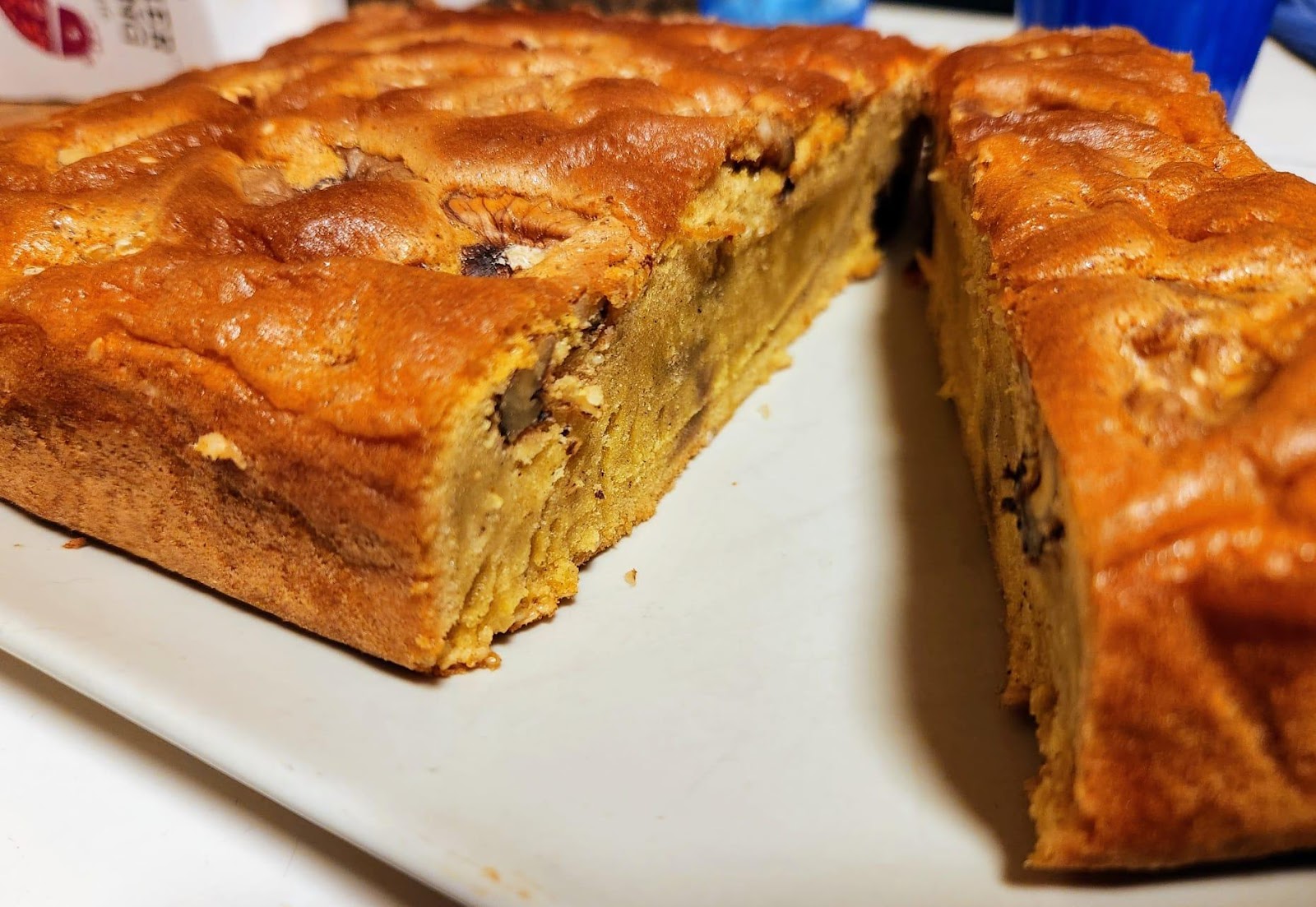
  • Ogaili is a tense saffron cake with two types of flour, which I prepare the previous night. It has a very strong taste that some of us enjoy whereas others find it too intense
C:\Users\139942\OneDrive - UTS\Pictures\IMG_7963 (2).jpeg

With all the food, our Bahraini night is very successful. We find no Bahraini music lists on Spotify, and we are equally unsuccessful on our other platforms, which means there will be no music for this Virtual Nomad entry. Nevertheless, FK holds a trivia for us and we learn several things about Bahrain such as:

  • Bahrain has no personal income tax. Instead, there is a social insurance contribution (7% for Bahraini employees; 1% for expats).
  • Healthcare and primary/secondary education are free
  • Bahrain has the world’s largest underwater theme park, Dive Bahrain
  • There is an over 400-year-old tree in the desert called the “Tree of Life
  • Bahrain has a 3D printed coral reef

An Island of a regime of absolute power

C:\Users\139942\OneDrive - UTS\Pictures\29cde8c2-42c1-4a86-a245-a9528a14f13c.jpeg

Once upon a time, Bahrain was green with flourishing nature, part of the ancient Dilmun civilization that dominated trade in the region. Different rulers followed (Assyrians, Achaemenid Persians, Iranians, Persians and others), and in 1783, the Al-Khalifa clan stepped in to rule Bahrain, which they still do to this day. Bahrain has longstanding links with the UK (and later with the US) and in 1892, Bahrain was annexed to the British Empire. After  becoming independent in 1971, times were turbulent and human rights violations were rampant. The first emir of the independent Bahrain, Isa bin Salman al-Khalifa, was a key figure in herding Bahrain into a modern nation and financial hub, but he dissolved the parliament and installed an initiative called the State Security Law. This law was applied widely by Ian Henderson, a British head of the Bahraini General Directorate for State Security Investigations. Henderson adorned a charming nickname ‘the Butcher of Bahrain’. The law permitted the arrest, killing and torture of thousands of people without any political accountability for over 25 years.

The 1990s (1994-99) saw an uprising in Bahrain, the “uprising of dignity”. The uprising was a joint effort between different groups (such as leftist, liberal, Islamist groups) to demand political reforms and an end to repression. 

This did not end until the new emir, Hamir Hamad bin Isa Al Khalifa stepped into power after his father’s death in 1999. He fired Henderson, reached out to opposition groups, invited exiled Bahrainis back from overseas and promised political reforms in the shape of a widely supported referendum regarding the National Action Charter in 2001. But Hamad had other changes in mind as well, and the new constitution of 2002 was very different from what he had presented to the people, and what had been approved. Essentially, he basically made the new referendum a vehicle to grow his own power. Until 2002, the Al-Khalifa rulers were referred to as ‘hakims’ (meaning emirs), but Hamid decided to opt for absolute monarchy ( proposed as constitutional monarchy) and rule the country as a king, giving the Al Khalifa family even more power and control. The country changed its name to a Kingdom, but nothing changed, and by 2010, the Bahraini people had grown tired. 

Books: The Arab spring and child brides

The Arab Spring was a series of anti-government protests that swept across several Arab nations starting in Tunisia in 2010. In Bahrain, the Arab Spring started on 14 February 2011 with intense protests and frequent clashes between police and protestors with police raids from 17 February (Bloody Thursday) onwards. Saudi Arabia sent 1,000 troops to Bahrain in fear of the protests expanding. 

I decided to read Sectarian Gulf: Bahrain, Saudi Arabia and the Arab Spring That Wasn’t by American scholar Toby Matthiesen. While reading a book by a scholar and an ‘expert’ outsider is always risky, reading it offered some information about the aftermath of the Arab Spring in Bahrain. Although interesting, some of the information is outdated as it is 10 years old (2013). The book presents background information explaining sectarian tensions and how Saudi Arabia and Bahrain declared the Arab Spring as Iran’s plot to help the Shia population. Saudi Arabia and Bahrain have strong political and economic links (and more ‘liberal’ Bahrain remains a weekend holiday destination for Saudi parties). As the protests in Bahrain were mainly Shia-led, the Shia population in Saudi Arabia was strictly prohibited to enter Bahrain. Matthiessen visited Bahrain several times around  2011 and was a witness to the protests and the aftermath. 

The Bahraini royal family did not take the protests lightly. The Bahrain Independent Commission concluded that some of the tactics used were classified as torture, psychological abuse and other human rights violations. The situation for the opposition has not improved much  since 2011 despite promises of reforms. In 2019, the King reinstated nationality to hundreds of people, however excluded members of the opposition. Several opposition members have received jail sentences. Rights activist Nabeel Rajab was incarcerated from 2017 to 2020 for accusing Bahraini authorities of torture. The royal family still holds the absolute power they have had for the past two centuries. 

Child bride

The book by Matthiesen is not enough for me so I decided to read Yummah (2005) by Sarah A. Al.Shafei. It tells the story of Khadeeja, a young girl sold away as a child bride to an older man at the fragile age of 12. She starts to procreate with the husband from an early age and has eight or nine children (her first at 13). She faces numerous deep losses and tragedies in her life and is abandoned at 25 by her ‘loving’ husband whom she then takes back when he returns to her in a wheelchair, with no one else to care for him. I was prepared for a heart wrenching, emotional and self-reflecting book on a tragic life of someone silenced of her own will. Instead, it is mostly a simple book that in my eyes romanticizes forced marriages and child brides. Yummah is written in a naïve, nearly childish way, with many details regarding dresses and possessions and how to be a good wife. There is a darker tone towards the end when Khadeeja faces hardship and the political times are changing. Her firstborn daughter is sold as a bride at 13, but her younger daughters marry much later in life, and by choice. It is hard to say whether I like the book or not – it is an interesting description of a woman’s place in a changing country, however it  reads as very child-like and infuriating at times (especially when it comes to Khadeeja’s devotion to her deceitful husband). The last passage reveals that the story is probably a recounting of Sarah’s grandmother’s life that Sarah has written and self-published. Even if her  book is not very well written, we forgive Sarah as it comes from a place of love.

When Kariya knew about Alkooky’s search for a bride, I was the first one to come to mind. We had the same background and she believed I had all they were looking for. We were both from well-off families, we were from the same class, we were both Sunnis and our grandparents were both religious leaders. I had all the beauty, reputation, smartness, manners and character they were looking for and he was rich so she knew he’d pay her good money”

——-

  • You spent all these years giving all you had for others, all your strength and courage, even your beauty, dear friend’, she seemed to say
  • It’s fate, Layla, it’s God’s fate and I am happy
  • ‘You only think you are, but reality is quite different. I know you miss him.
  • He is my life, how can I forget my life?
  • But he forgot you.
  • No he didn’t, even if he is in the arms of another woman his heart is thinking of me. I know it, I see him in my dreams, I feel him every single day, he smiles when I’m smiling, he aches when I cry. My heart tells me he’s still there for me and I know he knows I’m still here”

Movies: Photos of the heart 

The movie industry in Bahrain is practically non-existent as there is no public or private funding for production. There have only been a handful of Bahraini feature films, but a number of short films by independent filmmakers. One of the few ( 3-5 depending on the source) feature films is A Bahraini Tale by Bassam Al-Thawadi, an award winning director. It is somewhat interesting, albeit has too many faults to be really compelling. The setting is intriguing – it’s 1967,the time of the Arab-Israeli conflict. The main theme of the movie is freedom in unsettling periods of instability. It is also a story about gender inequality and the limiting freedom of Bahraini women at the time. The main protagonist Fatima lives through a series of disappointments and her own sacrifices in life. The setting and premise are attractive but the realisation itself lacks focus. The story has good intent but the plot is unfortunately uneven. 

As for the short stories, I watched Yesterday’ by Ammar Al-Kooheji. “Life is a series of photos that pass quickly and we rarely remember them. Yet dear photos are different. We keep them deep in our heart,” says a character in this melancholy, very amateur 17-minute video of loss and longing.

To finish the Virtual Nomad stop in Bahrain, JK and I watched  the documentary The Defenders (2023) by Matthew Bate about Hakeem Al-Araibi, an Australian professional football player. Born in Bahrain, he was part of the national senior team playing for the country . Like many other athletes, he took part in the anti-government protests of the Arab Spring, was arrested and tortured, and applied for asylum in Australia. When travelling on honeymoon to Thailand in 2016 with his wife, he was arrested at the airport and taken into custody (and prison) to wait for extradition to Bahrain on terrorism charges. Led by sport broadcaster Craig Foster, an international campaign followed to free Hakeem, which ultimately saved his life. The documentary is a testimony of the corruption and destructive power of absolute monarchies and international sports associations, but also of the power of the people.  It is a highly recommendable, powerful documentary.

Next stop: Bangladesh 

proof read by L

Bahamas

I concentrate on riding this wave of cool blueness, being inundated by it. It occurs to me that we must come up with words for the blues that appear in the Bahamas; the ones in the dictionary were made before anyone who recorded things in writing had seen the waters and sky of this country.” 

The Bahamas sounds exotic, exquisite, luxurious. For the kids it sounds like a place where very wealthy people go for a holiday, own holiday houses or hide their money.  This is not far from the reality, but the Bahamas is of course, much more than that. It’s a young country surrounded by beautiful waters, sublime weather and exposure to cyclones and hurricanes. 

C:\Users\139942\AppData\Local\Microsoft\Windows\INetCache\Content.MSO\1108DD4B.tmp

A lot can be said about the sea around the Bahamas. While the entry of Antarctica was full of snow and ice, and inspired us to find abandoned penguins while ice-skating, the focus of the Bahamas is the sea. It is a country spread over 233,000 square km of water.

Sydney Sealife has a virtual experience that welcomes the virtual visitor to immerse in the sea around the Bahamas. That sea is very blue due to high levels of chlorophyll and the Bahamas not having much plankton. 

The Bahamian flag represents the sand of the beaches (gold), the surrounding blue seas (blue) and the strength of the Bahamian people (black). 

Cooking Island Food 

There is no Bahamian restaurant in Sydney, which leads us to organise another fun cooking night at home. We try to avoid the mistake of making too much food and decide for five dishes. All core Virtual Nomads are present – that is JK; CH (the Virtual Nomad Special Adviser who has been to approximately 140 countries); the kiddos L (16), FK (14) and A(10); and me of course. This Bahamian dinner is special as we have a new delightful addition to the group that is NA, L’s boyfriend (16).

C:\Users\139942\OneDrive - UTS\Pictures\bahamas 1.jpeg

We decide for five dishes prepared by three different teams. The menu consists of the following:

  • Bahamian curry chicken or Bahamian stew chicken 
  • Pigeon peas and rice 
  • Bahamian mac and cheese 
  • Johnny cakes 
  • Bahamian fruit salad 

Team 1 (JK with occasional moral support from FK) prepares an excellent Bahamian curry chicken while Team 2 (CH) creates a yummy mac and cheese. Team 3 (L and NA) team up to create outstanding Johnny cakes and my team (me and my moral supporter A) use our magic to make peas and rice, and fruit salad. We could have also prepared boiled fish dishes that are typical to the Bahamas but no one was too keen on the idea. 

The Bahamian night is very lovely. The food is delicious and CH tells travel stories of different places she has been to, including the Bahamas. These tales capture the attention of the young nomads of the group. It is another lovely virtualnomading event and we are transported into the blue skies and waters of the Bahamas from the gloomy skies of winter Sydney. 

Where the Pirates Are

C:\Users\139942\OneDrive - UTS\Pictures\bahamas 2.jpeg

The Bahamas is an archipelago of nearly 3000 islands, islets and rocks in the sea (30 of them are inhabited) with the capital Nassau on the island of New Providence. It was inhabited for centuries by Indigenous Taino in a relatively peaceful state until 1492 when Cristobal Colon (known in English as Christopher Columbus) with his troops set foot there. The Bahamas was the first landing place of the Spaniards and, as expected, they were not friendly and supportive of the ‘natives’. Instead they used them as slaves in mines and other back-breaking activities. The Spanish did not bother to colonise the islands but left that to the willing Brits who established a colony, initially as a safe place for puritans.

In the early 1700s the Bahamas became the pirate centre for the world and Blackbeard himself resided there. The British took control and made the Bahamas a British crown colony in 1718. Slavery was widespread with American Loyalists moving to the Bahamas in the aftermath of the American Civil War. While the slave trade met its end in 1807, it persisted in the Bahamas until 1834. Economic hardship remained a curse until the 1960s when tourism and tax free offshore deposits (for millionaires) allowed the Bahamas to build wealth. The Bahamas became independent in 1973 under the rule of Sir Lynden Pindling who was the PM for 23 years. 

Today the Bahamas has the second-highest GDP in the region with tourism and offshore finance as its main industries. More than 70% are employed by tourism. The Bahamas is currently a parliamentary constitutional monarchy with predominantly a two-party system. The Panama Papers revealed that the Bahamas has the highest number of offshore companies of any jurisdiction in the world. English is the official language of this Caribbean island state of around half a million inhabitants.

Tales that we tell

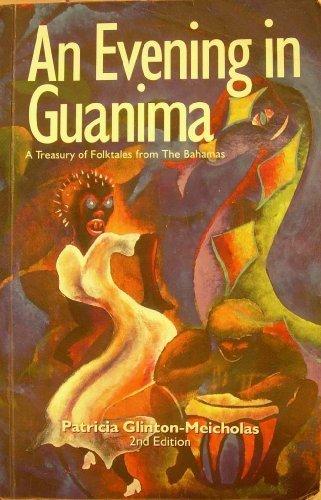
The Bahamas is said to have strong Afro-Bahamian folk literature based on popular folk tales. Some of these tales are reproduced in Patricia Glinton-Meicholas’ book An Evening In Guanima: A Treasury of Folktales from the Bahamas (1993). Patricia Glinton-Meicholas is the first winner of the Bahamas Cacique Award for writing and also the recipient of a Silver Jubilee of Independence Medal for Literature. She’s an author, lecturer, cultural critic and academic, and a fierce defender of Bahamian history, culture and tradition. Her books include a strong sense of Bahamian identity and place in the world. 

https://images-na.ssl-images-amazon.com/images/S/compressed.photo.goodreads.com/books/1456329122i/2056049.jpg

That sounds like the right place to start submerging in Bahamian literature. 

In the introduction of An evening in Guanima Patricia explains the importance of storytelling to the Bahamian culture and the culture’s roots in the Senegambia tradition (85% of the population derives from Africa). Bahamian storytelling is a wonderful hybrid mixture of tales from the mother continent, colonial and European influences. Patricia explains to us the purpose and format of these stories and the main themes she mentions are:

  • Cleverness is the key to problem-solving / overcoming adversity, rivals etc.
  • Goodness will always trump evil in the end
  • Elders are repositories of wisdom and must be respected
  • Good manners, good deeds and correct behaviour win out in the end
  • Love can overcome death
  • Pride goes before a fall
  • Greed / intemperance brings about loss rather than gain
  • Strangers are not to be trusted. 

Based on this information, I proceed to read the book. It is fascinating and slightly old fashioned. The stories that Patricia has created/collaged are simplistic and magical, as folk stories often are. All these stories carry a strong symbolic meaning and a lesson to learn while also including universal values of bravery, honesty and humility – be that the ghost of a loyal dog that punishes a wicked suitor of a good-hearted widow after his master’s death, or a hardworking mother with one grateful and one greedy and rude daughter and the lessons they learn from an old witch, or the smart boy who saves the children of uneducated children from being eaten by a devil disguised as a teacher. These are charming little tales if not very different from the archetypes of folk stories around the world. It is an easy read but not excessively memorable nor impactful. Nevertheless, it’s an enchanting and a wonderful expression of the cultural heritage and a testimony to its rich oral traditions.  

https://images-na.ssl-images-amazon.com/images/S/compressed.photo.goodreads.com/books/1456329535i/1897733.jpg

As lovely as the folk stories are, I long for something a bit more substantial before moving onto the next country. I proceed to read another book from the same author, this time autobiographical ‘fiction’ named A Shift in the Light (2001). It is a wonderful, well-narrated book of memories of a sun-filled childhood with colourful anecdotes and interesting characters.  It is a warm reflection on a happy childhood with a best friend (and cousin), sister and several family members, and then a reflection on growing into an adult in a more uncertain and unequal environment. While the childhood period is carefree and beautiful, there are darker underlying themes such as parents’ unhappy marriage, global events or the rampant racism felt and experienced by the different Bahamian characters in the novel. 

C:\Users\139942\OneDrive - UTS\Pictures\Bahamas.jpeg

The book starts in the 1950s in the changing Bahamas and concludes in 2000. It is a testimony to a carefree childhood but also a love letter to the Bahamian spirit and identity. It is a story about decolonisation, defining the Bahamian nature and defining the future of the country. Patricia Glinton-Meicholas grows up to defend the uniqueness of the Bahamians, who are not Africans nor Europeans but a little bit of both. It is a wonderfully written book, rich in language, symbolism and story – a narration of family ties and friendship, tradition and modernity, racism and national pride. 

Another Bahamian author that I am keen on reading is Natasha Rufin but her books, especially Sunflower, are not available on any literature platforms so I will place it on my reading wish list for now.

Beautiful setting for painful things  

“They lied to me when they told everyone deserves a chance to succeed” (‘Passage’ by Kareem Mortimer)

The Bahamian film industry is not huge. The most prolific current movie maker is Kareem Mortiner who has directed and produced numerous tv series, documentaries, feature films and experimental art films. Kareem is an awarded filmmaker whose works tackle important societal themes from immigration and racism to LGBT rights and gender identity. 

One of his most awarded films is Children of God (2010), the first Caribbean film with LGBT themes. Cargo (2017) is about human smuggling, Wind jammers (2011) about racism and I am not a dummy (2008) is about disability. His 2022 documentary on a Bahamian real estate ‘icon’ Sir Harold Christie won awards in the Academy of Interactive and Visual Arts (AIVA) Communicator Awards. His 2014 short film Passage (2013) was awarded the Best Short Film from the Diaspora by the African Movie Academy. 

I decide to watch those that I can find access to and, after a search, I find the awarded short film Passage, and the feature film Children of God

Passage is available on Youtube – a story of Haitian refugees being smuggled on a boat towards North America. It is incredibly powerful, haunting and unsettling, and with its mere 16 minutes, worthy of all the awards it has won. It has been a long time since I have seen something that keeps you at the edge of your seat every second. 

Kareem’s first feature film Children of God is quite a milestone. Despite occasional clunkiness in some of the acting and the unevenness of the script, it deals with homophobia in the Bahamas and is beautifully shot. In 2006, Brokeback Mountain (a movie about gay cowboys that failed to win the rightly deserved Oscar for best movie) was banned in the Bahamas but Kareem’s film has been well received. It shows the Caribbean like a painting, beautiful blue skies and seas – a dreamy background to the pain and struggle depicted in the story. 

About homophobia in the Bahamas, Kareem says in an interview:

“I think the Bahamas is a microcosm for what happens in the larger world, it’s just more intense and smaller,” Mortimer said, adding that he does not think that Caribbean people are intrinsically homophobic.  Instead, he thinks much of the hostility can be blamed on pop culture imports, like the popular reggae dancehall song “Boom Bye Bye,” which advocates for the murder of gay men and women, and the influence of some “outlandish” religious groups who use anti-gay rhetoric.”   

Most of the audio-visual material from the Bahamas though is far removed from the social commentary of Kareem Mortiner. I learn that several of the Bachelor and the Bachelorette series were filmed there, as were some of the Pirates of the Caribbean franchise. 

Moody and upbeat island sounds 

The Caribbean beat is often associated with chilled, relaxed Island-mood. Think about Blind Blake with his Gin & Coconut water song. More contemporary artists include Matthew Pinder with a lovely moody melody Golder Hour and Cascade. Not very distinctive or ground breaking but lovely enough nevertheless.   

Brettina is a jazzy young artist with an acclaimed debut album (released in 2010). Bob Baiye is a fusion of jazz with Caribbean sounds. More mainstream but with a happy beat is Wendi. Her song Visage sounds like a Caribbean Eurovision song – happy and upbeat. 

Pink Beach

The stop in the Bahamas finishes with the photo of the famous Pink Sands Beach on Harbour Island

Pink Sands Beach, Harbour Island, Bahamas – My Happy Place

Next stop: Bahrain

Bonus A

There are other places, regions and areas that are not sovereign but have a distinctive nature, culture, governance or identity. We know that countries are diverse and the world is diverse, and the Virtual Nomad does not completely give credit to that diversity by going through a list of only sovereign countries. We recognise this fault and therefore we have decided to introduce a bonus after each letter. 

In the A group there are places like Aruba, Anguilla, American Samoa and many others that are not independent states but have their own identity and flavour. It would take the Virtual Nomads even longer to go through all these places so for the ‘other As’ the Virtual Nomad chooses one place. 

We decided it would be Antarctica

Everyone knows where Antarctica is. A land of snow and ice without native human inhabitants. Antarctica does not really belong to anyone or belongs to everyone, but some states claim their share of the icy cake. 

It never snows in Sydney so in order to have a sense of an icy environment, we opt for ice skating at Ice Zoo. There is a lost penguin on the ice.

Tin Can Party

Let’s just say that Antarctica is not a place for foodies. There is no distinctive cuisine or food culture. Farming is not an option meaning food choices are very limited, and most of the food is shipped in by governments. The most ‘popular’ food in Antarctica is seafood, especially shellfish. The isolated winters mean that what has been shipped in is the food that you can consume. Fresh vegetables and fruit quickly deteriorate and packaged food is the most convenient option for the long isolated months.

We decide to do an experiment in order to do homage to the isolated months of canned food. Each of us can bring two tinned cans of food and one other ingredient, and then we will put it all together. 

The selection is hilarious – A (9) brings martini olives, coconut milk and Nutella, L (16) chooses lychees, cheetos and corned beef; JK has opted for tuna, baked beans and dolmades and my choices are organic beans, curry paste and brown rice. FK (13) is away as is the Virtual Nomad Special Adviser CH. 

We then put it all together for a wonderful tinned food dinner that is great for winter and would serve the Antarctica researchers very well.

No landing without a permit

There are tales of Antarctica that include mixtures of mystics and science. The truth is that it is a continent of extreme weather and no permanent human settlement. It is not permitted to land in Antarctica unless you are part of a scientific expedition. It is governed by the Antarctica Treaty System (established in 1959) by ten countries. About 42% of the territory is under the Australian Antarctic Territory (AAT), which is more than any other nation. A fun fact is that Antarctica has the lowest infant mortality rate in the world as all 11 babies born there survived. Emilio Palma, born in 1978, was the first child to have been born in Antarctica.

Stranded in the land of snow and ice

I decide to read two very different books on the experience of being stranded in Antarctica. Both are famous stories, and somewhat tragic. First is the famous tale of the struggles of the Endurance, a doomed expedition to the Antarctic. The other is the story of Dr Jerri Nielsen who discovered a lump in her breast while in Antarctica and had to operate on herself. 

The story of Jerri Nielsen, ghost written by Maryanne Vollers, is fascinating but also unsettling. Dr Jerri is a busy professional at the top of her medical game who decides to go to the South Pole to escape the after effects of a failed marriage. She takes the opportunity to revaluate her life and put some distance between her and an ex-husband, who she describes as manipulative and toxic. But there are also children left behind. This is the unsettling part. Jerri is estranged from her children and accuses her ex-husband of emotional abuse but the relationship with the children is never restored, not even in their adulthood (or around the time of Jerri’s death ten years after the cancer was discovered), so there is a sense of a story left untold. All of this is, of course, speculation on someone’s private life, and the more important – and interesting for an outsider – part of the book is Jerri’s stay in the land of perpetual ice. 

The book strips the reader of any desire to spend the southern winter at the Pole. The South Pole is not an easy ride for Jerri and the penetrating cold is present everywhere, all the time. Jerri is a busy doctor working long hours and making friends with other people who also stay on the Pole during the winter. She describes the customs, the daily routines, the struggles and the joys of working in the land of ice. Life is not easy but it is interesting, and she finds a sense of self purpose. In the middle of winter she discovers a mass in her breast and life at the Pole becomes a different struggle from there. 

It is an interesting book for sure. Winter at the Pole is an intense, life changing experience and Jerri’s story includes many elements from people to emails and conversations. Some of her most meaningful relationships are formed during those winter months and the Pole is a place where she has felt truly herself. The sad post script of this book is, of course, and it is not a spoiler, that Jerri passed away in 2009 after a cancer relapse had invaded her brain and most of her body. Unfortunately it looks like that she never recovered her relationship with her children which is, in my opinion, a bigger tragedy than anything else that happened to her.

While Jerri was very sick with cancer at the Pole, she read the book that I have reserved as my next Antarctica book – Endurance, by Alfred Lansing that promises to be “the true story of Shackleton’s incredible voyage to the Antarctic”. For Jerri, it gave solace in the rapid decline of her health – that there was someone else who survived the polar winter with unbelievable skill and ‘endurance’. 

Ernest Shackleton was a British Antarctic explorer who, at the dawn of the First World War, embarked on a journey with 27 men to the Antarctic. He personally chose the men to accompany him from 5000 candidates (including three girls). The gorgeous vessel, Endurance, got stuck in thick ice and was slowly swallowed by the icy waters during a gruelling month. The men first found refuge on the ice where they camped for months. Then the breaking ice forced them to travel to Elephant Island on small boats, where they were finally rescued after Shackleton’s 16-day journey with three others to George Island. All the men survived. It is an extraordinary tale of resilience and endurance. Shackleton’s ambitious (and somewhat crazy) plan was to walk across the continent from shore to shore but then, of course, the plan went horribly wrong. Shackleton’s leadership, through a period of despair and hardship, was apparently so amazing that his decision making processes are still taught in business schools. 

It’s an extraordinary story worth knowing, even if the whole idea behind the expedition makes you shake your head in disbelief. But an adventurer’s spirit is an adventurer’s spirit. The book itself is skilfully written and relies strongly on real materials – documents and diaries of Shackleton and others. It is an intense, fascinating story of hardship and struggle, but also a testimony to their strength, team spirit and ability to endure. The men survived unbelievable situations from attacks by sea lions to resisting unbearable cold, day after day. 

“Greenstreet paused to get his breath, and in that instant his anger was spent and he suddenly fell silent. Everyone else in the tent became quiet, too, and looked at Greenstreet, shaggy-haired, bearded, and filthy with blubber soot, holding his empty mug in his hand and looking helplessly down into the snow that had thirstily soaked up his precious milk. The loss was so tragic he seemed almost on the point of weeping.

Without speaking, Clark reached out and poured some of his milk into Greenstreet’s mug. Then Worsley, then Macklin, and Rickinson and Ker, Orde-Lees, and finally Blackboro. They finished in silence.”

It is an extraordinary tale that drills into the character of the different people, but above all paints Shackleton as a silent unbreakable hero. He manages to get all his men out of the cold, wet, freezing hell to safety, but not without sacrifices. One loses toes, another is forced to shoot his dogs. Shackleton did not live a long life but he surely knew how to put together a team where everyone bought into something special. 

Bad horror on ice 

Only one movie has been filmed in Antarctica and it is a very bad horror movie. Sound of Sanity was filmed entirely in location with an amateur cast and what makes this movie remarkable is that it was filmed in such conditions. The trailer of the movie is available on Youtube, and an interesting article describing the process can be found here.

However, there are several documentaries that are far more interesting. The Youtube rabbit holes on offer vary from travel blogs to conspiracy theories, from science documentaries to national geographic. 

Music in the land of ice and dark 

Nunatak was the house band of the British Rothera Research Service Station. The five member band consisted of a physics engineer, a communications engineer, a marine biologist, a polar guide and a meteorologist – and their instruments. Their song ‘Would you do it again’ was written and performed for Life Earth in 2007. 

And just like that, the As are finally done and Virtual Nomad moves into the B world. 

Next stop Bahamas

Azerbaijan

The Virtual Nomad is slowly approaching the end of the A territory with its last sovereign entry being Azerbaijan — the other half of the neighbourly tensions with a former Virtual Nomad stop, Armenia. At this stage it is also healthy to acknowledge that the time between  Virtual Nomad stops seem to have increased, as has the amount of text. With this stop we are trying to return to a more compact format, whilst doing justice to the destination by providing the attention it needs, of course.

So, back to Azerbaijan.

Azerbaijan

Azerbaijan sits by the world’s largest (saline) lake, the Caspian Sea and has as its neighbours Russia, Iran and Georgia. Its capital is the ancient city of Baku, famous for being the lowest-lying national capital. The exclave of Naxçıvan (Nakhichevan) is bounded by Armenia, Iran and Turkey. And then there is of course, Nagorno-Karabakh, that has been the heart of the conflict between Azerbaijan and Armenia since 1988. 

The landscape is varied from lowlands to mountains. Winters are mild and long, summers hot. Azerbaijan has 14 economic districts with the Baku region being the most populated. An interesting fact about Azerbaijan is that about half of the world’s mud volcanoes are found in the Gobustan region of the country. 

Azerbaijan is one of the six Turkic states. The name Azerbaijan was first used officially in 1918 when a short-lived independence was established. The Soviets invaded the area in 1920 and from 1922 until 1991, Azerbaijan was part of the Soviet Union. 

Azerbaijan is mainly a Muslim country (96% in 2010), 75% being Shia and the rest Sunnis

C:\Users\139942\AppData\Local\Microsoft\Windows\INetCache\Content.MSO\E08D3F6.tmp

90% of the population are Turkic-speaking Azerbaijanis. The Turkic strain is said to have arrived in Azerbaijan in the 11th century.  The Arabic script was in use until quite recently (20th century). The Cyrillic alphabet was introduced in 1939 and since 1992, Azerbaijan has had a Roman alphabet as the official orthography. 

The tricolour Azeri flag includes a blue line (symbolises the Turkic heritage), red (progress and social democracy) and green (Islamic civilization). 

Happy cooking

The Azerbaijani food services in Sydney are another victim of the global pandemic and this sad fact forces us to prepare the food ourselves. This time I recruit the Virtual Nomad Chief Editor and fellow nomad, JK, to help me with the ‘fooding’ as his talents are not limited to proof reading overlong texts. He has an excellent understanding of the order in which ingredients are introduced in cooking. Virtual Nomad Special Advisor (who has been to over 140 countries) CH joins us in the preparation of the Azerbaijani night. 

C:\Users\139942\OneDrive - UTS\Pictures\azeri.jpeg

We reserve a warm autumn Sunday for five delicious dishes from Azerbaijan. A (9) is away but L (16) and FK (13) join us for dinner but leave cooking for JK, CH and the non-Master Chef, me.

The menu includes:

  • Toyug kebabs
  • Lamb pilaf (national food)
  • Dark greens with noodles and yoghurt
  • Azerbaijani herb-filled pan cakes
  • Yoghurt and herb soup (we leave that for another day).
C:\Users\139942\OneDrive - UTS\Pictures\noodles.jpeg

Preparing the food includes leaving Toyug Kebab meat to marinate overnight. Toyug is made of chicken thigh fillets. The marinade includes lemon, oil, salt, pepper and sugar. I manage to do that and the result looks awesome. 

The preparation for the Azerbaijani night involves a lot of chopping and coordination. While JK prepares the lamb pilaf, I make the dough for the noodles and pancakes and CH prepares the chicken skewers. JK knows how to cut (almost) perfectly shaped noodles so I hand it over to him once the dough is ready and I turn to herb-filled pancakes. I struggle to make the pancakes crispy and thin but am having more success with dark greens. 

Then after a couple of hours of cooking we are ready for dinner. FK (13) says that this might be the best Virtual Nomad so far as the meat is so good. As I am the only vegetarian of the group, I cannot verify this statement personally but the rest of the party agrees with FK (on the quality of meat, not necessarily on the order of the Virtual Nomad dinners). The lamb dish is particularly well received as are the skewers. Dark greens are very good and have an exotic taste but they are noodle-heavy and the greenness disappears as the floury taste dominates. Nevertheless, the home made noodles are excellent. The least successful dish is the herb-filled pancakes as they are a bit too thick. The traditional Azerbaijani pan cakes are much thinner.

C:\Users\139942\OneDrive - UTS\Pictures\azeriss.jpeg

We have another wonderful Virtual Nomad night. CH tells about her four month sole-woman trip along the Silk Road that included Azerbaijan. Her experience of Azerbaijan is a tale of friendly people and an interesting mix of a very modern capital with heavy nightlife and traditional slow-pace life in the countryside. 

We have a second part of the dinner a few nights later as the ingredients for the yoghurt and herb soup are still waiting to be cooked. FK (13) and A (9) are both away so JK, L (16) and I decide to do two versions of the soup; the traditional one with mince balls and a vegetarian-friendly one for me. The result is a delightful combination of unusual taste that is surprisingly fresh and interesting. This might be my personal favourite of the five Azerbaijani dishes. 

C:\Users\139942\OneDrive - UTS\Pictures\azeri soup.jpeg

Keeping it in the family

Who were the first people of Azerbaijan? No one seems to know except for the fact that they lived in places like the Azock Cave. There are records of Scythians and Caucasian Albanians living in the area around 8 BC, with the former building the large empire of Scythia. In the area that is today Azerbaijan also lived Persians who left a permanent mark on the culture and gave the area the name Atropatene, named after Aturpat, a ruler who served many military leaders (such as Alexander the Great) and then founded his own kingdom. 

Christian faith became the official religion around the 4th century. The Arabs invaded the territory in the 7th century and ruled for some time. Then came the Turkish tribes that brought their language with them. But there were other invaders and rulers as well — Mongols (13th century, and they were not nice to the locals), Turkish Mongols (14th century, also not nice), Ottomans, Russians and then Persians again until the Russian rule in the 19th century. The Russian rulers had a clear preference for Armenians which the Azeri population resented. Economic recession led to violent conflict between the two (Armenians and Azeris, who else.) The 20th century brought little respite to the country. Following the declaration of independence, Russians came again in 1920 and invaded, attracted by the prospect of oil wealth (Azerbaijan was the world’s biggest provider of petroleum). In 1922, Azerbaijan was incorporated in the Soviet Union and it was not always an easy ride. It became a constituent republic in 1936. Azerbaijan went through economic hardship in the 60s and became an independent state in 1991 —which then led to conflict with Armenia over the Nagorno-Karabakh region in Azerbaijan, that is majoritarian Armenian. 

The market economy made an entrance in the 1990s and oil remained the primary export. The first president, Hyedar Aliyev (ruled from 1993 – 2003) was followed by his son Ilham Aliyev, who was so charming that he decided to get rid of the presidential term limitations in the constitution and limit free speech and the press. The 2003, 2008, 2013 and 2018 elections that Ilham won with over 80% of the vote have all been declared fraudulent. The election app in 2013 showed the election results before the election had even taken place. Political corruption is rampant (Transparency International scores Azerbaijan as low as 30) and the Aliyev family has enriched itself with public money and placed it in offshore accounts. Human rights activists are persecuted (such as Anar Mammadli), LGBTQ rights violations are severe and bribing of international politicians and business leaders is standard practice. 

Love across boundaries

Azerbaijan has an important literary tradition. Nizami Ganjavi is Azerbaijan’s most influential author. Despite the fact that he died 800 years ago, his influence is far reaching in the development of poetry in Azerbaijani, Arabic, Turkish and Persian. His main work is called the Five Treasuries (Khamsa). Part of this masterpiece is the famous story of Layla and Majnun which has been compared to Romeo and Juliet by Shakespeare, but written a thousand years before. This tragic love story has inspired literature and music for centuries, including the song Layla by the disgraced musician Eric Clapton. 

Another important figure in the Azerbaijani literature is Mikayil Mushfig, father of the new Azerbaijani poetic style in the 1930s.  

I decide to read the most famous novel placed in Azerbaijan and maybe, or maybe not, by an Azerbaijani author. 

Ali and Nino by Kurban Said | Goodreads

Ali and Nino is a love story between an Azerbaijani Muslim, Ali, and a Christian girl, Nino, from Georgia. The author, Kurban Said, is a pseudonym whose true identity has never been completely revealed. Different theories attribute the authorship to different people including Austrian Baroness, Elfriede Ehrenfels, who signed the publishing contract. Other potential authors include Muslim-turned Jew, Lev Nussimbaum, Azerbaijani author, Yusif Vazir Chamanzaminli, or a Georgian author, Grigol Robakidze.  Published in 1937, the book is now considered a modern classic. It was out of print for three decades. 

Ali and Nino meet at school and fall in love. They are devoted to each other while being products of their religions, customs and traditions – two vastly different worlds that, in the end, provide the underlying landscape of the novel. What makes Ali different is that he falls in love with a girl that “has a soul”. Older Muslim men, including his father, teach him that women are empty vessels for child bearing and they do not have a soul, but Ali wants to marry for love and wants to marry a woman of a different faith. The beginning of their courtship — despite barriers of beliefs and cultures — is fairly carefree as they both come from affluent families and Baku is a city of cultural diversity and has an active culture life. The first interruption is the kidnapping of Nino — an ancient tradition that brings not only shame but also the burden of tradition through blood and sacrifice. Then World War I breaks out and brings uncertainty, worry and hardship. Their world is pushed into turmoil and now includes finding a balance between loyalty and personal freedom, nationalism and security, loss and devotion. War becomes a reality, as does Azerbaijan’s very short independence before forming part of the Soviet Union. 

“if the Russians despise me, Nino will not take me as a husband. But I must marry Nino, even though she is a Christian. Georgian women are the most beautiful in the world. And if she refuses? Well, then I’ll get some gallant men, throw her across my saddle, and off we go over the Persian border to Teheran. There she will give in, what else can she do?”

And then, much later in the book when reality bites…

“then she made plans for the Toy’s future [their child] in great detail, with tennis, Oxford English and French languages courses, all European. I did not say anything, for the Toy was still very small, and there were thirty thousand Russians at Jalama” 

The story is definitely compelling and a wonderful read from the start. The author gently smiles at Ali’s youthful energy and his blossoming masculinity while Nino grows from a girl with big eyes and slender figure — who is a victim of her own gender and therefore always inferior to Ali — into someone of her own mind and desires. Their love and commitment goes through several trials, not only due to their different backgrounds but also their different sense of belonging between the Asian and the European worlds, modernity and tradition. Their worlds and backgrounds clash, not the least regarding the role and place of women but they are able to overcome this through nearly unbreakable love. But the world is changing and challenging around them and that weighs on them both and their destinies. 

Ali and Nino, Batumi

In 2010, a Georgian artist, Tamara Kvesitadze, built a kinetic sculpture in the Georgian city of Batumi of a nameless woman and a man. It has been nicknamed Ali and Nino. The statue has the two figures kiss each other every ten minutes only to be torn apart again. The statue is said to symbolise love despite nationality or belief but also the fleeting nature of everything in life. 

As the mystery of the authorship of Ali and Nino remains, I decide to read another book by an Azerbaijani author. Ali and Nino finishes with the ending of the Azerbaijani independence in 1918 and the looming Soviet occupation. The book by Rustam Ibragimbekov, an award winning screenplay writer, Solar Plexus: A Baku Saga in Four Parts commences in the 1940s, deep into the time of Soviet rule. The story is told from the perspective of four different characters but they share the same origin — a courtyard where they grew up in Baku. The story spans several decades and generations from the 1940s through challenging times to the dawn of independent Azerbaijan and the violence of the early 1990s. 

9781782671169: Solar Plexus

It is a long book that is interesting in parts but generally quite uneven. The first part relates to the weight of family pride and sacrifice, and how carrying that family pride can have devastating and life altering consequences. The second part feels like a filler and has very loose connections to the first story, or maybe it just was not compelling or engaging enough for me. The third is interesting again as it returns to some of the events of the first part but from another perspective. The fourth pulls the childhood friends together around a violent event and describes their life stories and destinies. Life in the Soviet Union is not easy and the Soviet rule mixed with traditional manly pride does make the courtyard, and the life after that, a complex place to live. Women in the novel all seem crazy in one way or another and their life purpose is related to the men around them. The societal changes and events push through the story from Stalin’s purges to the war with Armenia in the 1990s. Baku is one of the characters, even more important than some of the five friends (as some of them are more defined than others) and its changing nature from a more multicultural and accepting human landscape into more narrow-minded, exclusive and nationalistic is well portrayed. 

“What made him follow all the others? Certainly not courage, he knew that now. He was probably driven by fear. Not the kind of fear that can be overcome with an effort, but a different kind, more powerful – the fear of losing people’s respect.”

Uneven pairings

C:\Users\139942\AppData\Local\Microsoft\Windows\INetCache\Content.MSO\9E36A6BF.tmp

Pomegranate Orchard (2017) is said to be one of the most successful movies of independent Azerbaijan, representing the ‘new’ wave of Azerbaijani cinema. Filmed in 2017, the movie was subjected to some censorship in the home front. Directed by Ilgar Najaf, the movie is very hard to find on streaming platforms.  Najaf was born in Armenia but became a refugee in 1988 when his family was expelled and they moved to Azerbaijan. He is winner of two Asian Pacific Screen Awards, one of which was granted for this movie. 

When I finally find it, the movie promises but does not fully deliver. The story is not unusual – a prodigious son who abruptly left 12 years ago returns to his native rural village to meet the family and the wife + son he left behind. His old man is suspicious him while fighting the interest of others to buy him out of his farm surrounded by pomegranate orchards. There is some family trauma, of course. It is the story of the clash of modernity and tradition again, the duty and the free will, the family and the individual, and the little choice that women have when tradition, authority and expected sacrifice hold a hard grip on them. The willingness of the wife (who looks much younger than the husband even if they are meant to be the same age) to forget and forgive no questions asked makes me almost angry. The pace is slow and the resolution somewhat unsatisfactory. There is of course beauty in the rural Azerbaijan and great effort in the symbolism and unspoken dialogue. 

C:\Users\139942\AppData\Local\Microsoft\Windows\INetCache\Content.MSO\FF798E02.tmp

Due to the fact that I have read Ali and Nino, I decide to watch the movie of the same name, based naturally on the story that I have just read. It does not achieve the magic of its material and falls flat. If a word of advice is allowed, I would not waste time with this movie but would read the book. And yes, one of the producers is the perpetual president’s daughter

I decide to watch another Azerbaijani movie and I am glad that I do. Steppe Man (2012, available on youtube), a fascinating, minimalistic story of a literally nameless young boy/man living in a steppe with his father. They live far away from the civilisation and hold their livelihood by raising camels. The slow rhythm of his life changes at the

C:\Users\139942\AppData\Local\Microsoft\Windows\INetCache\Content.MSO\94D0DD60.tmp

sudden apparition of a young woman escaping from her past. The movie is filled with stillness and very little dialogue. The shots are long and the pace is slow but there is certain effectiveness. It is an interesting movie with raw and unfiltered take on human nature and the clash between the life styles and forms of traditional and modern way of living, the innocence and betrayal, the gain and loss of hope. 

Finally, whilst I cannot get hold of a movie Dolls (2010), I place it on my watch list and hope to see it one day. The reviews are very good and the description of the movie states that the “powerful anti-war message was not welcomed by Azeri authorities, who found it embarrassing to depict their soldiers crying. Despite the censorship, however, the film remains a solid portrayal of life in those turbulent years and demonstrates how quickly peaceful relations between different communities can degenerate into awful sectarian violence.”

World heritage and Eurovision 

The Azerbaijani night invites to put on the Spotify playlist of Azerbaijani music but the result is lukewarm and forces us to find Azeri music elsewhere. The Spotify Azerbaijan top 50 (May 2023) is dominated mainly by Russian pop and recent Eurovision entries.

British musician Sami Yusuf has strong Azerbaijani roots. He was born in Teheran in 1980 to Azerbaijani parents – the family left Iran after the Islamic Revolution. His grandparents had left Baku at the dawn of the Soviet rule. His music has strong spiritual and ethereal nature. He plays multiple instruments and sings in Azerbaijani, Kurdish, Arabic, Persian, Turkish among several other instruments. Here is Ateshgah and his song Azerbaijan. 

Azerbaijani folk music instruments include balaban (cylindrical obie), nagara (drum); tutek (flute); Tulum-zarna (Bagpipe) and zurna (a type of shawm). The folk music styles include AshiqsMeykhana and Mukham, all different styles. In 2009, the Ashiqs was declared as part of the UNESCO intangible world heritage. UNESCO describes Ashiqs as:” 

The art of Azerbaijani Ashiqs combines poetry, storytelling, dance and vocal and instrumental music into a traditional performance art that stands as a symbol of Azerbaijani culture. Characterized by the accompaniment of the saz, a stringed musical instrument, the classical repertoire includes 200 songs, 150 literary-musical compositions known as dastans, nearly 2,000 poems in different traditional poetic forms and numerous stories. The regional variations may include other musical instruments, but all are united by a common national language and artistic history. Ashiqs take part in weddings, friendly parties and festive events throughout the Caucasus and appear on concert stages, radio and television, sometimes synthesizing classical melodies with contemporary ones as they continue to recreate their repertoire. Their art is considered an emblem of national identity and the guardian of Azerbaijani language, literature and music. Even as Ashiqs represent the consciousness of a people, they also help to promote cultural exchange and dialogue: Kurds, Lezhins, Talishes, Tats and other ethnic groups living in the country often perform the Ashiqs’ art, and their poems and songs have spread across the region.

Contemporary music includes stars in the domestic market such as Nikki Jamal who is the other part of the duo that won the Eurovision song contest in 2012. 

C:\Users\139942\AppData\Local\Microsoft\Windows\INetCache\Content.MSO\85F8DB95.tmp

We finish the stop in Azerbaijan with one of the most beautiful contemporary buildings in the world, the Heidar Aliyev Cultural Centre by the late Zada Hadid

Next stop: ‘Bonus A’ 

Austria

“Have you ever realised that life itself is all just a memory except for the fleeting moment that is present” (Eric Kandel, Nobel Laureate) 

Once I stood in line for hours to get a new Medicare card and when I finally got to the desk, the woman at the counter told me that she was going to Vienna in Austria in a week’s time and she was so excited because she loves the Sound of Music. I asked her if Vienna was the only destination she was going to visit and she said yes. Then I had to tell her that the Sound of Music takes place in Salzburg, not Vienna. She was not happy. 

C:\Users\139942\AppData\Local\Microsoft\Windows\INetCache\Content.MSO\E2FFCE74.tmp

Austria is world famous for an American film and then for very unfortunate people that lock their children in the basement for years. And for some other really bad people. And for classical music (think Mozart, Strauss, Schubert and Mahler). And for a bearded lady who won the Eurovision song contest. And for the Terminator. And for the creators of the Oedipus complex and penis envy theories. And for the father of genetics. And also partly for Eric Kandel and his work on memory (see below). 

Austrians also have a persistent reputation of being unfriendly. Recently (2022), Austria ranked as the second least friendly country in the world. What a reputation for a country.  

Austria is a landlocked country in Europe and borders Germany, Hungary, Switzerland, the Czech Republic, Slovakia, Slovenia, Italy and Liechtenstein. There are 9 million inhabitants and the main language is Austrian German. The hills are alive in Austria with the Alps dominating 75% of the country. The country has nine states, some with familiar names such as Tyrol and Salzburg. 

Photo: Geology.com

A Strange way to serve

There are a few options for Austrian food in Sydney. 

We are moving towards schnitzel and sacher torte territory, we assume. 

C:\Users\139942\AppData\Local\Microsoft\Windows\INetCache\Content.Outlook\VOGC5EG3\A289E27A-2E04-4808-968C-B39B7C4FF09D.jpeg

I have an Austrian friend TM – a very friendly Austrian – in Sydney and she advises against the Austrian Club and instead suggests that we go to Una’s in Darlinghurst. I also have two local friends, AX and RX who lived a few years in Vienna and immersed themselves in the local culture. AX thinks Una’s might be the best Austrian option available even if still not authentic enough. 

On a windy and chilly winter Friday, once A (9) and I have played badminton and then collected L (15) from theatre, we head to the charming and bubbly Darlinghurst, full of people. JK and FK (13) are waiting for us at Una’s door. They have not been given a table and they have been asked to step out of the queue and wait outside until the kids and I arrive. Over the phone, I have been told that the restaurant does not take any bookings but when we arrive, we see reserved tables. JK, who also has lived in Austria, comments that this is just the way Austrian customer service works. Not the greatest start. 

C:\Users\139942\AppData\Local\Microsoft\Windows\INetCache\Content.Outlook\VOGC5EG3\426852E3-EFCA-4C54-8425-B2E8A848FD53.jpeg

The restaurant is full. We get a corner table next to another table with very large people with very large plates. This is heavy cuisine and the portions are very big. 

Most of our party proceeds to get schnitzels – pork schnitzel to be precise – and weisswurst with mashed potatoes. I get a vegetable strudel with mashed potatoes that is ok but not outstanding. As we have observed, the portions are very large and look homemade, which is probably the intention. 

Una’s seems popular with all tables full and most people with very large beers. It reminds us what an Alpine Austrian restaurant would be like and you almost expect the waiters to wear lederhosen. But they don’t – even if most are young, tall and blond. 

The party agrees that the food is ok and quite heavy but not an outstanding culinary experience. 

For food, atmosphere and the (rude) service Una’s gets 6.5/10 from us. 

The hills are alive 

Austria has been inhabited since Palaeolithic times. There was a Celtic Kingdom called Noricum around 400 BC, famous for its Noric steel – cool steel stuff that everyone wanted to have their swords made of. When Noricum peacefully became part of the Roman Empire, the Romans built cities including Vindobona which became Vienna. Later there were German invasions and other tribes dominating parts of the land. In 800 the land joined the Carolingian Empire as the ‘Eastern Kingdom’ – Österreich’. Several combinations followed until Rudolf 1 of Habsburg took over, which led to the Habsburg Dynasty that reigned for over 600 years (and included  marriages between close relatives that resulted in a somewhat problematic genetic inheritance). What followed was plenty of fighting including the Battle of Vienna in 1683 which marked the end of Ottoman Rule in Europe. The legend says the Croissant was invented to commemorate the victory by having Austrians devour the Turkish half moon. 

The Habsburg Dynasty was the most powerful house of Medieval and Renaissance Europe and ruled over a collection of lands from the 13th century to 1918. The inbred dynasty ruled over vast territories in Europe (and overseas) and extended their tentacles into most of the European royal houses. There were as many as 71 marriages among close relatives. I then read Danubia by Simon Winder (see below) where I learned even more of their strange ways. 

The Habsburgs linked Austria with a large portion of European history from Spain to France to England to The Netherlands to Germany to Hungary to Romania, and so on. It is an unnerving history of endless wards and absolute power in the hands of incompetent people. It all came to an end in 1918. The 20th century saw the decline of the Habsburg Dynasty and its demise, the atrocities of World War I, the experimentation of the First Republic (1919 to 1934), the annexation by Germany under Hitler, the occupation of the Allies after defeat (1945 to 1955) and then the birth of the new Austria in 1955 by the signing of the Austrian State Duty. This was the same year Austria joined the United Nations. Chancellor Bruno Kreisky dominated the political arena for more than a decade in the 1970s and former UN Secretary General Kurt Waldheim was elected president in 1986. Later it was discovered that Waldheim had lied about his military past as an officer of the German Army, deployed in the Balkans during the Second World War. 

In recent decades –  the last 30 year or so – Austria joined the European Union in 1995 and saw the rise and fall of a flamboyant ultraconservative and very controversial politician, Jörg Heider, up to his death in a high speed drink-driving accident. There was also the heartbreaking case of J.Fritz who imprisoned his daughter in a cellar for 24 years and had numerous children with her. 

The Habsburg Dynasty strikes again 

I plan to read the Man without qualities (an unfinished novel from the 1930s/1940s) that dominates “the Best Austrian books” lists and seemingly does not have a well defined plot. But when I found out that it is over 1000 pages, I decide otherwise. 

I turn to TM, my Austrian friend in Sydney, for advice about literature but she is indecisive, which is completely understandable. I then ask AX and RX, the wonderful couple who lived years in Vienna and are well acquitted with literature. RX recommends Danubia by Simon Winder. Even if written by an English author, it deals with the Habsburg Dynasty in a fairly entertaining way.  

In Danubia, Simon has done extensive research on these strange and rich monarchs that ruled large tracts of land in Central Europe for centuries. Simon has a true passion for what he is writing about, incorporating personal anecdotes of himself in the text. I learn that he prefers to holiday in the north rather than in the south and, if forced to be in a sun-drenched country, he prefers to stay indoors in a hotel and read. But I also learn about the enormous procession of kings, queens and emperors of the House of Habsburg. There are many Ferdinands and Marias – monarchs with enormous jaws due to intensive inbreeding. 

I learn that Maximilian I (King of the Romans 1459 -1519) was a geek interested in the latest developments in military technology (utilised in many of his unsuccessful battles) but also had a PR team to pour out propaganda about how great he was. He was an inconsistent figure, in the habit of initiating and then dropping projects. He also loved his first wife, Mary of Burgundy, very much, treated her as his equal and was crushed when she died in 1482. Their son, Philip the Handsome, (his good looks seemed to be his primary asset) became the King of Castile and married Juana of Spain (Juana la Loca). She had the reputation of being mentally ill, which may or may not be true. Their son, Charles/Carlos, ruled from east to west, a territory that included Habsburg Austria and its territories, Spain, the Netherlands and southern Italy. But he abdicated in later years to leave Spain to his son Philip and Austria to his brother Ferdinand (who had been born and raised entirely in Spain). He was also not very fond of Protestants –  particularly Martin Luther – and kept himself busy fighting them. 

I also learn that some of the castles had bear moats (yes, bears in them). The Habsburgs fought long and hard for centuries against the Ottomans. Ferdinand’s grandson, Rudolf II, (Holy Roman Emperor 1576 – 1612) was a hoarder who collected exotic animals and other rarities, was partly a recluse interested in the occult and religiously tolerant (or indifferent). He is widely considered pretty ineffectual as an Emperor as the Long Turkish War (1503 -1606) shows. Poor Rudolf just wanted to study and collect ‘stuff’ and was not suited to military action, as was necessary in those times. He died childless and his ambitious brother Matthias, ultimately proved to be a weak Emperor. Matthias was also childless and desperately tried to marry a much younger woman in the hope of producing an offspring and heir, but the poor girl died soon after. The disastrous political movements of both Rudolf and Matthias led to the Thirty Year War (1618 -1648) that has been described as one of the most destructive conflicts in Europe, resulting in the loss of between five and eight million soldiers and civilians. 

C:\Users\139942\AppData\Local\Microsoft\Windows\INetCache\Content.MSO\1527479.tmp

The Habsburg continued to intermarry close relatives. One of the daughters of Matthias’ successor Ferdinand II, Cecilia Renata, married her first cousin who was the King of Poland (Wladyslaw IV). Another married her uncle, Maximilian I of Bavaria. Ferdinand’s son (Ferdinand III) married two of his first cousins. Ferdinand II’s granddaughter, Maria Anna, at the tender age of 14 married her maternal uncle, the King of Spain. Then Ferdinand III’s only surviving child (of several children from three different wives), Leopold I, married his Spanish niece and first cousin Margarita Teresa (Maria Anna’s daughter), most of whose siblings had also died. Margarita Teresa is, in fact, the 5-year old child in the very famous painting of Velazquez Las Meninas.

Leopold and Margarita Teresa were not beauties as they both had inherited distinctive features of intensive inbreeding. Our author Simon bluntly states that it does not surprise modern biologists that so many children died. But for our Habsburgs, other people just were not good enough so the best was to marry close family. Ugh. 

Margarita Teresa died in childbirth at the age of 21 and only one of her six children (that she had with her ‘uncle’, as she rightfully called her husband) lived past infancy. The author, Wilder says: “A book could be written which told the Habsburg story just from the point of view of the disregarded queen mothers, the terrified wives, the daughters used as trans-national pawns, the widows and daughters who vanish from history as they are put in convents or into little-frequented palace wings, all those moments of bored irritation when the child being born proved to be merely female and the grant witnessed of the mother’s agonizing labour hurriedly dispersed.” And then there is the story of dead children – only between Ferdinand III and Leopold I there were eleven dead children. 

Habsburg possession in Europe circa 1700 Source: Wikipedia

https://upload.wikimedia.org/wikipedia/commons/thumb/d/db/Habsburg_dominions_1700.png/260px-Habsburg_dominions_1700.png

The burials of the Habsburgs were curious as their bodies were often buried in a different place than their hearts for religious reasons. Leopold I lived quite a long life and most of it was battling Ottomans and having a rivalry with his first cousin Louis XIV, the Sun King and long-lived King of France. Leopold I fought three wars against France and several other wars so he was quite busy on that front during his nearly 47-year rule. He was married three times with two of his wives dying in childbirth. The third one (Eleanora) did not want to marry him, preferring to become a nun, but could not say no to her parents. She brought that religious joy to her court, which was described as quite gloomy and strict. She also gave birth to ten children and did finally manage to live as a nun after her husband’s death.  

C:\Users\139942\AppData\Local\Microsoft\Windows\INetCache\Content.MSO\BDBE906A.tmp

A couple of Holy Emperors (as they were termed) followed. Leopold’s eldest son, Joseph I, was Holy Emperor for a mere six years and died of smallpox (after giving his wife a STD that made her sterile). Our author Simon describes Joseph as “startling and inspiring – hard-drinking, reckless, adoring warfare, sexually chaotic hard to imagine a less Habsburg Habsburg”. Joseph’s only surviving children were girls and therefore his younger brother Charles VI made it to the throne. Charles then loved a man called Michael Joseph and procreated out of duty. He also only had girls but then decided to challenge the traditional male-line succession and became obsessed with issuing the Pragmatic Sanction of 1713 (it took him 29 years). This was designed to ensure the Habsburg lands could be inherited by a daughter (he also made clear that his girls were favoured over Joseph’s girls), but also led to multiple wars over the issue of succession in different territories. This made his unprepared daughter, Maria Theresa, (that Charles hardly ever talked to) the ruler, but not without wars and conflicts, and division of territories and hardly anyone recognising her right to rule. She was the last direct Habsburg heir, ruled for 40 years and had 16 children, many of whom died young. Her youngest daughter was a famous woman called Marie Antoinette

Maria Theresa’s son, Joseph II, believed in absolute monarchy (enlightened despotism / absolutism) and was described as “over-enthusiastic, announcing so many reforms that had so little support that revolts broke out and his regime became a comedy of errors”. He was followed by his brother Leopold II who, according to our boy Simon (and other historians) was an exceptionally capable ruler – for a Habsburg. Simon says of his 2-year rule that it was “capable, flexible and thoughtful rule without precedent within the family” and that his death basically marked the downfall of the family. “His completely pointless death (ushered in by doctors messing around with him in an unknowingly dirty and infective way) marked him out too as the last ever genuinely shrewd and resourceful (but not disturbing) Hapsburg ruler. His successors were a narrow dullard, a simpleton, a narrow dullard and a non-entity and those four get us to 1918.”  

Leopold II was the first ruler in modern history to oppose capital punishment (which was abolished in Tuscany in 1786 during his rule). He was a supporter of the arts and science, and campaigned for better treatment of the mentally ill. He had 16 children, one of whom burned to death when playing with fireworks. His successor, son Franz II, fought Napoleon, losing almost every time and had to give his attractive 15-year-old teenage daughter, Marie Louise, as a wife to Napoleon (fearing of course the same destiny as his aunt Marie Antoinette.) When asked for her consent, she replied: “I wish only what my duty commands me to wish.” She had a son with Napoleon, outlived her husband, married twice more and died at the age of 56 in Parma. 

Franz’s son, Ferdinand I, (the numbering beginning again) was the next ruler and the result of more awful inbreeding between Franz and his double first cousin. Ferdinand was physically and mentally incapable of ruling, despite being the king for 13 years.  He was followed by Franz Joseph – nowadays probably most well known as Sisi’s devoted husband. Franz Joseph was not a great emperor and not a lucky man. He resisted the growing nationalism of his nearly 70 years of rule, his (highly fictionalised in movies and tv series) wife was assassinated, his brother Maximillian executed, his son Rudolf committed suicide with a young lover and his nephew (that he strongly disliked), Archduke Franz Ferdinand was also famously assassinated. This assassination, of course, was the catalyst for a dreadful and tragic event called World War I. Franz Joseph gave Hungary greater autonomy, created the dual monarchy of Austria-Hungary and died in 1916 – two years before the end of the Hapsburgs and the with world around him in war. The Habsburgs saga came to an end in 1918 under the rule of Franz Joseph’s grandnephew.

I learned all that from Simon’s massive (+500 pages) book (and from further reading). The book is well researched, very detailed, covers a lot of wars, has a critical and sometimes amusing take on things and talks a lot to the ‘reader’. It is a huge effort which is at times extremely interesting and at times tedious. It is not linear enough to be completely clear, but then very detailed and slow in parts. Nevertheless, it offers a huge amount of information that I was only superficially aware of and for that reason it is worth a read. 

https://m.media-amazon.com/images/I/61lxz+1bfLL.jpg

By then I had had quite enough of silly royals and the whole weird system that a monarchy is. Before Virtual Nomad moves on, there is time and space for one more book. Eric R Kandel is an Austrian-born Nobel Laureate in Medicine who was awarded the prestigious prize for his ground-breaking work on memory and neurobiology. Kandel has had a complicated relationship with being born in Vienna (and for a long time identified as Austrian-American rather than Austrian) but has since reconciled with his past. I decide to ‘read’ his book In Search for Memory – the emergency of a new science of mind as an audio book. It is a fascinating blend of autobiography, neuroscience and neurobiology. I learn about Eric’s childhood in Vienna, his parents’ toy store and them fleeing from Nazi Vienna. I learn that bourgeoisie Viennese families used to choose their maids with their teenage boys’ sexual needs in mind. I learn that Eric was an excellent student, a dedicated researcher and an absent father and husband (his wife sacrificed her own scientific interest and career in favour of his). I learn about psychoanalysis, neuroscience, molecules and proteins, brain cells and the origins of mental disorders, genetically modified mice, long-term memory and learning, where thoughts come from and how genetics affect the ways how we memorise and remember things. Eric presents the history of brain science and psychology, the sensory processes and the experiments he and other researchers have done. He laments the greed of many researchers who are not driven by the advancement of knowledge but competition and rivalry. He explains how our conscious actions are affected by the unconscious. Above all, it is about his love for science and his fascination with the brain, with how memories are created and fed. It is a fascinating book that is better read than listened to due to the complexity of concepts, scientific developments and names of researchers. My brain has changed after reading it, as he predicted, and I also understand now why women and men give directions in a different way. 

Ok then. One more book. Some Austrian contemporary literature so that I can at least claim I have really read something from an Austrian author. I end up choosing Vienna by Eva Menasse. It is a tale of a family at the heart of a changing world with its members spread around countries. The story jumps back and forth in time, and several people travel through the pages to the point that it is difficult to keep track of who is who. Its feel the intention is to build a plentiful narrative as in the 100 years of solitude, but this book is a far cry from the magical tale of Macondo.  It is slightly confusing and a bit boring, and the story or the writing style never truly gets off the ground. The people and their motivations are mostly pointless and almost irrelevant, and I struggle to finish the book. The Austrian entry of the Virtual Nomad takes more time than expected for the sole reason that I force myself very slowly through the dense narrative of the nearly 400 pages, and I am relieved when I put the book down. 

Old age, silent cruelty, shallow empress, deep connection and hopeless existence

Michael Haneke is an Austrian filmmaker whose films are often dark and unsettling, and sometimes controversial. I have seen several of his movies that are uncomfortable but fascinating, especially the highly awarded The Piano Teacher and Cache. I have had two other movies on my watchlist for a long time but have postponed them, consciously or unconsciously. With Virtual Nomad now stopping in Austria it is time to face them. 

C:\Users\139942\AppData\Local\Microsoft\Windows\INetCache\Content.MSO\DADBC5EF.tmp

First, I watch Amour (2012), which to my surprise is an understated and quiet movie about old age, love, commitment and ‘managing the suffering of someone you love’, as the director says himself. Set in France (and in French), it is slow and beautiful and sad at the same time. It is a story of an older couple – the husband becomes the carer of the wife after her stroke, and then she gradually declines. It is a movie about riding not so graciously into the sunset – the path that inevitably we all will take. The actors (Emmanuelle Riva and Jean-Louis Trintignant) are magnificent. The director had the idea in his mind for a long time and it is loosely based on something that happened in his own family. 

Next on my list is the White Ribbon (2009). Again, not set in Austria but in Germany. I know that this movie is a masterpiece and I have postponed watching it because I also expect that it will be unsettling. I decide to watch it with JK and I am happy we do. It is a mesmerizing movie – much less unsettling than haunting, set in the years before the First World War and about the generation that grew up to be Nazis. In fact, the director has stated that the movie is not only about fascism but also about radicalisation in general. The movie has the subtitle of ‘A German-children’s story” (Eine Deutsche Kindergeschichte) but it is only for German audiences that can understand the “roots of Nazism”, whereas the theme itself is universal.

The White Ribbon - Wikipedia

The movie is in black and white, which is effective in its stillness. The viewer is left defenceless with the understanding of where the incidents of cruelty and malice come from. The director states that although the town is fictional, the story is based on real incidents that took place in Austria and Germany in the 1920s-1940s.  

C:\Users\139942\AppData\Local\Microsoft\Windows\INetCache\Content.MSO\E11E4CD2.tmp

AX and RX, the wonderful couple that lived in Vienna and who I happily call my friends, recommend watching The Empress, a German Netflix series about Sisi, the Austrian empress. The series is interesting and intriguing enough and I watch the six episodes in a week. Everyone in the Austrian court seem to be really pretty and dominated by their desires more than political motives, which makes the series reflect human experience. There are many links to the true story even if it is strongly romantised. 

C:\Users\139942\AppData\Local\Microsoft\Windows\INetCache\Content.MSO\2CA594B0.tmp

But what about something in Austria? I make JK watch Before Sunrise, the first part of my all time favourite movie trilogy, set in Vienna. It is not an Austrian movie but an American one with beautiful and mesmerising young Julie Delpy and Ethan Hawke as leads – two young people who meet on the train and decide to spend one day and night together walking around the streets of Vienna. Vienna is the third main character in this movie and is generously portrayed in this wonderful small movie about connection by Richard Linklater. I have seen the movie several times and again it does not disappoint. 

C:\Users\139942\AppData\Local\Microsoft\Windows\INetCache\Content.MSO\5157CE3E.tmp

After two films by an Austrian filmmaker but set elsewhere and an American film set in Austria, I decide to watch an Austrian movie set in Austria and preferably in Austrian German. I decide to go for Import/Export (2007) by Ulrich Seidl whose film Dog Days depicting brutality and humiliation in the Viennese suburbs won the Gran Prix at the Venice film festival. Seidl is known for his harsh and unsettling movies of spiralling lives that depict a cruel and colourless reality of the less fortunate. Import/Export is no exception. It is a dark tale of people trying to find a better life; a Ukrainian nurse involved in low paying sex work and an Austrian security guard at the other end of that sex traffic. One of them heads towards the West and one of the them heads towards the East, each for a better life. Not much light or laughter in this movie, and not much hope of a better future for the exploited and humiliated. 

Ulrich Seidl is also famous for his Paradise trilogy, with the second part winning the Special Jury Prize at the Venice Film Festival. An interesting fact is that Ulrich Seidl is married to Veronika Franz, a horror movie maker. Their breakfast conversations must be a cradle of joy. 

The sounds of music 

Vienna has been described as the Music Capital of the World, which is probably well deserved when it comes to classical music. Austria was the cradle of great classical maestros; Mozart, Haydn, Mahler, Strauss, Schubert, Schoenberg, Bruckner and several others. Austria has several classical and folk music festivals around the country and highly regarded classical music conservatories. 

When it comes to contemporary music, Falco, an unmistakably 80s-beat musician remains Austria’s most prominent and famous musician. His biggest hits include Rock Me Amadeus (1986) and Der Kommissar (1981, an early non-English rap song). Described as an eccentric, controversial and complex person, Falco died in a car accident in 1998. When his mother was pregnant with him, she was expecting triplets and miscarried the identical twins. While Falco survived, he would later describe how he felt the presence of his deceased siblings.

C:\Users\139942\AppData\Local\Microsoft\Windows\INetCache\Content.MSO\F0BED4FC.tmp

For other musicians, DJ Parov Stelar is known for his fusion of electric swing. His song All night is inviting whereas The Sun featuring Graham Candy is his biggest hit, together with Booty Swing. The Virtual Nomad playlist also welcomes the Princess, Soul Fever Blues and Black Bird. 

As for other musicians, Wanda is a popular band in Austria but for Virtual Nomads their music is not engaging enough. Experimental art project Soap&Skin is interesting but inconsistent. There also seems to be quite an appetite for metal music, judged by the Austrian music website that lists musicians and their number of monthly listeners. 

While navigating the musical waters of Spotify, Virtual Nomads seem to take a bit of a liking of the sound of some of the songs of an Austrian Indie band Leyya (eg. the song Superego). The conclusion was that they offer a varied musical landscape with some clever and quite nice songs, but nothing extraordinary. 

The Kiss by Klimt 

C:\Users\139942\AppData\Local\Microsoft\Windows\INetCache\Content.MSO\91B8CAE0.tmp

Virtual Nomad farewells Austria with a painting of Austria’s most famous painter, symbolist Gustav Klimt. The painting is ‘the Kiss’ (1908) – one of the most visited paintings in the world and thought to represent the artist himself with his lover Emilie Flöge. The painting was considered ‘pornographic’ but enthusiastically received by the public and the Austrian government that purchased the painting. It can be visited at the Österreichische Galerie Belvedere.

Next stop: Azerbaijan 

Thank you JK for proof reading the very long Virtual Nomad stop in Austria. 

Australia

This is going to be a long entry. 

Australia Atlas: Maps and Online Resources

Before I start, I would like to acknowledge that I am writing this in the land of the Gadigal people of the Eora nation and I would like to pay my respect to the traditional custodians of this land. 

Yes, Oz it is. The current homeland, the birthplace of my second child A and a vast, vast continent of its own. Australia, where constellations are different from the northern sky and the flushing toilet water swirls in a different direction. The place we now call home. 

So much to say about Australia. As an immigrant, I admire many things and then there are things that I am not crazy about. But this is not about me. This is about approaching Australia as an experience – there is so much, so it’s hard to decide where to start. 

This is going to be a long entry. 

Everyone knows where Australia is. It is down under, far from everywhere. Australia has 10,000 beaches, more than any other country in the world. That makes a lot of beaches. When visitors come to visit us, we would like to remind them of the charming Australian wildlife

Kangaroo meat and bush food 

C:\Users\139942\AppData\Local\Microsoft\Windows\INetCache\Content.Outlook\VOGC5EG3\7250BCD5-E002-47E9-81A0-D692678AE408.jpeg

Australian cuisine is not famous. Even the kids look at me puzzled and say: “So we will have a barbie [barbecue] and tim tams for dessert?” They omit vegemite, the Australian culinary gift to the world. A black yeast paste that has an indescribable taste – you have to be born to it to like it. There are also Anzac cookies, pavlova but no, there is not really such a thing as an Australian cuisine. 

We should not forget that Australia hosts the oldest living culture, over 60 000 years old. So this is where we turn for an ‘Australian’ cuisine experience. Bush food, also called bush tucker. Bush tucker has been the source of nutrition and medicine for First Nations people in Australia. Bush food consists of animal meat, seafood, vegetables, plants, fruits and spices. 

C:\Users\139942\AppData\Local\Microsoft\Windows\INetCache\Content.Outlook\VOGC5EG3\26172FDC-9276-4C4D-BFFB-4AD3CAA7A6A9.jpeg

For the bush tucker lunch, it is just the three of us – my children L (15), A (9) and me. We find an Indigenous-owned café in Glebe that serves bush food from Far North Queensland and has a very good reputation. It is called Lillipad Café, after another Lillipad Café in Cairns.   

We head to the café one busy Saturday morning and pass by the wonderful Glebe markets. The café is full but the incredibly friendly staff finds us a table at the back. We walk past many groups of people and others waiting outside to be seated. The lovely back area is charming, as is the whole restaurant. There is a lot of Aboriginal and Torres Strait symbolism. The atmosphere is wonderful, accepting and inclusive. 

The food is delicious. L takes a Wild Country Platter (that has kangaroo salami, chorizo, roasted cauliflower, spices, vegetables and halloumi) and I have a vegetarian plate (that I share with A) with bush vegetables and halloumi, and A has a pancake with berries. The taste is rich, delicious and fresh. Lillipad gets 10/10 from us for food, service and atmosphere – and we are very likely to be back. 

C:\Users\139942\AppData\Local\Microsoft\Windows\INetCache\Content.Outlook\VOGC5EG3\EF6A74A2-93B6-4596-8CCB-A90474F38085.jpeg

The world’s oldest living culture 

Australia is a country of many nations and immigrants. More than half of all Australians are first or second-generation migrants. SBS states: “The results of the 2021 Census by the Australian Bureau of Statistics (ABS), showed 48.2 per cent of Australians have a parent born overseas, and 27.6 per cent were born outside Australia

Australia is also a country of nations. There are many different nations of Australian First Nations (Aboriginal and Torres Strait), each with their own unique language. The 2021 Census recorded 167 Aboriginal or Torres Strait languages used at home. The First Nations people form around 3.3% of the current population in Australia. AJATSIS (Australian Institute of Aboriginal and Torres Strait Islander Studies) has a map of Indigenous Australia that cannot be reproduced without permission. 

As for history…

The story is well known. Australia hosts the most ancient living culture, shared by different nations, clans and around 250 different language groups. These people are thought to have come from East Asia around 60,000 years ago. The Aboriginal storytelling, art and understanding of the environment was developed during thousands of years. The different groups did not always coexist peacefully and clashes were common. 

C:\Users\139942\AppData\Local\Microsoft\Windows\INetCache\Content.MSO\5E9B6DA4.tmp

Image Art by Mirree

The Spanish and Portuguese did some exploration of the northern coast but did not see much of interest and retreated. The Dutch went a bit further and a fellow named Abel Janszoon Tasman ‘discovered’ Tasmania, and called it Van Diemen’s Land after his superior.  

The ones to come with force were of course the Brits. Captain Cook and company did three expeditions, claiming New South Wales for Britain in 1770. Colonisation followed with the First Fleet arriving in 1788. As with colonizers everywhere, many awful things followed. The treatment of the First Nations was atrocious and well documented, and some of that carries on to this day.  

Matthew Flinders gave the vast land a name ‘Australia’ and undertook several expeditions, including circumnavigation. The Brits established several colonies and claimed the land. Wool was a major industry product and in the 1850s gold was found. The colonies united to form a Federation in 1901 with Edmund Barton as the first Prime Minister. Aboriginal people were excluded from different civil and constitutional rights such as vote, maternity allowance, pensions and employment in different institutions such as the post office and Armed Forces. 

The Australian government established in 1901 a charming initiative called the White Australia Policy to keep the country primarily British while expecting the First Nations to slowly die out. The Stolen Generations refers to a policy of forced removal of Aboriginal and Torres Strait descent children from their families to state care between approximately 1869 and 1969. The exact number of removed children is not known but the impact of the forced removals and the intergenerational trauma is still visible today. 

Aboriginal and Torres Strait Islanders gained the right to vote in 1962. The following decades brought acknowledgement of other rights related to things such as land, native title and deaths in custody. The National Sorry Day to commemorate the Stolen Generations was launched in 1998 (26 May) and has been celebrated ever since. Following events such as Cathy Freeman’s historic Olympic Gold, a formal apology to Aboriginal and Torres Strait people – long refused by the conservative party in power – was finally delivered by Prime Minister Kevin Rudd (Labor party) on 13 February 2008.  

Australia is a country of immigrants and multiculturalism. In 2020, nearly 30% of Australia’s population had been born overseas, representing 7.6 million people. The largest groups are English, Indian and Chinese. Australia is the country with the largest Chinese population outside China (5.5%). The median age of the English immigrant group (58 years) is more than 20 years older than the Indian immigrant group (35 years). The oldest median age is from Latvia (78 years) and the youngest the Cayman Islands (14 years). Western Australia has the highest proportion of overseas born immigrants (35%), whereas Tasmania has the lowest (13%).

Australia has a compulsory voting system and the political landscape has long been dominated by two ruling parties (Liberal and Labor). The current government is a Labor Government (since 2022), headed by Anthony Albanese. Australia has a federal system of government with eight states and territories (New South Wales, Queensland, Northern Territory, Western Australia, South Australia, Victoria, the Australian Capital Territory, and Tasmania.)

A young rapper from Redfern 

So much to say about Australian music. Everyone seems to have an opinion about it, with favourites including Kylie Minogue, Nick Cave, AC/DC, Midnight Oil, INXS, Keith Urban, Archie Roach, Savage Garden, Natalia Imbruglia, 5 Seconds of Summer, Sia or the recently passed Olivia Newton-John. These are global Australian imports. Rolling Stone magazine has had its take on the greatest Australian musicians.

There are also other musicians that are very popular in Australia but less known elsewhere – at least in Europe – such as Jimmy Barnes, Yothu YindiNo Fixed AddressGeoffrey Gurrumul Yunupingu and Christine Anu. Some of these artists make a distinctly Australian contributions to world music.

But, this time I will focus on one artist only, the one that has been on A’s playlist for months.

In May 2022, I took A to his very first real concert at the Qudos Arena in Sydney Olympic Park to see the Australian superstar The Kid Laroi. He is an 18 year old from Waterloo/Redfern (inner-city neighbourhood in Sydney famous for flourishing Aboriginal culture) and the first Australian-born male singer to hit the number 1 spot on US Albums Chart and Billboard Hot 100 in 40 years. 

The day we attended the concert was the National Sorry Day and The Kid Laroi – a Kamilaroi man – acknowledged this when he took the stage and shared that his family are members of the stolen generation. The 18 year old sang for a sold-out arena and commanded the stage. He has incredible talent, stage presence and charisma. He also is quite young and that shows in his language with the prolific use of the word  f**k, to the point that the word loses its power. 

C:\Users\139942\AppData\Local\Microsoft\Windows\INetCache\Content.Outlook\VOGC5EG3\D76166E8-55A2-4E97-AB1E-853BFEE22FF2.jpeg

It was a wonderful concert and a wonderful experience. People around us were into the music as much as we were. The public was delightfully varied. We sat next to three young men of South-East Asian background and in front of us were a group of six young people – all of different ethnicities; next to us were a young couple of differing skin tones, and behind us a Polynesian dad with his two young kids. Around us, mums and dads were with boys like A – boys that got up and sang their lungs out with The Kid Laroi. He is an incredible stage performer with palpable charisma. The concert was short – just over an hour – but I was not complaining (A did) as it was a good duration for a first concert. 

We make lists of our favourite songs by The Kid Laroi. So Done is our shared favourite but I also love Where Does Your Spirit Go, that he made for the fallen Juice Wrld, who had taken him under his wing. I asked A to put his favourite The Kid Laroi songs on my playlist. I find there are now 179 of them. It would be an understatement to say that I have heard this artist a lot. The importance of the Kid Laroi in my household (and on long drives with the 9-year-old A) is demonstrated by the fact that out of the 621 artists that I listened to on spotify in 2022, the Kid Laroi was number 1 and ‘So Done’ the number one song. 

“The silences are as powerful as the words”

Larissa Behrendt is a Eualeyai/Kamillaroi woman from her father’s side. She is the Director of the Jumbunna Institute of Indigenous Education and Research at the University of Technology Sydney. She is also the first Aboriginal woman to have graduated from Harvard Law School with a Doctorate in Juridical Science. She is an accomplished scholar (Laureate in 2022 – the highest academic distinction in Australia), highly awarded (Order of Australia 2021, NSW Person of the Year 2011). She is a lawyer, academic, activist, film maker, author and so many other things. She is, in simple terms, an incredibly impressive human. 

What really makes Larissa rise above so many other important people is her connection to people – her connection to country, to community, to people around her. She brims with intelligence, warmth, presence, wisdom, style and knowledge. She is eloquent, charming, incredibly bright and approachable.  She has a palpable charisma that affects everyone around her. I have been in the same room with Larissa, grateful to be able to enjoy the effect she has on those around her. 

I know Larissa through work, so when L wanted to do a school project about Larissa, I asked if she would be available. Despite being incredibly busy, Larissa found time to be interviewed by a 15-year old. She squeezed in time between important engagements to sit and answer all of L’s questions. She listened attentively and responded with commitment, respect and warmth. These are human attributes you cannot fake. Larissa was probably unaware of the impact that she had on my 15 year old, who has since then embarked on a journey to champion for justice, equality and girls’ right to education. 

For all these reasons and more, I decided to read Larissa’s latest book of fiction, After life (2021). The book is about a difficult relationship between a mother and a daughter, and the phantoms of the past. In the story, a mother (Della) and a daughter (Jasmine) embark on an organised literature trip around England. They not only learn about the heavy weight of English literature but also reflect (each in their own way) on their relationship with each other, their community, the past and the disappearance of Jasmine’s sister Brittany thirty years prior. It is a fascinating book that moves on two levels – the past and present and everything between. What makes it rich is the relationship between the two, the weight of grief, loss and trauma and also the life of the Aboriginal community in a small town.

It takes me a while to get into the book but when it happens, the book crawled under my skin and swallowed me with force. The stories of the past (Della and Jasmine’s) are fascinating from the start but the interaction between the literary tour participants is less engaging. At first, I find myself wanting to skip over the dialogue between the different people taking the tour and the long explanations of the life and creative process of some of the English writers but it all starts to make more sense half way through. In the end I found myself weeping. 

Larissa’s book talks about the strength of being open about trauma. Jasmine says to her mother Della “I guess it made me realise that things happen in families and trauma impacts on one generation to the next. And even if it’s not spoken, it’s still there and it has repercussions. I’m just saying people don’t need to talk about it unless they’re ready, I just mean – we shouldn’t be ashamed. There’s strength in saying things.” I think about how, in recent times, I have coincidently come across people – some very close – who have disclosed traumatic elements from their past, and been brave and courageous by telling their story. This is the strength of saying things.  

Larissa’s book should be sufficient for the Virtual Nomad Australia entry but several people have recommended for me to read Why warriors lie down and die (2000), so I do. 

This is a very different book written by Richard Trudgen. The book focuses on the history of the Yolŋu people in Arnhem Land and the challenges First Nations people face in modern Australia. From the devastating histories of first contact and the loss of land, life and culture to the challenges of poor health, unemployment, low life expectancy and other obstacles to living a fulfilling life with equal opportunities and the chance to prosper (not only in economic terms). This book ties in brilliantly with a movie, Charlie’s country (see below), that is also set in Arnhem Land with the same themes. 

The book talks about the same issue of communication that Larissa’s book does – how things do not translate from one language to another, and that is one of the causes of the Aboriginal health crises. When English is used, a patient might understand the words but not the real meaning behind them. I have always wondered why more Aboriginal languages are not taught at school. I once asked this and got the answer that it is not useful. Hmmm. I have never come across a language that is not useful. The book says: “For readers who don’t speak a second language, it must be said that there is no such thing as literal translation of languages. In other words, a word in one language does not always have a different equivalent in another language.” 

Because – through work – I have been exposed to much material on Indigenous research and culture – a lot of the things in the book do not surprise me. I also find myself longing for a more Indigenous voice – not Indigenous stories told by others. But I do recognise the merits of the book and do understand why it is considered essential reading. But it should not be the only entry to understanding Indigenous realities. There is so much material that is equally important. A good place to start is Jumbunna or AJATSIS

Caught in between two realities 

One of my dearest friends in Sydney is SA, a woman in her late 70s who has worked in film all her life and is very well read. SA knows Australian film and literature inside out, she and her husband NH, love film, art, food and travel. They are people with curious, young and adventurous spirits, and a never-ending thirst for knowing, learning and experience. I have learned so much from SA about Sydney through her childhood and the vivid life of independent media in the 60s and 70s. Her life itself is a book that I would love to read. 

I had a glass of wine with SA and NH and asked them for their opinion of what other book I should read in addition to these two. She promises to reflect on it and come back to me. In a day or two she provides a list of suggestions that I reproduce here with her permission, but have removed her comments. Many of these have been made into movies. 

  1. Careful He Might Hear You, by Sumner Locke Eliot (1963)
  2. The Women in Black by Madeleine St John (1993) 
  3. My Brilliant Career by Miles Franklin (1901)
  4. The Harp in the South by Ruth Park (1948)
  5. Picnic at Hanging Rock by Joan Lindsay (1967)
  6. Looking for Alibrandi by Melina Marchetta (1992)
  7. Tracks, Robyn Dalton (1980)
  8. Come In Spinner (term used in two-up games), Dymphna Cusack and Florence James (1951)
  9. Dirt Music by Tim Winton (2001)
  10. The Potato Factory by Bruce Courtenay (1995)

I cannot read them all (or the Virtual Nomad journey would be even longer) so I place them on my books to read list and choose to go for number 1 on this list, just because SA made it number 1. 

Sumner Locke Eliot was an Australian novelist and playwright and Careful He Might Hear You is his most famous book, bringing him the Miles Franklin Literary Award. The book is based on his childhood where he was the object of a bitter custody battle between his aunts. 

The book is lovely, and very long. It is a story of a series of miscommunications and misunderstandings within a family, and the conviction of knowing what is the best for others. The main character is a  six year old boy caught in between two aunts fighting for custody. The aunts are the sisters of his mother, who died in childbirth, and both seem to think they know what is best for him. Set in Sydney during the Great Depression, it is a study of family dynamics and urban life through the eyes of the child. I find it very lovely but slow at times.  

An Australian Movie Marathon 

One night I have dinner with some friends and we realise that there are several quintessential Australian movies my eldest child L (15) has not seen. I feel like a bad mother and decide to proceed to correct this error immediately. We draw up a list of some of the heavy weights of Australian cinema – most I have seen, some I have not. Many of the movies are not suitable for my younger child A (9) but some are. I also realise that there are classic movies that I have not seen. That makes me also a bad citizen. 

I also discuss this with SA and NH who have worked in media and Australian film all their life. They approve of my list and give me a couple of other titles. I also check with GdS, my young colleague who is of Garrwa, Barunggam and Māori descent and gives me a fresh perspective of a First Nations man. After all this consultation, I feel pretty confident the list of movies includes the must-see ones. 

All this leads us to embark on an Australian movie marathon

We start with the most essential. 

The Adventures of Priscilla, the Queen of Desert by Stephan Elliot (1994) is the first on the list. This is the movie that everyone I know in Europe, if asked to name an Australian movie, would come up with. I have seen it several times but this is the first time for L. L loves it. It’s colourful, it’s hilarious, it’s thought provoking, it’s inclusive and it is a must see. Apparently, when it came out, people overseas saw it as an important representation of the LGBTIQ+ community in cinema, whereas in Australia it was seen as another movie about the Australian way of life. It is a wonderful movie about tolerance, belonging and community. It also gives homage to the Australian outback, the red centre and the breathtaking scenery. And it of course has Hugo Weaving in drag. Very suitable for L (15), not yet for A (9) – not because of the drag but for the (very occasional) violence. 

Next on the list is Picnic at Hanging Rock (1975). It was my first Australian movie ever and it had an enduring effect – to the point that I still have the ‘Hanging Rock’ where the movie was filmed on my list of places to visit. It is some 80k north of Melbourne and I intend to finally go there in January 2023. (updated: I did.)

This time around, it was less impactful and less haunting than I had expected. A generation Z person (L) finds it slow and without a satisfactory resolution. It is a story – mistakenly thought to be based on a true story – of schoolgirls that disappeared on a school picnic trip in 1900s Victoria. It is still considered to be one of the best Australian movies and is one of the first directed by Peter Weir. 

Rabbit Proof Fence (2002) by Phillip Noyce (available on Netflix and Youtube) is a difficult but important movie to watch. Set in 1931 Australia, the child removal policy (in use until approximately 1967) authorised the removal of ‘half-caste’ First Nations children from their families into the custody of the state and to ‘educational facilities’.

These people are known as the Stolen Generations. The movie follows the story of three girls removed from their mothers who escape from the Moore River Native Settlement and start a long journey back home (2,400 kilometers) by foot along the rabbit-proof fence to their home in Jigalong. It is based on the true story of the mother of author Doris Pilkington Garimara, Molly Craig, whose real life story is tragic and hard to read. “In spite of himself, the native must be helped”, says the white officer in the movie, the Chief  Protector of Aborigines who becomes the custodian of the stolen children. I first watch it with L, and then again with A. A cannot believe that anyone would ever take a child from their mother, and he holds onto me a bit tighter for the rest of the day. 

Walkabout is a 1971 movie by Nicolas Roeg about two English siblings lost in the Australian outback where they are found by a young Indigenous man on a ‘walkabout’ (an initiation ritual and rite of passage for some young First Nations men, when they might  travel for several months). The movie is strong in symbolism, hidden emotions and suffocated desire, as well as strong repressed sexual longing. David Gulpilil plays the Indigenous boy. His bio states that this is the first time in film that an Aboriginal person was portrayed in film as sexually attractive. It is incredibly multilayered, mesmerizing and effective in its stillness, silence and atmosphere. 

Another important movie that I have not seen yet is Samson and Delilah (2009) by Warwick Thornton. I watch it by myself. An amazing, disturbing, visually stunning movie that is very difficult to watch. The lighting in the movie is astonishing, all stills are like photographs but the shattering story is unsettling, almost in a good way. The movie deservedly won the first Feature Award Caméra d’Or at the Cannes Film Festival. It is an amazing piece of moviemaking and even if the acting is clearly amateur, the movie is a winner. The strong themes include alienation, isolation, discrimination and racism, but also hope, connection and resilience. Warwick is also famous for his 2017 movie, Sweet Country. Warwick is currently filming ‘The New Boy’ with Cate Blanchett. (update: JK and I saw The New Boy in 2023 at Randwick Ritz – with Cate and Warwick came to present the movie, he was very drunk and she was in save mode. Unfortunately the movie was not good.)

Charlie’s country (2013) by Rolf de Heer is my third David Gulpilil movie on this marathon. It brought him the best actor award in the 2014 Cannes Film Festival. It is an amazing movie about the loss of culture and feeling disconnected between the past and the present. Filmed in Arnhem Land, Northern Territory, the movie is worth watching. Gulpilil is exceptional in it, 44 years after he starred in Walkabout. The movie is loosely based on his life which is a series of challenges, including when he is treated as a child by the white police officers. Dominated by a melancholy undertone and sense of devastating, gripping loss of culture and purpose, it is a powerful message of the value of diversity and deep listening. 

Muriel’s wedding (1994) by P. J. Hogan is considered an iconic and high-quality film. I vaguely remember seeing it and I recall it as being a comedy. This time it feels quite remote from a comedy and unfortunately, both L and I are turned off by it. The movie made us uncomfortable and unable to see the much-hyped value of the story. This is, of course, only our personal opinion and some people I talk to tell me that there might be something wrong with me that I don’t like it. Therefore, no one should take our opinion as a review. Even if we did not like the movie, we still loved Toni Collette and Rachel Griffiths

Strictly ballroom (1992) is a sentimental favourite. This movie is suitable for both kids. We actually already watched it during the lockdown but it is still a wonderful pastime. It’s Baz Luhrmann at his best. It razzles and dazzles, is corny, sweet and funny. This movie is for the feel good moments. Lotsa’ dancing, lotsa’ glitter, lotsa’ funny characters, lotsa’ fun. A great family film to watch.

Another feel-good movie is the Sapphires (2012) by Wayne Blair – a highly fictionalised story of an Aboriginal girl band in the 1960s. It has Jessica Mauboy and Deborah Mailman and is a lovely, light romantic comedy.  

Red dog (2011) by Kriv Stenders is a movie that I have seen once. A (9) has seen it at least three times and loves it. A story about the importance of a dog in a mining town in Western Australia. Loosely based on a true story of a dog in the 1970s who searched for his owner around WA. In the movie, the dog is adopted by the miners and forms a special relationship with one of them. It is an emotional movie about loyalty and connection between people and animals.

L has not seen Moulin Rouge (2001) so we proceed to watch it as well. What makes the movie Australian is the director, Baz Luhrmann, and the fact that it was filmed in Fox Studios in Sydney. Nicole Kidman is one of Australia’s biggest movie star exports and she shines in this one. It is brilliant, unconventional and an explosion of colour. One critic once described the movie as like being in an elevator with a circus. I have seen it several times but L has not so we embark on the incredibly jam packed sensorial experience that is Moulin Rouge. L loved it and later said that she has never seen anything like it. Nicole Kidman and Ewan McGregor both are insanely beautiful, and good in it. Come what may! 

Baz Luhrmann has another Australian movie called Australia (2008) which, despite powerhouse names such as Nicole Kidman, Hugh Jackman and David Gulpilil, does not deliver. The scenery is stunning and the movie could easily work as advertising material for the breathtakingly beautiful Northern Australia but the story, the plot and the uneven work of everyone involved makes it inelegant.  

An Australian movie marathon without fallen hero Heath Ledger would feel incomplete so I proceed to watch, by myself once the kids are at sleep, Candy (2006) by Neil Armfield. This is a movie about addiction – specifically the addiction of a pretty, young couple in love. Addiction seems to be more glamourous and compelling when people are beautiful and maintain their perfect teeth while on heroin. The movie is not compelling enough to be credible and not harsh enough to be compelling. I struggle to be interested until the end and I congratulate myself for sitting through it. Oh, and it has Geoffrey Rush too in a weird gay professor role that introduces the young lovers to heroin. Duh! 

I include Penguin Bloom (2020) by Glendyn Ivin on the list. It has been a while since we saw it, but it is a great family movie. The main character – played by the always so wonderful Naomi Watts – has an accident and is paralysed from waist down. The family adopts an injured magpie that becomes a symbol of healing for the whole family. It is a lovely movie with a sad undertone but a good film for talking about difficult issues with younger children. 

We watched the Dish (2000) by Rob Sitch a few months ago, before the adventures of the Virtual Nomad began so we can easily add it to the list. It is very loosely based on actual events and the role of the Parkes Observatory in relaying live television footage of the moon landing in 1969. It is sweet and heart-warming – a small movie that is nothing remarkable but still a lovely thing to watch. Fact checking shows the differences between the movie and the real story but it’s still fun to watch.  

At first, I do not know what to think about Jedda, the first Australian film shot in colour by director and scriptwriter Charles Chauvel (1955). This movie was recommended to me by my colleague GdS, a young man of Garrwa, Barunggam and Māori descent. The movie tells the story of a young Aboriginal woman in the Northern Territory whose mother dies in childbirth. She is adopted by a white mother who just lost her baby. The girl finds herself in the crossroads of being educated as a white girl but longing to belong to and know more about her Aboriginal culture. I still don’t know what to think about the movie. I acknowledge the merits of it and that it clearly is a product of its time, but ultimately it is less a movie about understanding identity and cultural belonging and more about the possession and coercive, abusive control of a 16-year-old, as Jedda gets abducted by a man obsessed with her. Her abductor exercises control over her to the point that he feels the right to decide whether she lives or dies. There is nothing romantic, nothing tender, nothing wonderful in their relationship. For me it is not a movie about Jedda’s struggle with cultural identity but a movie about violence against women. 

Opening credits of the movie: (the photo says To cast this picture the producer went to the primitive Aborigine race of Australia and now introduces NARLA KUNOTH as JEDDA, a girl of the Abunta Tribe and ROBERT TUDEWALLI, a man of the Tiwi Tribe as Marbuk. In this film many people of the Northern Territory of Australia are reliving their roles. The story of Jedda is founded on fact”.

To finish the Australian movie marathon, we decide on the Castle (1997) by Rob Sitch. None of us (except JK, who fully supports the inclusion of this movie as the final one) has seen it so we organise a movie night on a very rainy night. Takeaway food and a cosy sofa for five people. The movie is hilarious. It is one of the most loved Australian movies of all time – people start to smile and make references (“This is going straight to the pool room.”) when talking about the movie. It really does serve as a lovely, hilarious way to finish the movie marathon. 

There are a few movies still on the watchlist that were not available for streaming; Ten Canoes (2006, another David Gulpilik); Sweetie (1989, by Jane Campion), the Dressmaker (2015), Bad Boy Bubby (1993 – well, this one is available but I don’t have the stomach to watch it just yet) and the very highly rated Animal Kingdom (2010) that I still have not managed to see. 

This is probably enough or we will never get to the next stop. 

The sculptures and the colour world 

The colour world of Digby 

C:\Users\139942\AppData\Local\Microsoft\Windows\INetCache\Content.MSO\6F41CB7C.tmp

My favourite Australian artist is by far Digby Webster. I used to work in the same building as Digby and he would come around every morning to chat with all of us. His art is colourful, emotional and distinctive. When discussing Digby’s art, it is often mentioned that he has a disability but that has nothing to do with his art, that is vibrant and lively. 

Digby is an accomplished visual artist who has exhibited solo and group works in many galleries and events. He is part of the Front Up group – a disability-led Arts and Cultural group. He has also worked in production design and as a performer.

Image: digbywebster.com

Sculpture by the sea

I have lived in Sydney for many years and one of the things I love most is the annual Sculpture by the Sea Exhibition that takes place around November (except during lockdown years). Sculptures are placed by the walking path from Bondi Beach to Tamarama Beach.  

I walk it with A (9), my very astute and clever art critic. When we start walking, the first sculpture we find is a woman trying to stay in balance. We learn this because we happen to meet the artist, Sue Corbet. She tells us about her sculpture and she takes pictures of people reacting to her art. She also tells us that this year, the organisation has commissioned four sculptures from artists from Ukraine. Those sculptures have already been sold and the money given to Ukraine (without commission). 

This is the sculpture by the lovely Sue Corbet (with the artist in the background)

And these are the favourite sculptures according to A this year, with  the lobster being the absolute favourite. The cherry pie piece is one of the Ukrainian art works.

It has been quite a long visit for Virtual Nomad in Australia. I thank you, very wonderful JK, for proofreading this long entry. Thank you for being part of the journey. 

Next stop: Austria 

Armenia

Someone tells us that the Kardashians are Armenians. I did not know that, and I honestly do not know much about the Kardashians. We watch an episode of their reality show and lose an hour of our lives to something I do not find a word to describe. This is not the best entry for Armenia and I feel we are not doing the country much justice by starting this way. 

Back to the beginning then. Rewind. 

Armenia is a country in the Caucasus region of Eastern Europe, bordered by Turkey, Georgia, Iran and Azerbaijan. Its capital is Yerevan, one of the world’s oldest continuously inhabited cities. For most people, the name Armenia resonates with the Armenian genocide during the First World War. It is also the homeland of a mystical woodwind instrument, the duduk

Beautiful frames, disappointing content

Once upon a time, there was a great Armenian restaurant in Sydney called Seraglio. But then the global pandemic forced it to close down and there was no great Armenian restaurant any longer. As an alternative, I find an Armenian-Lebanese restaurant Teta’s in Roseville Chase. The menu has Armenian dishes mixed with Lebanese flavours so that is good enough. For the younger audience in our group the name (Tetas) is a funny one as it means boobies in Spanish. 

We are 11 in our party tonight including the Virtual Nomads with a special guest MM from the Isle of Lewis in the Outer Hebrides and his host EB, a delightful new contact who follows a 90% plant-based vegan diet (and looks fabulous). MM, whom I have known for twenty years, is an exceptional human. He rightly defends his position that his country should be placed in the As, as ‘Scotland’ in Gaelic is called Alba. So this is a trial for Alba/Scotland in its rightful place, as it will take some time to get to S.

The restaurant is more Lebanese than Armenian and a slight disappointment. The atmosphere is beautiful with walls close to the colour of the skin and stunning, friendly waitresses who move around like elegant gazelles, but cannot recommend a dish or answer questions about ingredients. The party has two large plates of grilled meat that include a little bit of everything from the menu. What I get from the meat-eaters is that it is ok but average at best. MM’s friend EB and I share a couple of vegan plates (hummus, tahini, falafel). While the big plates are Armenian, the small ones are clearly Lebanese. 

The biggest disappointment of the night is when we are told that dessert is not available because the dessert person has already left. This is surprising as we have a party of 11 people who very likely were going to order desserts. This is the lowest point of all the Virtual Nomad experiences that we have done so far, even taking into account my atrocious attempts at international cooking. I also feel that we have not done Armenia much justice by choosing an Armenian-Lebanese restaurant, which was not great value.

The food is average at best but the night is saved by the wonderful company. CH again has travel stories to tell and can show her photos from Armenia that are interesting and full of feeling. We chat and laugh, and exchange travel notes. Later when we drive MM and EB to EB’s house, we share plans for future Virtual Nomad travels and we bond across the idea. 

Overall, a highly successful night, if less Armenian than we would have liked. 

Unfathomable cruelty 

History – ancient and contemporary – shows that humans are awful to each other, and Armenian history is no exception. Documentaries from Armenia are not an easy piece. The history of Armenia cannot be told without the mention of the genocide in 1915, and ethnic cleansing of approximately 1.5 million people. 

But first, back to the beginning of time. The first Armenian settlement, Urartu, was established around 850 BC. A few hundred years later gave way to the Saltrapy of Armenia. A patriarch called Hayk is mentioned as the founder of Armenia by the historian S. Mouses Khorenatsi. Until Armenia’s conversion to Christianity it was predominantly Zoroastrian, In 301 AD, Armenia became the first state in the world to adopt Christianism as the official religion. 

For centuries, Armenia was the battlefield for different armies and invasions by different parties, predominantly Ottomans and Persians. In 1804, Russia invaded Armenia but the tension with the Turks continued. Hamidian Massacres (1894-96) oversaw the deaths of up to 300,000 Armenian, Greeks and Assyrians. This was just the first act of something much worse that would follow ten years later. 

The Armenian genocide was a systematic massacre of the Armenian population. Due to the failure of Turkish attacks on Russian forces in 1914, the government in Turkey viewed the Armenians as a threat. Armenians were rounded up and forced to march to the Syrian dessert. Around 1.5 million people died either as a result of direct violence (including mass killings) or starvation, heat, deportation and death marches. 

Armenia became part of the Soviet Union in 1920. It achieved its independence in 1991 following the dissolution of the Soviet bloc. Armenia was in a war against Azerbaijan 1988 – 1994, and relations have not been good ever since. 
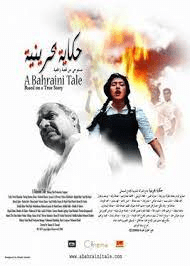
We watch a BBC document Remembering the Armenian massacres about two women – Lara Petrossians from BBC Persia and Rengin Arian – and learn about Armenian history through their families and the experiences of different Armenian populations around Turkey. The documentary also includes the Turkish perspective on events. 

What else do we learn from Youtube documentaries? We learn that:

  • The Armenian flag (adopted in 1990) has three colours (red, blue, orange) and has been interpreted in different ways. The red has been said to symbolise the Armenian Highlands, the Christian faith but also the struggle, survival, independence and freedom of the Armenian people. Blue symbolises the peaceful skies and orange stands for hard work.  
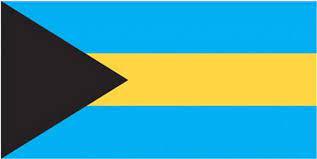
  • Mesrop Mastots invented the Armenian alphabet around the year 405. It has 38 different letters (31 consonants and 7 vowels). Armenian is an independent branch of the Indo-European language family but uses its own alphabet. Armenian is written horizontally from left to right 

We also learn that: 

  • There are around 16 main languages and dialects spoken in Armenia. (97% of the population speaks Armenian) 
  • The Armenian language has two main forms: Eastern and Western Armenian 
  • It is widely accepted that the Armenian language originates from the ancient Pahlavi language, whose alphabet was derived from Aramaic 
  • The Armenian diaspora is quite large – approximately 5-8 million people. 
  • Armenia is situated where the Arabian plate abuts against the Eurasian plate making Armenia earthquake prone. 
  • The 1988 Earthquake killed up to 50,000 people and injured 130,000
  • Armenia has 44 Grand Masters of Chess and is 6th on the International Chess Federation rankings
  • Relations between Armenia and Turkey have been strained for a long time. In January 2022, Armenia lifted its embargo on Turkey 
  • Armenia and its neighbour Azerbaijan are not on friendly terms. This is mostly due to the dispute over the region of Nagorno-Karabakh in the Azeri territory, but inhabited and governed mostly by ethnic Armenians. The First Nagorno-Karabah war (1988 – 1994) was followed by a recent 2020 Nagorno-Karabah conflict. The conflict has also strained Armenia’s relationship with Pakistan. 

Ethereal, mystical duduk and other sounds

Armenian music has a couple of its own genres that are quite interesting and have intriguing backstories.

photo Pinterest

The Duduk is an ancient Armenian woodwind instrument made of apricot wood, often played in pairs with one person playing the melody and the other a steady drone. The duduk was listed as UNESCO Intangible Heritage in 2008. The sound is quite deep, meditative, and melancholic. The instrument has a 3000 year history and was first mentioned in the ancient manuscripts in Urartu. You can log into several hours of duduk mediation music. The sound is almost unearthly, captivating and mystical. 

Rabiz is a quite different genre of Armenian music that combines Armenian folk with dance music (mainly synthesizers). It emerged in Yerevan in the 1980s as the music of Armenian immigrants from rural areas and cities such as Baku. It is an interesting genre that has clear Middle Eastern influences. There are a few playlists on Youtube and Spotify.

As for Armenian artists, Armenian-Syrian Lena Chamayan has a very clear soprano voice and her music is a fusion of Armenian, Arab and Western Music. She comes from a mixed cultural background and considers herself multicultural and multi-linguistic. 

Carahunge is a prehistoric archaeological site in Armenia but also the name of a beautiful song by the Carahunge band

Serj Tankian is a Lebanese-born Armenian-American heavy metal singer of the band System Of A Down. He is also a trained opera singer. Serj is another diaspora Armenian artist who is politically active and outspoken. He campaigned for US recognition of the Armenian genocide that was signed by President Biden in April 2021 (also recognised by 30 other countries). In 2015, he recorded a version of an old Armenian lullaby, Ari Im Sokhag, with Larisa Ryan. It’s melancholic and sorrowful. 

Another melancholic diaspora artist is Apo Sahagian. He has been credited with reviving old dialects and Armenian history. Even if I cannot understand the lyrics, some of the song are harrowfully beautiful.  My favourite is probably a song named:

Իմ Սիրելիս

Grandchildren and grandparents

Every ‘essential’ book of Armenian literature is about the genocide. The books are about generational trauma and how it endures to this day. They demonstrate the impact the genocide has had on the Armenian collective memory, the construction of identity, and the diaspora. 

There are quite a few books about grandchildren discovering the harrowing life stories of their grandparents. Titles in this genre include The Spice Box Letters by Eve Makis (2015), Family of Shadows by Garin K. Hovannisian (2010) and Black Dog of Faith by Peter Balakian (1997). Mostly these are from the Armenian diaspora in America but include some other countries. I decide to read My Grandmother – an Armenian-Turkish memoir. Written by Fethiye Cetin in 2012, Turkish lawyer and human rights activist, it is the story of her grandmother who grew up under a Turkish name. Her original name had been Armenian. It tells of how she (the grandmother) was taken from her Armenian mother during a death march. 

Roughly, half of the book is about Fethiye’s memories of her childhood and her grandparents. Around that time, she was still not aware of her grandmother’s past. Despite facing some terrible challenges (such as losing a parent), there is bliss and beauty in all of it. 

Half way through the book turns grim and becomes difficult to read. Fethiye’s grandmother is stolen from the hands of her mother, never to see her again. Fethiye slowly learns about the atrocities that took place during this time. She also starts to connect the dots from her childhood,  from Armenian songs to unnamed visitors. She then discovers members of her family in unexpected places and learns what happened to them. 

The hard part is, of course, that it is a true story. It is an impactful tale about Fethiye and her grandmother’s relationship, and Fethiye’s decision to tell the truth and bury her grandmother under her real name. It is also a story of connection, growth and healing. 

The Sandcastle Girls by Chris Bohjalian (2012) frequently appears on the list of ‘best’ Armenian books. It is available at the local library so I reserve it, but for some reason it never finds its way to me. A book lost somewhere. Therefore, I turn to Kindle again.

The author, Chris Bohjalian, is an Armenian-American whose grandparents were survivors of the genocide. The book has the same premise as many of the others – grandchildren discovering the secret past lives of their grandparents. 

It is very well written, engaging and captivating. It’s clear why Bohjalian is a bestselling author. What makes it different from Cetin’s book is that it’s fiction, whereas My Grandmother – an Armenian-Turkish memoir is a true story. 

The book moves between two different time zones – the grandparents meeting and falling in love in the midst of the genocide and the grandchild navigating the past and the present. It includes Armenian and Turkish families coming together through their children dating. It is captivating, well written and carries the narrative well. I found it perhaps slightly too long and far more interesting in the parts describing the past than the grandchild in the present. The stories enmesh in surprising ways that, in some cases, are almost too hard to believe. This is, of course, the richness and the limitation of fiction. 

Armenian movies

I’m surprised to discover there are quite a few Armenian movies available. Not so surprisingly, many of the movies are related to the genocide. 

I would like to watch the highly regarded Amerikatsi by Michael A. Goorjian but unfortunately it is not yet available for streaming. There is a nice interview with the director on Youtube however.

Instead, I watch a movie called The Last Inhabitant (2016) by Jivan Avetisyan, set in 1988 during the Armenian-Azerbaijani conflict. It’s the story of a man who stays behind in enemy lines after losing his home and is waiting to be reunited with his traumatised daughter. It is slow and dark, reflecting relationships between people and friendships that carry beyond enemy lines. It’s a story of loss and cruelty, sacrifice and conflict in which no one is a winner and everyone suffers. The ‘feel-good’ elements are few and far between, with profound sadness and loss dominating. It is harrowing, but also very real. 

Right before closing the entry for Armenia, I happen to meet an Armenian-Lebanese person at work who tells me that The Cut is a movie to watch. RT, my Armenian-Lebanese colleague (of very striking, distinctive beauty), tells me briefly about her visit to Armenia with her dad and the story of her family. She has a surname finishing with -ian, which is an indication of Armenian heritage. It feels like fate as I tell her that I have just finished an Armenian entry for Virtual Nomad. I would rather be educated by RT than the Kardashians, and it is fascinating. 

I decide to watch The Cut before Virtual Nomad moves to its next destination. It is, sadly, not available on any of the streaming channels that I have (and I now have quite a few) so I place it on my watchlist and will return when it is available. There is an extended trailer available on Youtube as well as an interview of the director, Fatih Akin (German director of Turkish parents) where he recognises the genocide also as “his”. I’ve seen several of his movies in the past so I hope The Cut will be accessible at some point. It is a movie about the genocide and a man’s quest to find his missing children. 

Growing numbers 

News tell us that the number of Russians citizens entering Armenia (many escaping from or protesting the war) has increased to more than 300,000 – over 10% of the population in the small country. This has put pressure on housing, increasing rents and feeding inflation. 

Next stop: Australia

proof read by JK