

Russia’s closest ally, Belarus, has no access to the sea. It is a landlocked nation and has Ukraine, Poland, Lithuania, Latvia and of course Russia, as its neighbours. The name Belarus is closely associated with the term Belaya Rus or White Russia, and the two countries are connected, having formed a Union State in 2000. The capital of Belarus is Minsk and while in theory Belarus is a republic, independent Belarus has had a single president, Dictator Alexandr Lukashenko, since 1994. Belarus has the dishonour of being ruled by Europe’s only dictator and lives under corrupt, authoritarian rule. Belarus has also backed Russia’s war in Ukraine. An estimated 100,000+ people have left Belarus in recent years.
Belarus is much more than Lukashenko and his buddies, making life difficult for ordinary Belarusians, and being supportive of a war most Belarusians do not approve of. There are incredible acts of bravery in standing up to the authoritarian regime, from the massive peaceful protests due to electoral fraud in 2020 to the artists in exile voicing their opposition to the war and the lack of civil and political rights. There is an active, brave generation of Belarusians standing up and not shutting up.


Photo ABC news
The Virtual Nomad stop in Belarus has, so far, been the most surprising. We knew so little of this country and have been amazed by its turbulent history. Around 25-35% of its population was lost in the Second World War, 70% of the Chernobyl radiation landed in Belarus and the country has lived under authoritarian rule for thirty years with severe human rights violations ‒ the clash culminating in the 2020 mass protests.
The humble intent of the Virtual Nomads is to dedicate this entry to those brave Belarusians and understand the Belarusian culture through the sacrifices, tragedies and incredible losses the people in Belarus have gone through.
Food: Yummy soup, disastrous pancakes
It is home cooking time again and our Belarus night grows into a Belarus festival with nearly 20 people preparing several different plates and enjoying time together. Belarusian music plays in the background with a mix of Eurovision-style music and folk music.


The main dish of the night is a Sorrel Soup – but as it is really hard to find sorrel, we replace it with spinach. JK is suspicious about the recipe not having enough flavour so he adds salt and the result is excellent. It takes some time to prepare and boil but in the end the sorrel-substitute-spinach soup is very good.
Next on the list is cottage cheese crumpets that look very yummy in the photo. The results are very different as the Virtual Nomads can attest. The failure of the cook (me with some assistance from JK) was to believe that the cottage cheese was solid enough for the pancakes and we could ditch the step of draining liquid through a cheesecloth (we did not have any cheesecloth). Bad mistake. The pan was also not the best for the occasion so the cottage cheese crumpets can be declared as a disaster with the exception of the gluten free option that turned out totally fine.


Fellow Virtual Nomad AK on her third Virtual Nomad night prepared a grated potato pie, a potato babka, that looks delicious and was well received. The Belarusian cuisine is very potato-rich, so potatoes are the main ingredients of the babka as well. Olgas flavour factory from where we got the recipe from says: Potato Babka is very popular in Belarus. It is made with grated raw potatoes. The potato batter is flavored with sautéed onions and salt pork or bacon. The batter is made similarly with potato pancakes, so the flavor is very similar but it is prepared by baking the potato mixture kind of like a casserole, instead of frying it into thin pancakes. The potato babka is crisp and golden on the outside and fluffy and tender on the inside.
AK also prepared a country salad that instead of potatoes, has beetroot. It has a fresh and rich taste, and is excellent for a summer gathering.


Virtual Nomad KD on her second Virtual Nomad night brings a Belarusian salmon salad that is multilayered and super tasty. It is her own recipe from a Belarusian friend so it will forever stay as a secret but the result is outstanding ‒ tasty and delicious and a great addition to the menu.
In addition, we have some dumplings and snacks, making the Belarusian night a great success! Yay, or Ypa, as they would say in Belarusian.
Living in the shadow of a long-lasting dictatorship


Belarus does not get a lot of attention from most of the rest of the world, and lives quietly in the shadow of the enduring dictatorship of Aleksadr Lukashenko.
The people of Belarus are descendants of the Slavic tribes that migrated to the area between the 6th and the 8th century. Prince Vseslav is a somewhat mythical figure in Belarusian history, rumoured to be a sorcerer and/or a werewolf, but who most certainly was a war general with an appetite for conquest and expansion. Over the centuries, Belarus has formed part of several countries and coalitions of countries including Lithuania (circa 1430), Polish-Lithuanian Commonwealth (1569), Poland (1700s) and the Russian Empire. The Russo-Polish War, also called the Deluge (1654-67), resulted in carnage and destruction for Belarus.
After the Russian Revolution, the Byelorussian Soviet Socialist Republic (SSR) became a founding member of the Soviet Union in 1922. This lasted until 1991 through the iron fist of Stalin, the devastation of the Second World War and the nuclear disaster of Chernobyl. The war was particularly harsh for Belarus – it lost between one quarter and one third of its population and its economy was devastated. Belarus became independent in 1991 during the aftermath of the dissolution of the Soviet Union and in 1994 its first President, Aleksandr Lukashenko, took power and has held it ever since. As with any authoritarian ruler, he is not friendly and loving to those who think that democracy should be restored, freedom of speech matters or human rights should be respected. Europeans do not like him either and several countries do not recognise him as the leader of the country.
In 2020, an independent uprising stood against the ugly face of the dictatorship that includes election fraud, suspension of freedom of the speech, lack of political freedom, deep-rooted repression, corruption, torture of political prisoners ‒ you name it. Russia came to help its buddy, resulting in masses of people going into exile and over 1800 people being imprisoned.
As for the language, the Belarusian, or Belarusan, language is a Slavic language with many words taken from Polish. While Belarusan is the mother tongue for more than half of the population, Belarusian contemporary politics have meant that Russian has been favoured as the official language and used by about 70% of the population. Both languages are official languages with Russian being favoured in public institutions.
Belarus scores highly on the “least welcoming countries list”, basically because it does not bother to provide any data on tourism or travel basically because no data is available.
Books from Belarus
More than a deserved Nobel


On 26 April 1986, Reactor Number 4 of the Chernobyl Power Plant exploded, causing the biggest nuclear disaster of our time. 70% of the radiation from Chernobyl fell on Belarus and affected millions of people. The impacts of the nuclear disaster in Belarus are still not well known. As a comparison, during the Second World War, Germany burned 628 villages in Belarus, together with their inhabitants. During the aftermath of Chernobyl, 485 villages were lost and radiation is the leading cause of the demographic decline.


Svetlana Alexievich, a Nobel-winning journalist (2015), now living in exile in Germany, spent three years collecting testimonies and interviewing people from scientists to firemen, villagers, people living in the exclusion zone ‒ everyday people whose lives were shattered. The result, Chernobyl Prayer: A Chronicle of the Future (also known as Voices of Chernobyl), is an astonishing, haunting, impactful book of testimonies and human stories. It is a collection of monologues by people affected by the Chernobyl disaster.
The opening pages of the book state:
“Belarus… to the outside world we remain terra incognita: an obscure and unchartered region. ‘White Russia’ is roughly how the name of our country translated into English. Everybody has heard of Chernobyl, but only in connection with Ukraine and Russia. Our story is still waiting to be told.” (Narodnaya Gazeta, 27 April 1996)

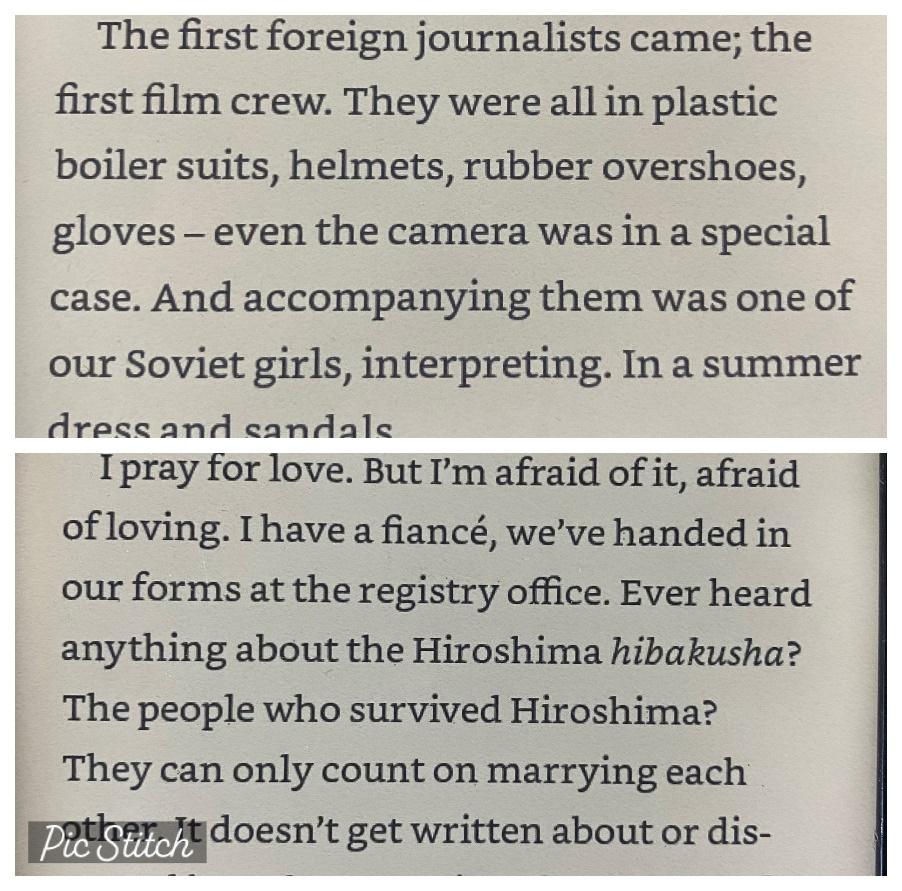
It is hard to describe the impact of this book.
“Daddy, I want to live, I’m only little,” says a six-year-old girl to her father after having black spots of radiation appear on her skin. A fireman’s wife describes the agonising death of her husband in fourteen days and the toll that she will carry for touching him before his death. A lonely old woman living in the exclusion zone tells how the rats ate through her blanket but her cat saved her. A neighbour was less lucky as the rats ate her. The cleaners and the firemen who sacrificed their lives to save the world. The hunters who, in their shorts, had to shoot dogs and cats left behind. The physical symptoms of the clean-up crew. The engineer who could not warn his wife because the phones were tapped. The unusual, pink raspberry glowing fire at the atomic plant that the ordinary people watched before being ordered to leave Pripyat. The kids who bicycled to see the fire in the reactor and no one told them to stay away. And yes, the little six-year-old girl died. Her name was Katya.


It is a grim read – radiation creeps in from between the lines as an invisible danger. The interviews in the book are an endless line of powerful, unsettling monologues, sometimes describing a dog-eat-dog world where there are no heroes. The party boss gets a truck to get his furniture out of the exclusion zone, while there are not enough vehicles to get the children out on time. The survivors of Chernobyl become people without a nation – outcasts, isolated and rejected. ‘Glowing’ death is everywhere and people who are in contact with their children, spouses, friends and family, get radiation sickness. There is the nuclear physicist working at the Institute of Atomic Energy who started calling everyone in Minsk. And then there is the negligence of the Soviet state; the lies, the cover-up, the propaganda.
All these stories hit hard – it is an intense, heartbreaking read. There are a few that stay with you and you have to take pauses to read it all, to take it in. Towards the very end, it is the voices of the children that probably hits the hardest. There are no words to describe what it feels like to read them. Chernobyl was not a war – it was something inexplicable that made puddles glow green and yellow.


Svetlana Alexievich gave all these people a voice. The Nobel judges got it right to give her the award, but an award feels small and insignificant. It is very powerful. This book should be mandatory reading. There is absolutely nothing like it and every story carries an incredible weight, inexplicable hollowness, grief and horror. After reading it, you just sit quietly for a very, very long time.
Women in arms


It is hard to follow the previous book so I have to take a pause before reading anything else, deciding which one to take next. I decide to read another book of my shero, Svetlana Alexievich. Another of her highly regarded books is War’s unwomanly face. This is not a book exclusively about Belarusians but a story of more than 200 women who became Soviet soldiers in the Second World War. The author spent four years collecting testimonies from all these women.
These are war stories. They are like the war stories men tell but with menstruation, shame and longstanding silence. Most of the stories come from women who chose to fight in the war, to defend the motherland. Life on the front was not easy but life after the war was not easy either. There were no medals but shame and silence. Some things are difficult to talk about, difficult to live through.
It is an impactful book and I am happy I have read it. The stories are not very different from each other, even if some of them are pure horror, such as the story of a young woman who had to kill her newborn baby to keep a group of partisans alive. Because I have read the Chernobyl Prayer, this book affects me less, which is not to say it is not a deep study, a collection of horrific experiences of women that practically were children at the time.
We went to die for life, without knowing what life was. We had only read about it in books. I liked movies about love…
Medical assistants in tank units died quickly. There was no room provided for us in a tank; you had to hang on to the armour plating, and the only thought was to avoid having your legs drawn into the caterpillar tread. And we had to watch for burning tanks… To jump down and run or crawl there… We were five girlfriends at the front: Liuba Yasinskaya, Shura Kiseleva, Tonya Bobkova, Zina Latysh, and me. The tank soldiers called us the Konakovo girls. And all the girls were killed…
Film : Moviemaking in the exile
The heavyweight movies of the Belarusian cinema are usually movies about war. All the ‘best of’ lists, ‘critics picks’ and movie platforms on Belarusian cinema count several war movies among the must-sees, especially one of the greatest anti-war films ever made, Come and See. We (JK and I) did watch it and I will get into that later, but first I want to touch on the current situation.
The difficult political situation in Belarus has had a devastating impact on the movie industry.
After the mass demonstrations in 2020 protesting the presidential election voting fraud, thousands of people had to leave the country in fear of state-sponsored violence and repression. Many artists had to leave due to censorship, persecution and lack of artistic freedom. In 2022, several independent Belarusian moviemakers living in exile founded the Belarusian Independent Film Academy The organisation “has been set up in response to a constant threat of persecution, imprisonment and torture against independent artists living in Belarus, who are forced to leave the country in order to work without state repression”. The collective says:
“The idea of creating an organization was born after the beginning of the war in Ukraine in 2022. More than 130 Belarusian filmmakers signed a collective statement on March 1 condemning Russia’s military aggression against Ukraine at that time.”
The six founding members of the Belarusian Independent Film Academy are producer Volia Chajkouskya, directors Aliaksei Paluyan, Darya Zhuk and Andrei Kutsila, film critic Irena Kaciałovič and festival programmer Igor Soukmanov. I wanted to check the movie productions some of them have been involved in:
Aliaksei Paluyan has directed a short story ‘Country of Women’ available on Youtube, which is moments and memories in the life of a Belarusian grandmother, Ludmila.


Aliaksei’s other documentary film, Courage (2021), was nominated for several awards and was the winner of the Political Documentary award in the Cinema for Peace Awards. The documentary is about the Belarus Free Theatre – an underground theatre group founded by human rights activists Natalia Koliada and Nikolai Khalezin, a playwright and theatre producer. The group is vocal in its criticism of Lukashenka and uses theatre as a voice to address the repression and human rights violations of the regime. It is an impressive political theatre and if you can, look them up and see what they do.
The documentary follows three members of the theatre group in the summer of 2020, amidst the mass protests and brutal reprisal from the regime, and how the authoritarian regime crushed peaceful resistance. It is an intimate portrait of young people in a world of no options and political repression. What the documentary does best is to portray the tension in the air, the unpredictability of the police force and the haunting feeling that something will go wrong.
As for the Belarus Free Theatre, in 2013 it was named by the New York Times as “one of the most powerful underground companies on the planet”. The underground group has existed since 2005 with the mission of defending artistic expression and free speech. Highly critical of the regime, the performances are/were mostly organised in private locations that would always change for security reasons. The founders, Nikolai Khalezin and Natalia Koliada, are currently living abroad. The group has won several awards including the European Theatre Award and enjoys broad international support.


Darya Zhuk is a Harvard and Colombia-educated young director who is living in the USA. Her first feature film, Crystal Swan, is not easily accessible so unfortunately I could not watch it but I watched her interesting interview on Youtube (2020, just before the fraudulent presidential elections and mass protests) with her talking about her film, the historical and political backdrop, the layers of censorship she needed to navigate in order to make the film and some of the cultural aspects that she feels are still rampant in Belarusian culture. For example, of gender relations she says: “Of course I have something to say about the gender relations there, how aggressive they are and how hard they think that the idea of consent is not something that exists.”
The movie itself, as the director describes it, takes place in the 1990s but it is relevant for today’s generation of young people in Belarus, but also in Ukraine, Russia and Georgia when they make the decision of where to build their life. The director talks about the masses of young people leaving the countries in search of opportunities, but also to escape repression. Based on the interview with the director, it sounds like an amazing movie.


The description of the movie states: As a symbol, the title alone tells us everything we need to know about post-independence Belarus: crystalline figurines may be found in homes across Belarus, and although they look beautiful, they are in fact cheap and mass-produced. Set in the 90s, the film follows workers in a glass factory who are paid for their labour in crystal products rather than cash — a consequence of the catastrophic economic crash that followed the fall of the Soviet Union. Behind tightly closed doors, we see the everyday violence committed by seemingly “good families”. Away from the assembly line, our characters are trapped in their own vicious cycles, best encapsulated in the quote: “our grandfathers lived this way, we live this way, and our children and grandchildren will live this way”. The film’s protagonist, Vel, stands for the everyday citizens of Belarus, and wants to break free and start a new life for herself in the United States — but many different obstacles already stand in her path.
The documentary When Flowers are Not Silent (2021) by Andrei Kutsila deals again with the events of 2020, this time from the perspective of several women. It is non-judgemental, the atmosphere is quite still and this adds to its power.
Then it is time for the war movies, or the war movie.
“Come and See” is the greatest anti-war film ever made. It’s a true masterpiece. Everyone should see it at least once in order to comprehend what war is, and does.” (critic)

Come and See (1985), whose name comes from the bible (the sixth chapter of the Book of Revelations) is directed by E Klimov, who himself survived the siege of Stalingrad as a child. The movie has been hailed as one of the best movies ever made and, for some, the very best war movie. It’s on several ‘the greatest films of all time’ lists, but comes with a warning that it conveys the genuine and deeply unsettling horror of war. I buckle my seat belt, put my helmet on and brace myself for what is coming because from what I have understood, none of this movie will be feel-good. Luckily JK watches this too but the kiddos are not invited as this is not for them.
It is different to what JK and I expected. It is an outstanding film. It’s harrowing, horrific and terrible in what it describes. It is true to the horrors of war and the cruelty of mankind. There are no jump scares and little by way of blood and explicit depictions of violence – just a very real feeling of almost being inside of the war.
There is an excellent article by Maximilian Turp-Balazs (of Emerging Europe) about this movie that is worth a read. It manages to express all the feelings I had in me after watching this movie, and could not express.
It is a powerful, slow, anti-war film that apparently inspired Steven Spielberg’s Saving Private Ryan and the recent Oscar-winner, All Quiet on the Western Front. It is also about the forgotten faces of the Second World War – the Eastern Front. While the Western Front and the unfathomable suffering and cruelty of the Holocaust have been well documented, the struggle and destruction of the Eastern Front has not. It bears repeating that one in every three or four people died in Belarus during the war and in total 27 million civilians lost their lives the Soviet Union, with the most affected being Belarus, Ukraine and Russia itself. But this movie is more than the Eastern Front. It is about what is rotten, damaged, and derailed in the human soul.
The Art of Resistance


Photo New East Digital Archive
Daria Semchuk is a young Belarusian artist who uses the artistic name of Cemra, meaning ‘darkness’ in her native Belarusian. In her work she reflects on Belarusian cultural heritage that has been forgotten and neglected under the current regime. She uses traditional symbols and artifacts, such as embroidered tapestries, in an effort to keep cultural handicrafts alive. The work depicted in the photo above refers to the loss of the cultural heritage, and was produced after she found a national costume in the trash.


Yana Chernova is a visual artist studying in Moscow. Her work Belarusian Venus is a homage to the brave women (and men) that took to the streets in the mass protests of 2020. The women tried to protect the men who were more likely to be detained and tortured. The women handed out flowers as peaceful gestures but many then were also detained and beaten. The objective of the artist was to use “the provocative image as a symbol of modern Belarus” – the bruised woman embraces the outline of Belarus.
Multi-talented artist and human rights activist Ales Pushkin, who was imprisoned by the regime in 2021 and received a five year sentence, died in prison in July 2023.


Photo Euroradio
Next stop: Belgium
proofread by JK